|
|
|
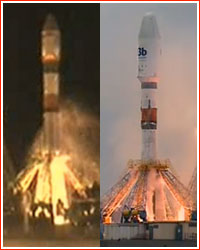
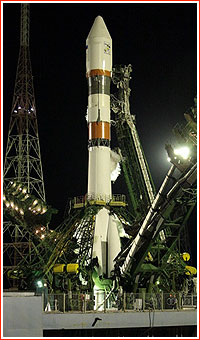
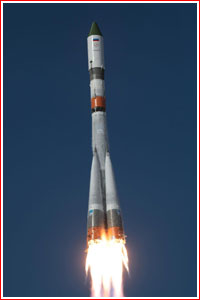
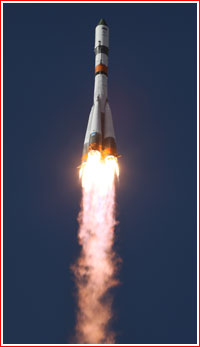
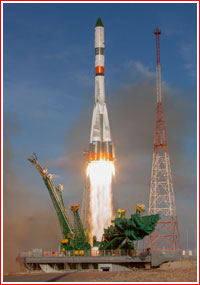
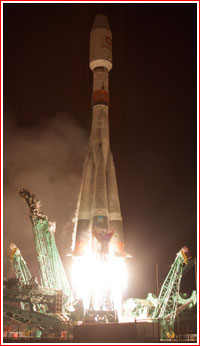
The Soyuz-2 rocket series With the disintegration of the USSR in 1991, developers of the Soyuz rocket, along with the rest of the nation's space industry, wanted to consolidate its subcontractor network inside the Russian Federation. To accomplish the goal, TsSKB Progress in the city of Samara, developed a new version of its workhorse Soyuz launcher, under research and development plan dubbed Rus. In addition to a fully domestic production, the project envisioned a number of technical improvements to the rocket which became known as Soyuz-2. The future three-stage, 313-ton base vehicle could be used in combination with Ikar and Fregat upper stages.
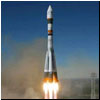
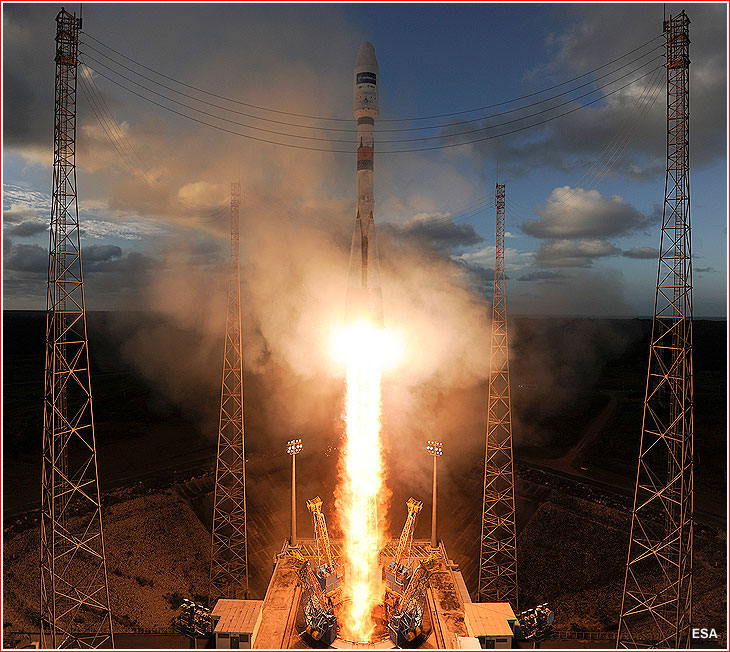
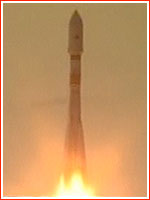
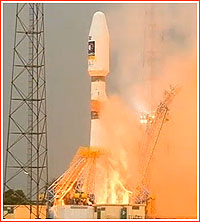
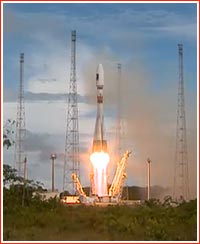
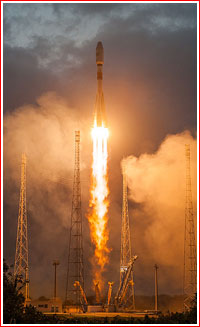
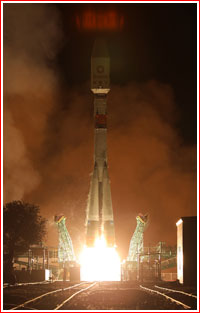
A Soyuz-ST (Soyuz-2) rocket lifts off from Kourou on April 3, 2014, with Sentinel-1A satellite. Credit: ESA The Soyuz-2 rocket at a glance:
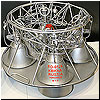
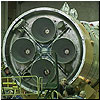
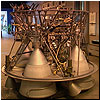
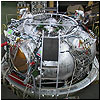
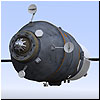
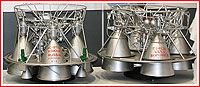
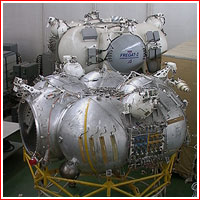
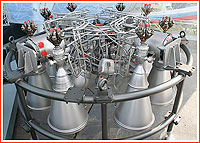
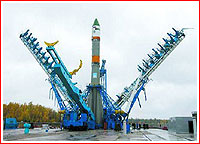
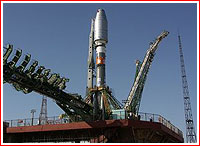
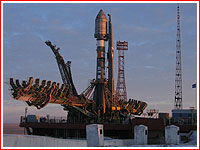
According to the original plan, the Soyuz-2 (military designation - 14A14, industrial designation - 131KS), also known as Soyuz-2K and Soyuz-M) would sport a brand-new RD-0124 (14D23) closed-cycle engine on its third stage and all-digital flight control system with terminal guidance system. The first and second stage would be equipped with 14D21 and 14D22 engines with improved injection system. All the upgrades combined would increase the payload of the vehicle by 1,200 kilogram in comparison with the base launcher. Prospective payloads If launched from Baikonur, the Soyuz-2 would be capable of delivering 8,500 kilograms into the low-Earth orbit and 2,350 kilograms toward the Moon. The Soyuz-2 could also fly from slightly upgraded launch pad in Plesetsk and from newly developed launch complex in Kourou, French Guiana. Launches from French Guiana could deliver as much as 9,000-9,200 kilograms to the low orbit. The Soyuz-2 could be employed to launch a variety of traditional payloads of the Soyuz family, including reconnaissance satellites. Before the rocket could be "man-rated," it was considered as a carrier of the enlarged version of the Progress M1 cargo ships equipped with the assembly and protective block SZB (11S517A2), with a total mass of 8,350 kilograms and a maximum diameter of 3,000 millimeters. Soyuz-2 could also launch prospective modules for the Russian segment of the International Space Station, ISS, with a total mass of 8,100 kilograms, a maximum diameter of 3,700 millimeters and a length of 14,100 millimeters. Soyuz-2 development To enable launches of the Soyuz-2 rocket toward the ISS, plans were made to upgrade processing facilities at Site 2 in Baikonur by the year 2000. However, collapsing funding of the Russian space industry during 1999 and 2000 forced Russian space officials to freeze plans for launching Soyuz-2 from Baikonur, as well as the development of its space station payloads. (164) Financial problems of the industry also pushed the rest of the Rus program nearly a decade behind schedule, forcing developers to introduce upgrades in several phases. Since the development of the new RD-0124 engine was the most expensive and time-consuming part of the upgrade, it was deferred to a later time. At the time of the first Soyuz-2-1a launch in November 2004, Russian space officials said that the next upgrade -- the Soyuz-2-1b launch vehicle with the RD-0124 engine -- could fly in 2006. Soyuz-2-1a The initial version of the upgraded vehicle, known as Soyuz-2-1a, featured a four-meter payload fairing. It was capable of carrying 300 kilograms more payload thanks to the replacement of an old analog flight control system with a digital computer and the use of a more flexible launch trajectory. In 2012, KBKhA design bureau promised to develop the 11D55 steering engine specifically for the Soyuz-2-1a rocket. New flight control system The work on the digital flight control system for the Soyuz-2 rocket started at NPO Avtomatika of Yekaterinburg as early as 1993. The system included three independent processing units and two gyroscopes, which drastically improved the reliability of the flight control system. In 2006, Lef Belskiy, Deputy Director of NPO Avtomatika for rocket and space systems told ITAR-TASS news agency that the work on the flight control system for the Soyuz-2 became a lifesaver for his organization. At the time, 400 employees of NPO Avtomatika have been involved in this development. Modest federal funding for the project started coming during 1994-1995 and the money flow increased substantially at the beginning of the following decade. Soyuz-2-1b status On January 4, 2005, Arianespace announced that the Soyuz-2-1b vehicle with the new RD-0124 engine would fly its first test mission from Site 31 at Baikonur, launching a 630-kilogram Corot astronomy satellite in a 850-kilometer polar orbit. In January 2006, the launch was expected in September 2006, given successful tests of the RD-0124 engine then planned for March and April 2006. The first test firing did take place on April 5, 2006, at the IS-102 facility of NIIKhimMash center in Sergiev Posad. Another test took place on October 20, 2006, at 17:20 Moscow Time. According to the deputy head of Roskosmos Viktor Ramishevskiy, quoted by RIA Novosti, it was the final test firing of the RD-0124 engine, thus clearing the way for the first launch of the Soyuz-2-1b rocket, then scheduled for December 21, 2006. In 2012, KBKhA design bureau promised to develop the 14D23 steering engine specifically for the Soyuz-2-1b rocket. The version of the Soyuz-2 vehicle known as Soyuz ST was adapted to fly from its launch complex at the European launch site in French Guiana. It featured a number of upgrades, including additional avionics supplied by European contractors. On June 22, 2006, French company Alcatel Alenia Space announced that it would provide subsystems for the complete safeguard chain of Soyuz-Fregat rockets to be launched from the Guiana Space Center in Kourou.The contract included the development and manufacturing of the BCA ("Boîtier de Commutation et d'Alimentation", the switching & power feeder unit), as well as electronic ground equipment for tests and the reception of the safeguard subsystem onboard Soyuz-2 rockets. In case of a botched launch, the BCA will ensure the emergency engine shutdown, leaving the vehicle on a ballistic trajectory. According to postings on the Novosti Kosmonavtiki forum, receivers on all stages were upgraded for S-band functionality. Four boosters of the first stage were upgraded with an additional system designed to breach their sealed compartments in order to prevent floating of the stages, after their splashdown in the Atlantic. It would achieved by a pyrotechnical device opening a pneumatic valve on the fuel tank. The oxidizer tank would be unsealed in any case, by opening a nozzle used to break the booster during the separation from the core stage. The second and third stage required no upgrades, since it was proven that they would loose integrity as they hit the ocean surface. To certify the rocket for operation in the tropical climate of French Guiana, developers evaluated all unsealed interior volumes onboard the vehicle and certified that all holes and cavities in its structure were adequately protected from insects and small rodents. The rocket's ability to withstand dust and humidity was also reconfirmed. Some upgrades included a special covering on the core stage and booster stages to reduce icing, as well as modified systems, which enabled the integration of the third stage and its payload module in vertical position. Unlike the standard Soyuz-2 rocket, chemical ignition was not expected to be used onboard Soyuz-ST, until the accumulation of reliable statistics on its performance with the "Russian" version of the rocket. On February 14, 2006, Jean-Yves Le Gall, Chief Executive Officer of Arianespace, and Anatoly Perminov, Director General of Roskosmos, signed the supply contract for the first four Soyuz launch vehicles to be launched from Kourou. A signing ceremony in Moscow was attended by the French and Russian prime ministers. At the time the first launch of the Soyuz from Kourou was expected in November 2008. On Sept. 20, 2008, in Sochi, Russia, Roskosmos and Arianespace signed another agreement for the supply of additional 10 Soyuz-ST launch vehicles with the reported price tag of between $300-400 million. The Soyuz-ST vehicles ordered within first two contracts would be based on both Soyuz-2-1a and 2.1b versions, and they were unofficially designated as Soyuz-STA and Soyuz-STB respectively. At the time of the second contract, the first launch from Kourou was promised in September 2009. In 2010, a total of 24 Soyuz-ST missions from Kourou were reported as ordered and in 2012, the head of Roskosmos said that 23 such launches had been planned until 2019. The shipment of two additional Soyuz-ST rockets to Kourou was scheduled during the summer of 2012. On Sept. 9, 2013, Arianespace announced that 11 Soyuz rockets had been under contract for near-term missions and the company was "in contact" with its Russian partners for (production) of between 7 and 10 additional launchers to be used from 2016. Probably hinting at some potential production conflict with Russia's internal needs, Arianespace said that it has been still enough time "to work out details in the production flow for Arianespace’s own requirements." Following a series of negotiations from February 20 and 24, 2014, Roskosmos secured a $400-million order from Arianespace for seven Soyuz-ST rockets. Specifically for its use in Vostochny, the Soyuz-2 family was expected to get modest internal updates to enable the fueled rocket to remain on the launch pad for up to 100 hours and withstand the rigors of transportation up to 10,000 kilometers from its manufacturing plant in Samara to the Russian Far East. Soyuz rockets built for launches from Vostochny would also be equipped with special valves to drain excess propellant outside of the Mobile Service Tower, MBO, to prevent dangerous concentration of oxygen vapors in its interior.
Key contractors in the Soyuz-2 project:
Commercial prices for the Soyuz-2 rocket as of October 2018:
Soyuz-2 payload capabilities (in kilograms):
A complete list of Soyuz-2 missions*:
|
|

|