|

Searching for details: The author of this page will appreciate comments, corrections and imagery related to the subject. Please contact Anatoly Zak. |
 |
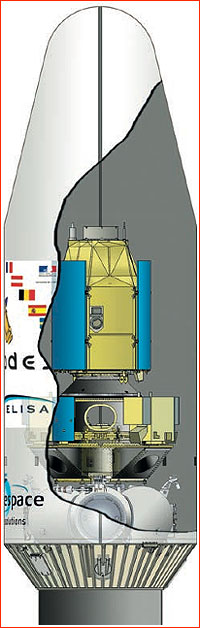
A payload section during the second Soyuz rocket mission launch from Kourou in December 2011. Credit: Arianespace
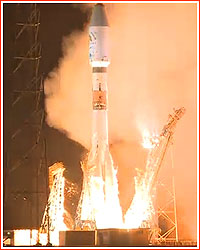
A second Soyuz to fly from Kourou lifts off on Dec. 17, 2011. Credit: Arianespace
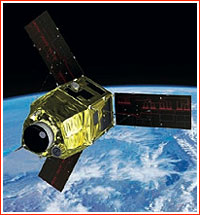
An artist rendering of the Pléiades 1 satellite, which promised to provide images of the Earth surface with a resolution of 70 centimeters. Credit: Arianespace
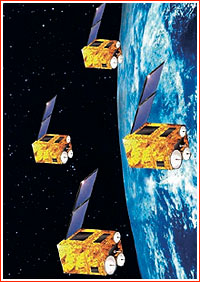
An artist rendering of a quartet of ELISA satellites designed for electronic intelligence. Credit: Arianespace
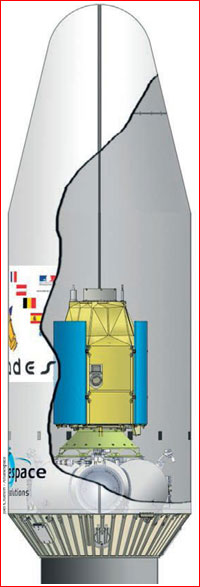
A payload configuration for the second Pléiades mission in November 2012. Credit: Arianespace
|
||||||||||||||||||||||||||||||||||||||||||||||||
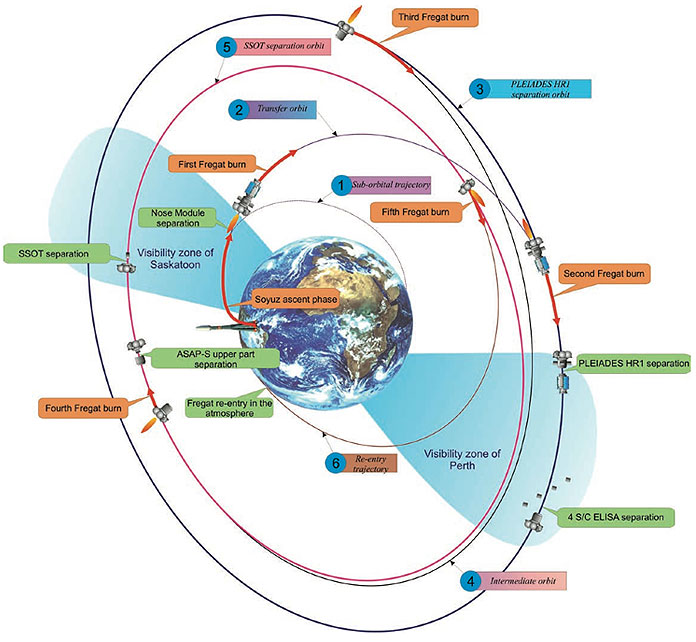
Above: A mission scenario of the second Soyuz rocket launch from Kourou on Dec. 16, 2011. |
||||||||||||||||||||||||||||||||||||||||||||||||||
The so-called dual-purpose Pléiades satellites were designed to provide military and civilian users with very high resolution optical imagery of the earth's surface from a 700-kilometer orbit. Covering swath width of 20 kilometers, Pléiades' photos could reveal details as small as 0.5 meters. Built by prime contractor Astrium for the French space agency, CNES, Pléiades were compact, hexagonal-shaped spacecraft with a mass of only 970 kilograms, optimized for operational agility and image location accuracy.
Previous chapter: Soyuz in Kourou Preparations for the first mission On Jan. 4, 2005, Arianespace announced that the first Pléiades launch was targeted for 2008 with the second mission coming in 2010. On Sept. 11, 2007, Arianespace also announced the agreement with Astrium for the launch of four ELISA satellites as secondary payloads on the same mission. By that time, the launch was expected to take place at the end of 2009 and, later slipped to April 2010. At the time, it was also expected to be the first launch of the Soyuz rocket from Kourou. During 2010, the delays in the construction of the Soyuz launch pad in Kourou delayed the mission from October of that year. The mission was finally reached the launch pad by the end of 2011 as the second Soyuz launch from Kourou. As of October 13, 2011, the delivery of the Block I upper stage for the mission was scheduled for December 6. The stage was recalled for additional checks in the wake of the Progress M-12M launch failure previous August. Secondary payloads: SSOT and ELISA First launch
As of Jan. 4, 2005, the second launch of Pléiades satellite, designated Pléiades-1B, was expected in 2010, however by that year it slipped to mid-2011. By the end of 2011, the mission was expected at the end of 2012. On October 25, Arianespace announced that the spacecraft for the mission, designated VS04, was delivered to Cayenne, French Guiana, onboard a Boeing-747 cargo aircraft. At the time, the launch was planned for November 30. According to Arianespace, Pléiades-1B was designed to provide optical observation coverage with 50-centimeter resolution for the French and Spanish defense ministries, civil institutions, and private users. It was to be inserted into a 695-kilometer quasi-polar heliosynchronous orbit. In preparation for the mission, the Soyuz-ST-A/Fregat launch vehicle was rolled out to the launch pad on November 26, 2012. The mission – designated VS04 in the Arianespace’s launcher family numbering system – was set for liftoff at exactly 11:02:50 p.m. local time in French Guiana. However around 30 minutes before liftoff, the launch was postponed by at least 24 hours due to problems with the launch vehicle's flight control system. Specialists had to replace coordinating and commutation device, known as SKU, where one of three operational channels apparently failed. On Dec. 1, 2012, the launch took place as scheduled and the payload section reached orbit flawlessly. Flight program Following liftoff from the Guiana Space Center, the powered phase of the lower three Soyuz stages was to last about nine minutes. The third stage of the launcher will then be separated from the upper composite, comprising the Fregat upper stage and the Pléiades 1B satellite. The three lower stages will fall back into the sea. The Fregat upper stage will ignite its engine a first time, operating for about four minutes, followed by a ballistic phase lasting about 27 minutes. It will then restart its engine, for another four-minute burn. The Pléiades-1B satellite was to be released 55 minutes after liftoff into a 695-kilometer circular orbit with an inclination 98.2 degrees toward the Equator. The Fregat stage was then to fire its engine a third time to deorbit and fall back into the sea, Arianespace said According to Arianespace, during this flight, the Soyuz was carrying an estimated 1,070 kilograms of cargo, which included the 970-kilogram Pléiades-1B satellite.
APPENDIX A complete list of launches in the Pléiades project:
Pléiades satellite specifications:
Page author: Anatoly Zak; Last update: December 1, 2012 All rights reserved |

|