Site news

Site map

Testimonials

About this site

About the author

Mailbox


ADVERTISE


SPONSOR


GLONASS-M

While Global Position System, GPS, has been one of the most recognizable symbols of space applications around the world, much less known was the fact that Russia also attempted to build a parallel network of satellites designed to provide accurate navigation. As its American counterpart, the Russian satellite navigation system, known as GLONASS, was born at the height of the Cold War for primarily military purposes. The GLONASS network could be used to determine coordinates and the speed of an aircraft, a vessel or any other vehicle across the globe.


Bookmark and Share

GLONASS network

A fully completed GLONASS system was expected to include 21 active and three spare satellites spread over three orbital planes at the altitude of 19,100 kilometers and inclination 64.8 degrees toward the Equator. The Proton rocket equipped with Block D or Breeze M upper stage is capable of delivering a trio of satellites into orbit, from which two satellites later maneuver themselves into final orbits.

When completed, the GLONASS constellation was designed to provide 100 meters accuracy with its "standard precision" C/A signals, which are deliberately degraded, and 10-20 meter accuracy with its P "high-precision" signals, originally available exclusively to the military. At the end of 2004, the head of the Federal Space Agency, FKA, called the separation between military and civilian frequencies in the GLONASS system, "awkward" and promised to provide the access to the high-precision navigation data to all users.

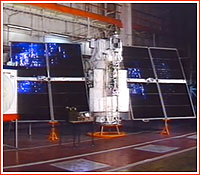
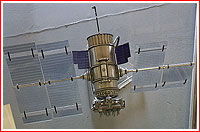
GLONASS spacecraft (11F654)

The Uragan spacecraft for the GLONASS network was developed by NPO PM in Zheleznogorsk and, until the beginning of the 1990s, the satellites were mass produced by PO Polyot in Omsk under supervision of NPO PM. However NPO PM later returned to the full development and manufacturing of the Uragan-M spacecraft "on site." The last Uragan spacecraft built by PO Polyot was launched in December 2005.

The Uragan satellite features a three-axis stabilization system, which points it in nadir during the operational flight. Two solar arrays provide power supply.

The spacecraft carrier transmitters send L-Band navigation signals in 25 channels separated by 0.5625 MHz intervals in two frequency bands: 1602.5625 - 1615.5 MHz and 1240 - 1260 MHz. EIRP 25 to 27 dBW. Right hand circular polarized. Onboard cesium clocks provide time accuracy to 1,000 nanoseconds.

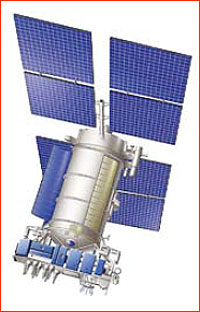
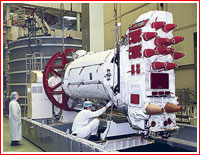
GLONASS-M (14F113)

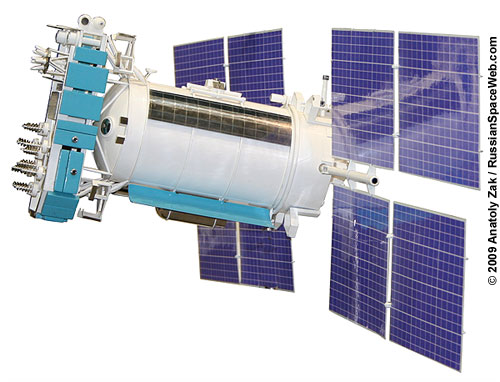
The GLONASS-M version of the satellite featured improved antennas, extended lifetime and the introduction of a separate transmission frequency dedicated to civilian users, known as L2. The satellite also sported an increased clock stability, more accurate solar array orientation and better maneuverability.

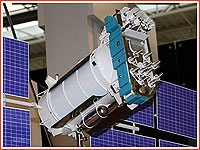
GLONASS-K

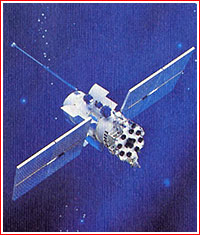
The GLONASS-K version was based on a brand-new Ekspress-1000 platform developed by NPO PM, which featured lighter, standardized unpressurized bus. The version also featured a third L-band transmitter for civilian users. Thanks to its extended service life, the satellite promised to cut its cost in half. The satellite's payload would also deliver more precise navigation than its predecessors and provide search and rescue functions. In December 2006, the head of NPO PM Nikolai Tostoedov promised the first launch of the GLONASS-K spacecraft in 2009, a year later than the launch date projected in 2005. At the time, GLONASS-K were expected to be launched by the Soyuz rocket, instead of Proton. However in 2009, official Russian documents said that the production of GLONASS-K satellites had only started that year. (367) The first launbch was then expected in 2010.

Summary of various Uragan modifications:

  Uragan (11F654) Uragan-M (11F113) Uragan-K
Mass
1,415 kilograms
1,570 kg (1,415-1,450 kg)*
745 kg
Payload mass
180 kilograms
250 kilograms
260 kilograms
Onboard power supply
1,000 Watts
1,450 Watts
1,270 Watts
Payload power consumption
600 Watts
580 Watts
750 Watts
Attitude control accuracy
0.5 degrees
0.5 degrees
0.5 degrees
Solar panel orientation accuracy
5 degrees
2 degrees
1 degree
Operational life span
4 years
7 years
10 years**
First launch
1982 Oct. 12
2003 Dec
2007 (originally); 2009 (as of end of 2006)

*according to Roskosmos; **As of 2009. Previously, Uragan-K's design life was quoted as 12-15 years


Deployment

It took more than a decade after the launch of the first Uragan satellite in 1982 to declare the GLONASS network in limited operation in 1993. According to official information, the network reached a full deployment in 1995 with 24 satellites in three different orbital planes. However, giving the economic conditions in the country, the network was allowed to degrade during the 1990s, as operational satellites were failing in orbit and new ones could not be launched. In 1996, in the first attempt to revive the system outside its primarily military use, Russia formally offered the GLONASS system to the world community. On Feb. 18, 1999, a presidential decree No. 38-rl ordered the Russian government to sustain and further develop the GLONASS network. The document also declared the Russian space agency to be a second (civilian) customer of the system, along with the Ministry of Defense. (367) Still, by 2001, the number of operational GLONASS satellites in orbit fell to seven.

In 2004, Russian officials promised to have 18 operational spacecraft within the GLONASS network by 2007, which would be the minimum needed for the practical use of the system. The constellation was expected to be completed with 24 spacecraft by 2010.

By the end of 2005, Russian official sources said 14 satellites were active in orbit, not counting three, that were launched on Dec. 25, 2005.

On August 30, 2006, RIA Novosti news agency quoted Minister of Defense Sergei Ivanov promising a full deployment of a 24-satellite GLONASS constellation by 2010. Ivanov's statement preceded a meeting of the military commission on the matter, presided over by a Deputy Prime Minister. Ivanov characterized the network as a vital element of the nation's infrastructure. The meeting also considered mass production of hardware for the end users of the system and related legal issues.

In 2007, the Russian federal budget expected to allocate 11,799.5 million rubles for the GLONASS system. It would be a two-fold increase comparing to the funding in 2006, Russian media said. During 2006, Russian officials said that in the following years, the launch rate of the satellites for the GLONASS network would increase from one to two per year, delivering six new satellites instead of three annually. Two launches, scheduled for 2007 promised to increase the number of operational satellites in the GLONASS constellation from 12 to 18, which could finally enable practical use of the system for navigation sometimes in 2008. However in reality, after the December 2007 launch, the status of the satellites within the GLONASS constellation had been as following:

  • Operational satellites: 13
  • Under servicing: 3
  • In-orbit waiting to join the network: 3
  • In-orbit waiting the withdrawal from the network: 2

Only if minimum two satellites designated "under servicing" would return to full operation in 2008 and newly launched satellites successfully join the network, the GLONASS network would reach 18 satellites.

On December 15, 2009, during his meeting with Prime-Minister Vladimir Putin, the head of the Russian space agency Anatoly Permnov promised to complete a GLONASS constellation with 24 operational satellites during 2010, with three launches of nine satellites in February, August and November, the official Russian media reported. Apparently counting a trio of satellites launched the day before, Perminov said that by the end of 2009, the network would include 19 operational satellites. A promotional video produced by Roskosmos for the MAKS-2009 air and space show promised 30 operational GLONASS satellites in 2011.

Interaction with American GPS

Russia discussed various issues related to the development and use of GLONASS in parallel with American GPS and European Galileo systems. According to the head of Federal Space Agency, Anatoly Perminov, in December 2004 Russia and the US discussed the ways of preventing the use of satellite navigation systems by terrorists.

Participation in Europe's Galileo network

Russia also was in talks with the European Space Agency on the possible cooperation on the Galileo navigation network. Details beyond the possibility of launching Galileo satellites onboard the Soyuz rockets were not specified.

Cooperation with India

During 2004, Russia discussed the possibility of launching Uragan satellites onboard Indian rockets, in exchange for this country's access to navigation data from GLONASS.

Cooperation with China

Number of contacts between Russian and Chinese space officials included discussions of the GLONASS network. On May 24, 2006, Chief of Staff of the Chinese Liberation Army Lyan Guanle visited ground control center of the GLONASS system, according to RIA Novosti. According to the Russian media, China considered the development of its own satellite navigation system, which could involve purchases of the Russian technology.


Recent missions

2004 Dec. 26: Russia sent up a trio of satellites to upgrade nation's global positioning system. A Proton-K rocket with a Block DM (11S861) upper stage, carrying two Uragan and a follow-on Uragan-M satellites blasted off from Baikonur Cosmodrome at 16:54 Moscow Time. The launch had previously been scheduled for Dec. 25, 2004.

2005 Dec. 25: The Proton-K rocket with Block DM upper stage blasted off from Site 81 in Baikonur Cosmodrome on Dec. 25, 2005 at 08:07 Moscow Time, carrying a trio of spacecraft for Russia's global positioning system, GLONASS. The payload included a regular Uragan spacecraft and a pair of upgraded Uragan-M satellites. The launch brought the number of active Uragan satellites to 17, while a fully functional GLONASS network was designed to have 24 spacecraft. However two Uragan-M spacecraft from the latest mission did not enter operational service until August 2006. At the time, there were 15 satellites actively functioning in orbit. During September 2006, three out of eight satellites within the 3rd plane were temporarily deactivated, apparently in anticipation of the launch of three new satellites in December 2006 and required re-arrangement of the constellation. (As many as five satellites were apparently affected during 2006).

2006 Dec. 25: The Proton-K rocket with Block DM-2 upper stage blasted off from Baikonur Cosmodrome on Dec. 25, 2006, at 23:18 Moscow Time, carrying a trio of spacecraft for Russia's global positioning system, GLONASS. According to the official ITAR-TASS news agency, the spacecraft successfully reached orbit at 02:50 Moscow Time on December 26, 2006. Satellites were still expected to use their own propulsion systems to reach final operational orbits.

2007 Oct. 26: Less than two months after its failure, the Proton rocket returned to flight, successfully delivering a trio of satellites for the Russian global navigation system, GLONASS. The Proton-K rocket equipped with Block DM upper stage and carrying three Uragan-M (GLONASS-M No. 18, 19, 20) satellites lifted off from Pad 24 at Site 81 in Baikonur Cosmodrome on Oct. 26, 2007, at 11:35:24 Moscow Time. According to a representative of the Russian space agency, Roskosmos, the upper stage successfully delivered all three spacecraft to its nominal orbit with the altitude 19,100 kilometers above the Earth surface and the inclination 64.8 degrees toward the Equator. At 15:07 Moscow Time, satellites successfully separated from the Block DM upper stage. Ground control then conducted two communication sessions with the spacecraft at 15:15 and 15:40 Moscow Time. According to a statement of the satellite manufacturer, NPO PM, on March 27, 2007, this mission was expected in September 2007.

2007 Dec. 25: Russia launched a second trio of navigation satellites aimed to complete the national global positioning system. A Proton M rocket with Block DM-2 upper stage lifted off from Baikonur Cosmodrome on Dec. 25, 2007, at 22:32 Moscow Decree Time. It carried three Uragan-M satellites for Russia's GLONASS navigation network. The mission was designed to deliver satellites into a circular orbit with the altitude 19,137 kilometers above the Earth surface and the inclination 64.8 degrees toward the Equator. According to a press-release of the Khrunichev enterprise, the developer of the Proton rocket, issued shortly after the liftoff, the launch went nominally. The satellites were expected to separate from the upper stage on December 26, 2007 at 02:24 Moscow Time.

2008 Sept. 25: Russia launched trio of navigation satellites for the nation's GLONASS global positioning system. The Proton-M rocket with the Block DM upper stage lifted off from Baikonur Cosmodrome on Sept. 25, 2008 at 12:49 Moscow Time. It carried three Uragan-M (GLONASS-M) satellites, which were successfully delivered into the planned orbit at 16:20 Moscow Time, a representative of the Russian space forces said. The mission was previosuly expected in July 2008.

2008 Dec. 25: Russia launched a second mission of 2008 to complete the national global navigation system. The Proton-M rocket with Block DM upper stage lifted off from Baikonur Cosmodrome on Dec. 25, 2008, at 13:43 Moscow Time. Block DM and a trio of GLONASS-M satellites separated from the booster stage at 13:53 Moscow Time, reaching the initial parking orbit. Two firings of the Block DM upper stage inserted the satellites into a 170 by 19,000-kilometer orbit and then to a circular 19,100-kilometer orbit. The mission was previously scheduled for October and November 2008.

2009 Dec. 14: Continuing a tradition of several previous years, Russia launched an end-of-the-year mission to replenish its navigation constellation. The Proton-M rocket equipped with Block DM-3 upper stage lifted off on Dec. 14, 2009, at 11:38 Moscow Decree Time from Site 81 in Baikonur Cosmodrome. It carried a trio of GLONASS-M satellites. According to Khrunichev enteprise the launch and the separation of the Block DM with its payload from the third stage of Proton launch vehicle 10 minutes later went normally. The satellites were scheduled to separate from the Block D upper stage around three and half hours after the launch, following two firings of the upper stage, Khrunichev said. With three more launches of GLONASS satellites scheduled for 2010, Russia was on track to return the constellation to its full operational capacity for the first time since 1995.


A complete list of launches of Uragan (GLONASS) satellites:

  Launch date Time of launch* Hardware name Launch vehicle Launch complex Launch pad Launch results
1 10/12/1982
17:57:00
Kosmos-1413
Kosmos-1414
Kosmos-1415
Proton-K
11S861
39
Success
2 8/10/1983
21:24
Kosmos-1490
Kosmos-1491
Kosmos-1492
Proton-K 11S861
200
39
Success
3 12/29/1983
03:52
Kosmos-1519
Kosmos-1520
Kosmos-1521
Proton-K 11S861
200
40
Success
4 5/19/1984
18:11
Kosmos-1554
Kosmos-1555
Kosmos-1556
Proton-K 11S861
200
40
Success
5 9/4/1984
18:50
Kosmos-1593
Kosmos-1594
Kosmos-1595
Proton-K 11S861
200
40
Success
6 5/18/1985
01:28
Kosmos-1650
Kosmos-1651
Kosmos-1651
Proton-K 11S861
200
39
Success
7 12/25/1985
00:43
Kosmos-1710
Kosmos-1711
Kosmos-1712
Proton-K 11S861
200
39
Success
8 9/16/1986
14:38
Kosmos-1778
Kosmos-1779
Kosmos-1780
Proton-K 11S861
200
40
Success
9 4/24/1987
15:43
Kosmos-1838
Kosmos-1839
Kosmos-1840
Proton-K 11S861
200
40
Failure
10 9/16/1987
05:54
Kosmos-1883
Kosmos-1884
Kosmos-1885
Proton-K 11S861
200
40
Success
11 2/17/1988
03:23
Kosmos-1917
Kosmos-1918
Kosmos-1919
Proton-K 11S861
200
39
Failure
12 5/21/1988
20:57
Kosmos-1946
Kosmos-1947
Kosmos-1948
Proton-K 11S861
200
39
Success
13 9/16/1989
05:01
Kosmos-1970
Kosmos-1971
Kosmos-1972
Proton-K 11S861
200
39
Success
14 1/10/1989
05:05
Kosmos-1987
Kosmos-1988
Kosmos-1989
Proton-K 11S861
200
39
Success
15 5/31/1989
11:32
Kosmos-2022
Kosmos-2023
Kosmos-2024
Proton-K 11S861
200
40
Success
16 5/19/1990
12:33
Kosmos-2079
Kosmos-2080
Kosmos-2081
Proton-K 11S861
200
40
Success
17 12/8/1990
05:43
Kosmos-2109
Kosmos-2110
Kosmos-2111
Proton-K 11S861
200
40
Success
18 4/4/1991
13:47
Kosmos-2139
Kosmos-2140
Kosmos-2141
Proton-K 11S861
200
39
Success
19 1/30/1992
01:19
Kosmos-2177
Kosmos-2178
Kosmos-2179
Proton-K 11S861
81
23
Success
20 7/30/1992
04:59
Kosmos-2204
Kosmos-2205
Kosmos-2206
Proton-K 11S861
81
23
Success
21 2/17/1993
23:10
Kosmos-2234
Kosmos-2235
Kosmos-2236
Proton-K 11S861
81
23
Success
22 4/11/1994
10:49
Kosmos-2275
Kosmos-2276
Kosmos-2277
Proton-K 11S861
81
23
Success
23 8/11/1994
18:28
Kosmos-2287
Kosmos-2288
Kosmos-2289
Proton-K 11S861
81
23
Success
24 11/20/1994
03:40
Kosmos-2294
Kosmos-2295
Kosmos-2296
Proton-K 11S861
200
39
Success
25 3/7/1995
12:24
Kosmos-2307
Kosmos-2308
Kosmos-2309
Proton-K 11S861
200
39
Success
26 7/24/1995
18:52
Kosmos-2316
Kosmos-2317
Kosmos-2318
Proton-K 11S861
81
23
Success
27 12/14/1995
09:11
Kosmos-2323
Kosmos-2324
Kosmos-2325
Proton-K 11S861
200
39
Success
28 12/30/1998
21:35:46
Kosmos-2362
Kosmos-2363
Kosmos-2364
Proton-K 11S861


Success
29 10/13/2000
17:12:44
Kosmos-2374
Kosmos-2375
Kosmos-2376
Proton-K 11S861
81
24
Success
30 12/1/2001
21:04:43
Kosmos-2380
Kosmos-2381
Kosmos-2382 (14F17)
Proton-K 11S861
81
24
Success
31 12/25/2002
10:37:58
Kosmos-2394
Kosmos-2395
Kosmos-2396
Proton-K 11S861
81
23
Success
32 12/10/2003
20:42:12
Kosmos-2402
Kosmos-2403
Kosmos-2404
Proton-M/Breeze-M
81
24
Success (Uragan-M)
33 12/26/2004
16:54
Kosmos-2402
Kosmos-2403
Kosmos-2404
Proton-M/Breeze-M
-
-
Success (Uragan-M)
34 12/25/2005
08:07
GLONASS
GLONASS-M
GLONASS-M
Proton-K Block D
81
24
Success
35 12/25/2006
23:18

GLONASS-M
GLONASS-M
GLONASS-M

Proton-K/Block D
81
24
Success
36 10/26/2007
11:35

Kosmos-2431, 2432, 2433 / GLONASS-M (No. 18, 19, 20)

Proton-K/Block DM
-
-
Success
37 12/25/2007
22:32

Three GLONASS-M (No. 21, 22, 23)

Proton-M/Block DM
81
-
Success
38 9/25/2008
12:49

Three GLONASS-M

Proton-M/Block DM
-
-
Success
39 12/25/2008
13:43

Three GLONASS-M

Proton-M/Block DM
-
-
Success
40 12/14/2009
13:38

Three GLONASS-M No. 30, 33, 34)

Proton-M/Block DM
81
-
Success

*Moscow Decree Time


This page is maintained by Anatoly Zak; last update: December 17, 2009

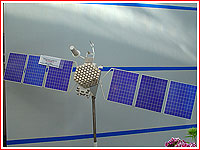
Scale model of the Uragan (GLONASS) satellite. Copyright © 2001 Anatoly Zak


The Proton-K rocket with Block DM upper stage lifts off from Baikonur with a trio of Uragan satellites on Dec. 25, 2006 at 23:28 Moscow Time. Credit: Roskosmos


Uragan

A scale model of the GLONASS- M (Uragan-M) satellite. Click to enlarge. Copyright © 2009 Anatoly Zak


GLONASS-M satellite

GLONASS-M (Uragan-M) satellite. Credit: NPO PM


Launch

The Proton-M rocket launches a trio of GLONASS-M satellites on Dec. 14, 2009. Click to enlarge. Credit: Roskosmos


GLONASS-K

The Uragan-K model originally promised to extend lifespan of individual satellites within GLONASS constellation to 12 or even 15 years. Later specifications called for a 10-year "guaranteed service life." Click to enlarge. Copyright © 2005 Anatoly Zak