|
|
|

|
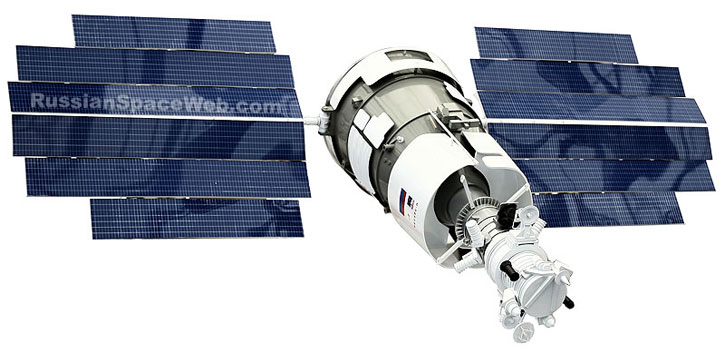
Resurs-P Earth-watching satellite series Developed by TsSKB Progress in the city of Samara, the Resurs-P (47KS) remote-sensing satellites were designed to provide high-resolution imagery of the Earth surface revealing details as small as one meter in size. Resurs-P (where "P" stood for "prospective") would complement and ultimately replace in this role the Resurs-DK spacecraft launched in 2006. Both satellites were believed to be civilian cousins of a classified six-ton optical reconnaissance spacecraft also developed by TsSKB Progress. The company's Soyuz-2-1b rocket was expected to orbit Resurs-P
Summary of Resurs satellite launches in the 21st century:
Resurs-P: Flagship of Russia's civilian remote-sensing fleet The 6,300-kilogram Resurs-P was designed to carry three types of remote-sensing payloads for high-resolution, wide-angle and multi-spectral observations of the Earth's surface. With its imaging cameras, the spacecraft could photograph individual targets on the Earth surface, as well as long stretches of Earth surface extending as far as 2,000 kilometers. The width of the shot would cover 38 kilometers of land during its pass, comparing to 27 kilometers for its predecessor. (562) Resurs-P could also image areas 100 by 300 kilometers during a single pass and conduct stereo-imaging. For the first time the Russian satellite would carry so-called hyper-spectral system featuring 96 spectral channels in each of its two optical-electronic converters. (570) TsSKB Progress also hoped to use the American GPS and Russian GLONASS networks for navigation of Resurs-P. The Resurs-P's projected life span was extended to five years, even though by the time the satellite reached the launch pad in 2013, its predecessor — Resurs-DK — logged seven years of operational life. Among users of the satellite, TsSKB Progress listed following institutions:
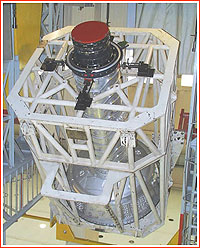
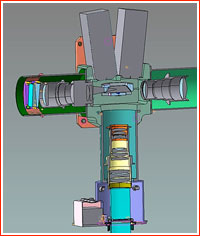
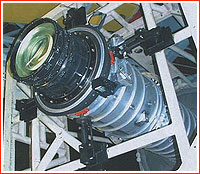
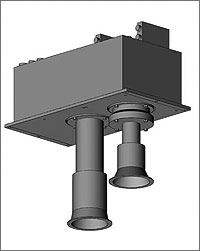
Payloads As its main imaging instrument, Resurs-P No. 1 sports the Geoton-L1 telescope developed at OAO Krasnogorsky Zavod with an image storing and conversion system dubbed Sangur-1U developed at NPP Opteks, a branch of TsSKB Progress in Samara. Sangur-1U converts optical images into digital signal and then processes, compresses and transmits this data to the satellite's radio system for a downlink to ground stations. From an altitude of 475 kilometers, Geoton-L could capture panchromatic images with a resolution of up to one meter. Spectral images could be produced at a resolution ranging from two to three meters. According to Roskosmos, the capability of the telescope to image a 38-kilometer swath of the Earth surface would be a record. In a single exposure, Geoton-L could scan 2,000 kilometers. OAO Karsnogosrky Zavod and NPP Opteks also developed a GSA hyper-spectral system and a dual ShMSA-VR/KShMSA-MR multi-spectral sensor system for high-resolution and medium-resolution imaging installed on the spacecraft. The pair of KShMSA cameras can shoot in six spectral ranges simultaneously including one panchromatic mode and five modes in narrow ranges of spectrum. ShMSA-VR camera can produce images with a resolution of 12 meters and cover 97 kilometers in its image. KShMSA-SR camera has a resolution of 60 meters and it can cover 441 kilometers. GSA payload was designed for simultaneous imaging in multiple narrow ranges of visual light and in near-infrared. A Soyuz-2-1b launch vehicle (No. 15000-013) with the Resurs-P No. 1 satellite was rolled out to the launch pad No. 6 at Site 31 in Baikonur on June 22, 2013. The launch was scheduled for 21:28:48 Moscow Summer Time on June 25. The launch vehicle would fly northward to enter orbit extending from the North pole to the South pole of the Earth to provide full coverage of the planet's surface. The spacecraft was expected to reach orbit 10 minutes later. On Dec. 26, 2014, Russia launched a second copy of its flagship remote-sensing satellite, designated Resurs-P No. 2 or Resurs-P2 for short. Developed by RKTs Progress in the city of Samara, the Resurs-P (47KS) series was designed to provide high-resolution imagery of the Earth surface revealing details as small as one meter in size. Resurs-P (where "P" stood for "prospective") would complement and ultimately replace in this role the Resurs-DK spacecraft launched in 2006. Both Resurs-DK and Resurs-P satellites are believed to be civilian cousins of a classified optical reconnaissance spacecraft also developed at RKTs Progress. On March 16, 2016, Russian specialists succeeded with their second attempt to orbit the latest "eye in the sky" for the nation's fleet of Earth-watching satellites. The nearly six-ton Resurs-P No. 3 was the fourth spacecraft in the series operating in orbit at the time. Development of follow-on Resurs-P4 and P5 satellites On Nov. 20, 2015, the head of division for the development and application of specialized ground systems at RKTs Progress Anton Yudakov announced that the company had been working on a technical assignment for the development of two additional Resurs-P satellites -- No. 4 and No. 5. According to Yudakov, the new spacecraft would carry imaging cameras capable of higher resolution than those on previous satellites but no actual specifications were quoted. At the time, the launches of Resurs-P No. 4 and No. 5 were scheduled for 2017 and 2018 respectively, however by the beginning of 2020, the launch of Resurs-P No. 4 was promised to be launched in the first quarter of 2021. By the end of 2022, the launch of Resurs-P No. 4 slipped to 2023 and Resurs-P No. 5 to 2024. On May 20, 2023, RKTs Progress announced that the assembly of the Resurs-P No. 4 satellite had been completed and the spacecraft would be shipped to the Baikonur Cosmodrome in the near future. It was launched on March 31, 2024. By that time, the launch of Resurs-M No. 5 was expected before the end of 2024. Resurs-PM program (INSIDER CONTENT)
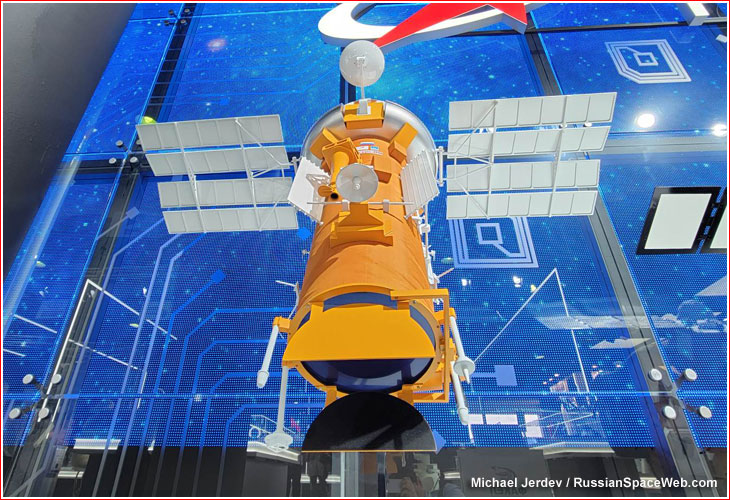
In 2024, Roskosmos reconfirmed its commitment to launching a next-generation flagship Earth-watching satellite called Resurs-PM. The long-delayed 6.5-ton spacecraft would be the largest in the growing class of Russian satellites designed to provide high-resolution dual-use imagery of the Earth's surface.
|
|

|