| |
|
Searching for details: The author of this page will appreciate comments, corrections and imagery related to the subject. Please contact Anatoly Zak. Related pages:
|
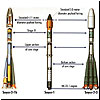
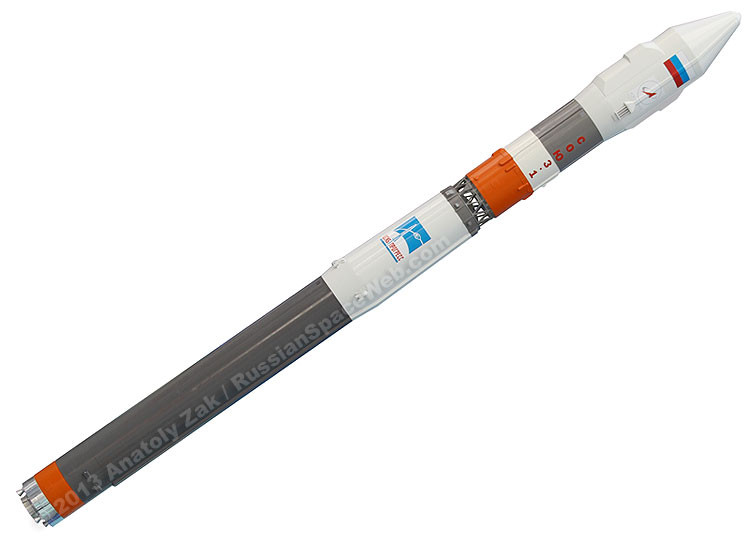
Above: A light-weight Soyuz-1 launcher could serve as an intermediate step between Soyuz-2-1b rocket and the more powerful Soyuz-2-3 launch vehicle. |
MEDIA ARCHIVE To order media contact Anatoly Zak
A 1 to 20 scale model of the Soyuz-1 launch vehicle at the ILA-2008 show in Berlin. Click to enlarge. Copyright © 2008 Anatoly Zak
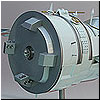
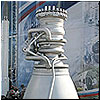
A scale model showing integration of the NK-33-1 engine into the core stage of the Soyuz-2-3 rocket. The Soyuz-1 would use a similar arrangement, minus strap-on boosters. Click to enlarge. Copyright © 2008 Anatoly Zak A scale model of the Soyuz-1 rocket demonstrated in 2010, featured a steering engine on the first stage. Click to enlarge. Copyright © 2010 Anatoly Zak
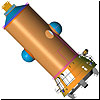
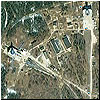
Two areas of modifications required in interfaces of the Soyuz launch pad with the Soyuz-1 rocket. Click to enlarge. Soyuz-1 would use an upper stage closely resembling a propulsion section of spacecraft developed at TsSKB Progress. Click to enlarge. Copyright © 2010 Anatoly Zak
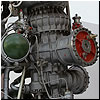
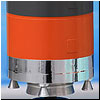
The NK-33-1 engine. Click to enlarge. The Aist satellite (shown in real size) was expected to be Soyuz-1's payload during the first test launch. Copyright © 2009 Anatoly Zak A tail section of the Soyuz-1 rocket. Credit: Roskosmos The core stage of Soyuz-1 rocket arrives to NITs RKP center for testing in December 2011. Credit: Roskosmos The first stage of the Soyuz-1 (2.1v) rocket is being rolled out to the test stand at NITs RKT center on Jan. 6, 2012, in preparation for live firing of its engine. Credit: Roskosmos |
||||||||||||||||||||||||||||||||||||||||||||||||||||||||||||||||||||||||||||||||||||||||||||||||||||||||||||||||||||
Previous chapter: Soyuz-2 rocket A Soyuz-1 concept During the first decade of the 21st century, TsSKB Progress in Samara, the developer of the Soyuz series of rockets, continued efforts to upgrade this legendary family of launchers. Around 2007, following its strategy of modest improvements with limited funds, TsSKB Progress proposed yet another intermediate step on the road to integrating NK-33 engines inherited from N1 rocket into the Soyuz family. Designated Soyuz-1, the new light-weight vehicle would use a core stage fitted with a single NK-33-1 engine, but without strap-on boosters typical for the Soyuz family. Also the diameter of the lower section of the core stage would be increased from 2,050 to 2,660 millimeters. Soyuz-1 would use the same ground facilities and hardware already available for the Soyuz-2-1b rocket in Plesetsk with relatively minor modifications. A standard payload fairing of the Soyuz rocket adopted for Soyuz-1 would have a diameter of three meters. The flight control system would also be borrowed from Soyuz-2, but its software and configuration would have to be modified for the new flight profile and the new engine. According to the information released at the ILA-2008 show in Berlin, a two-stage, 136-ton Soyuz-1 rocket was designed to deliver payloads ranging from 1.5 to 2.4 tons from Plesetsk into the low-Earth orbit with the inclination 62.5 degrees toward the Equator. By 2009, the launch mass of the vehicle grew to 158.5 tons. In 2010, TsSKB Progress quoted 157-160 tons as the launch mass. The vehicle would be 44 meters tall. If developed, the Soyuz-1 rocket would mark the first practical use of the NK-33 engine in Russia since its predecessors' failure to carry giant N1 rocket toward the Moon and several schemes to employ the technology in the West. Simultaneously, a US firm Aerojet worked on integrating NK-33 into the Taurus-2 launch vehicle. Soyuz-1 could also provide a critical engineering bridge from the operational Soyuz-2 rocket to Soyuz-2-3, possibly the most powerful version in the historic family of rockets. Soon after the cancelation of the Rus-M project in the fall of 2011, TsSKB Progress announced that it was considering launching the Soyuz-1 rocket (then renamed Soyuz-2-1v) from Baikonur and Vostochny launch site in addition to Plesetsk. Modifications A main design feature differing Soyuz-1 from other rockets in the Soyuz family would be the bottom section on the first (core) stage of the vehicle, accommodating the NK-33-1 engine. Sporting larger diameter than in previous rockets, the section could then migrate to the Soyuz-2-3 vehicle, if it was ever developed. Additionally, Soyuz-1 would need four new attachments around the "waist" of its first stage, which would be normally located at the tips of strap-on boosters. These devices would interface with the tulip-like supports of the launch pad, holding the rocket in place until the moment of a liftoff. Finally, in its tail section, Soyuz-1 would need four connectors for guiding devices (UN) extending from the launch pad, which would normally hold strap-on boosters. Respectively, on the ground, below the launch pad, a downward looking cable umbilical and guiding devices would have to be extended to reach much slimmer base of the Soyuz-1 rocket. (353) As of mid-2008, TsSKB was preparing to defend the preliminary design of the vehicle in September 2008. According to Ravil Akhmetov, a top official at TsSKB Progress, Soyuz-1 could fly three-four years after the beginning of funding. TsSKB officials hoped that the new rocket's entrance into the market would be supported by an increased demand for the delivery of light-weight payloads into the low-Earth orbit, however initial investments for the development of Soyuz-1 were hard to come by. The funding breakthrough for the Soyuz-1 and follow-on rockets equipped with NK-33 finally came after a successful demo firing of the veteran engine on June 2, 2008. The miraculous revival of a dacades-old NK-33 powerplant was attended by a number of high-ranking government and military officials, including then commander of the Russian space forces General Popovkin. Russian military apparently had potential payloads for Soyuz-1 and wanted to have a backup for Rockot boosters, which were plagued by delays in the production of their upper stage engines. The successful test of NK-33 paved the way to a government decree on the Soyuz-1 signed by Russian Prime-Minister Vladimir Putin, thus bringing the project to the new level of federal support. The challenging development schedule demanded to minimize innovations within the Soyuz-1 project. Particularly, TsSKB Progress rejected a proposal by NPO Avtomatika, (responsible for flight control system development), to install a more advanced Malakhit-7 computer instead of the older Malakhit-3 machine. Still, a brand-new gimbal mechanism developed by KB Arsenal in St. Petersburg was required to control the NK-33 engine in flight. (358) As of 2009, the accelerated development schedule initially called for the first launch of the Soyuz-1 rocket as early as 2010, but at the time of an August 2009 meeting between representatives of TsSKB Progress and NPO Avtomatiki (flight control system developer), the mission slipped to the first quarter of 2011. Still, TsSKB Progress officials apparently felt that it was critical to have a maiden launch of the Soyuz-1 ahead of a long-anticipated debut of the light-weight Angara rocket, also scheduled for 2011. Soyuz-1 reportedly promised considerable cost advantages in comparison to the light-weight Angara which offered similar payload capabilities. In June 2010, the head of TsSKB Progress Aleksandr Kirilin told official Russian media that the first launch of the Soyuz-1 rocket (then re-named Soyuz-2-1v) would take place at the end of 2011. According to Kirilin, all contracts for sub-systems supply, including the NK-33 engine, flight control and telemetry systems, had been in place. The additions to the preliminary design of the launch vehicle were scheduled to go for a formal review and approval on June 17-18, 2010, Kirilin said. Review teams also evaluated the necessary upgrades at launch pads No. 3 and No. 4 in Plesetsk to accommodate Soyuz-2 and Soyuz-1 launchers, Kirilin added. In the middle of 2010, TsSKB Progress representatives said that the manufacturing of the test version of the Soyuz-1's core stage was underway. At the time, its "cold" and live firings were planned as early as the end of that year. In February 2011, Lt. General Oleg Ostapenko, a commander of the Russian space forces, told Russian media that the first launch of Soyuz-2.1v (as Soyuz-1 became known) could not take place during 2011, due to a lack of payloads. At the time, Ostapenko planned a visit to Samara within a month for a discussion with TsSKB Progress of the further development schedule. However just a month later, a spokesman for the Russian space forces, Aleksei Zolotukhin, reconfirmed that Soyuz-1 would fly in 2011. Unofficial reports at the time said that during its first test launch, scheduled at the end of the year, the vehicle would carry the Aist satellite developed at TsSKB Progress. By mid-May 2011, the launch was promised at the beginning of 2012. During Paris Air and Space Show in Le Bourget in June 2011, the mission was promised in April 2012. At the time, the shipment of the first flight vehicle to Plesetsk was promised for Dec. 15, 2011. The rocket's payloads in the first mission were confirmed as Mikhailo Lomonosov and Aist satellites. The test flight program of the Soyuz-1 rocket, involving five launches, was to be completed in 2014. In August 2011, the head of TsSKB Progress, Aleksandr Kirillin, told Russian media that all design documentation for the Soyuz-1 rocket had been completed and the production and testing of its components had been underway. On December 13, 2011, the first stage of the Soyuz-2-1v rocket arrived to NITs RKP test center in Peresvet, north of Moscow in preparation for critical testing of its propulsion system. As usual for the R-7 family of rockets, during the transportation, the oversized core booster was split into two components: 2A, comprised of a propulsion section and a kerosene tank and 1A - an oxygen tank. Following the assembly of the stage, NITs RKP planned to conduct two "cold" tests, KhSI, and one "hot" static firing of a flight ready booster, OSI, inside a special test stand during 2012. The live firing test would be the last major development milestone, clearing the vehicle for the first flight. On Jan. 6, 2012, after its checkout at the processing building, a fully assembled stage was rolled out to the test stand IS-102. At the beginning of 2012, the first launch of Soyuz-2-1v was promised in the second quarter of that year. (540) Development of a steering engine In March 2010, Roskosmos announced that the RD-0110R engine developed by KBKhA design bureau in Voronezh would steer the Soyuz-1 (Soyuz-2-1v) rocket during the first stage of the flight. Four chambers of the RD-0110 engine have capability to rotate in a single plane each, providing a three-axis stabilization. Via its heat-exchanger system, the engine is also designed to heat up helium used for pressurization of propellant tanks. In 2000, RKK Energia, TsSKB Progress and KBKhA made a decision to use RD-0110R on the second stage of the Avrora rocket, proposed for a never-developed launch facility on Christmas Island, Australia. Based on a technical assignment from TsSKB Progress, KBKhA issued a preliminary design for this steering engine, closely based on the original RD-0110 engine. Modifications involved mostly secondary components including: gimbal system, shortening of the combustion chamber nozzles, supply lines for propellant and combustion chamber purging, helium heat exchangers and exhaust nozzles. The aft bulkhead of the launch-vehicle's tail section would be used as the attachment point for the combustion chambers, turbopump, gas exhaust system and propellant supply lines. (331) According to Roskosmos, the production of the engine was in process of being started at the adjacent Voronezh mechanical plant. The engine would have to be modified to fit into the core stage, apparently requiring to increase distance between four steering nozzles. Roskosmos promised first test firings of the engine, based on the existing 11D55 powerplant in April-May 2010. On May 24, 2010, Viktor Gorokhov, a chief designer of the engine, was quoted as saying that initial "cold" tests of the engine, involving flow of propellant without its ignition, had been completed and after few more "cold" trials, a live firing of RD-0110R would be conducted. Volga upper stage Within the Soyuz-1 development project, TsSKB also proposed a Volga upper stage, identified in official documentation as "block vyvedeniya" (insertion stage). Serving as a second stage of the Soyuz-1, the Volga would deliver payload into the final orbit during its mission lasting no more than 24 hours. Based on a propulsion module of existing satellites developed at TsSKB Progress, Volga was expected to have a price tag as much as four times cheaper than that of the Fregat stage. A standard part of the Soyuz-1 rocket, Volga could also fly on the Soyuz-2-1a rocket, replacing Fregat in up to half of expected missions.
APPENDIX Evolution of the Soyuz-1 payload capabilities:
*With the Volga upper stage;
Volga stage characteristics:
RD-0110R steering engine capabilities (331):
The Soyuz-1 development team:
*Would not be needed with the use of RD-0110R steering engine. Next chapter: Soyuz-2-3 rocket Page author: Anatoly Zak; last update: January 18, 2012 All rights reserved |