|
|
    
Related pages:
|
|
|||||||||||||||||||||||||||||||||||||||||||||||||||||||||||||||||||||||||||||||||||||||||||||||||||||||||||||||
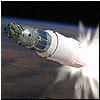
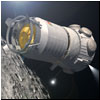
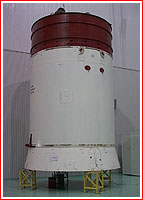
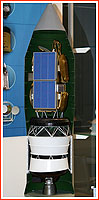
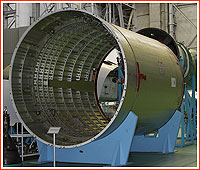
Block D: Fifth stage of the N1 rocket The upper stage, known as Block D (after the fifth letter in the Russian alphabet), was originally developed for the L3 lunar expeditionary complex to be launched on the N1 rocket. In the L3 flight scenario, Block D served as a space tug tasked with up to seven critical maneuvers during the multi-day journey to the Moon, so, unlike, the four lower stages of the N1-L3 complex, Block D had to perform multiple engine firings. Block D long outlived the Soviet lunar program, becoming the most significant heritage from the Moon Race in the USSR.
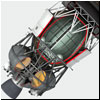
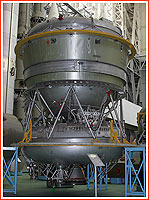
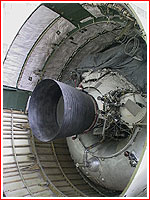
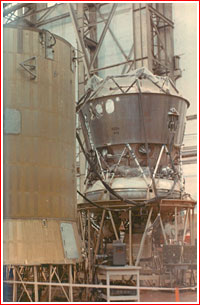
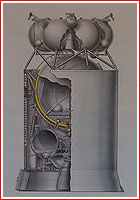
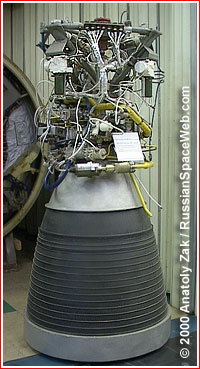
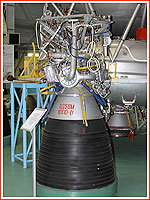
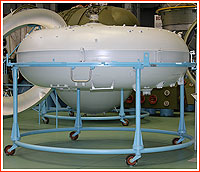
Following its separation from the Block G stage of the L3 complex on a trans-lunar trajectory, Block D had to perform at least one, but, possibly, two orbit corrections, ensuring the rendezvous of the expeditionary vehicle with the Moon, followed by a braking maneuver to enter lunar orbit. Block D would then fire its main RD-58 (11D58) engine two or three times to form a pre-landing orbit around the Moon and, finally, it would perform the braking maneuver for the LK lander to initiate its descent to the lunar surface. Block D would then separate from the LK and crash into the Moon. In the L3 project, Block D had a requirement to operate for up to seven days, probably taking into account various contingency scenarios. (52) In order to provide multiple firings in space, the OKB-1 design bureau developed the 11D58 engine with a thrust of 8.7 tons for Block D. The total burn time for this engine could exceed 600 seconds. As the four stages of the N1 rocket below it, Block D used kerosene fuel and liquid oxygen cooled to –193C degrees as oxidizer. To preserve its cryogenic propellant during its journey to the Moon, Block D was built around a cylindrical thermal radiator which enveloped the oxygen tank to help minimize the evaporation of its content. The oxidizer tank also contained helium vessels in its interior, providing necessary cooling for the pressurization gas. The spherical shape of the oxidizer tank, which minimized heat exchange, dictated the dimensions of the stage, apparently explaining why Block D ended up to be considerably narrower than the six-meter diameter that could fit on top of the third stage of the N1 rocket. With the 1965 decision to fit Block D on the UR-500K (Proton) rocket, which had the main diameter of 4.1 meters, to support the L1 project, the upper stage had to be equipped with a conical adapter because its structural diameter did not exceed 3.7 meters. The fuel tank, located in the bottom position, had an unusual torus shape to fit the main engine into its central cavity, apparently to limit the overall length of the stage to 5.5 meters. The tank was also tilted three degrees from the horizontal axis to facilitate kerosene flow toward the engine at low acceleration in orbit. That initial push in the weightlessness of space, designed to ensure stable flow of propellant toward the main engine was provided by a pair of thruster pods, known as ullage motors, which burned self-igniting hypergolic propellant. They were attached to the aft bulkhead of the fuel tank and both would be jettisoned at the start of the final firing of the main engine. When Block D migrated to the UR-500K rocket, the ullage motors also got the role of attitude control for the L1 vehicle during its coasting phase of flight in a parking orbit around the Earth. As a result, these pods got additional thrusters to provide three-axis control. (On the L3 complex, the attitude control function was performed by the DOK unit, attached to the front of the LOK crew vehicle.) Within the architecture of the N1-L3 and L1 projects, the overall control of the stage and data downlinks from Block D would be handled by the payload, but Block D still had its own power source and avionics. Block D development history Block D fired its main engine for the first time at the ground-based test bench in Zagorsk on Nov. 18 and Dec. 9, 1966, demonstrating dual maneuvering capability. Its first flight and operation in space took place on March 10, 1967, during the first test launch of the L1 circumlunar vehicle. In 1968, Block D was adapted for launching robotic missions to the Moon, Venus and Mars on the UR-500K rocket. Block D was favored over a new space tug proposed at NPO Lavochkin which would be equipped with a 10-ton engine developed at OKB-456 and burning a mix of oxygen with unsymmetrical dimethylhydrazine. Because UR-500K launches with robotic probes did not require Block D to function for several days, it was simplified for flights not exceeding 12 hours. In the continuous effort to validate Block D for the L3 missions, six additional ground tests of the stage were performed in Zagorsk, including three in 1967, one in 1970 and two more in 1971. During five of these trials, Block D fired seven times and, on March 4, 1971, it completed eight burns. In addition, two dedicated launches of the UR-500K rocket with the experimental Block D and the L1E prototype vehicle were made. The first such launch on Nov. 28, 1969 failed to reach orbit, but during the second L1E mission on Dec. 2, 1970, Block D successfully performed seven firings in orbit. From 1967 until 1975, the original Block D variant, known as 11S824, made 39 flights, nine of which ended with launch vehicle failures, in two missions there were flight control system failures and one mission resulted in the loss of the stage during an on-pad accident. From 1967 to 1976, Block D delivered 26 spacecraft into target orbits, including five spacecraft identified as Kosmos, five others as Zond, 10 launches were within the Luna series and six belonged to the Mars series. (52) Block DM variant From the beginning of 1969, OKB-1 worked on another version of Block D intended for placing communications satellites into geostationary orbit. Because this type of spacecraft could not accommodate flight control hardware for the upper stage, Block D was equipped with control avionics of its own, which were placed into a pressurized temperature-controlled torus-shaped container mounted on a radiator via a truss adapter. It also contained telemetry electronics and radio equipment. The stage was also equipped with the upgrade of the main engine designated 11D58M. The modified space tug became known as Block DM. It performed the first Soviet payload delivery into a geostationary orbit. There was still an option to use the upgraded DM stage without its avionics container and associated thermal control equipment while retaining the modified 11D58M engine, in which case the stage would be identified as 11S824M, while the fully equipped version with the flight control avionics container was designated 11S86. Block DM (11S86) specifications:
Between 1967 and 2001, a total of 10 versions of the Block D stage were developed, with 232 stages getting a chance to operate in flight, while experiencing a total of nine failures. During the launch of the Ekspress AM-2 spacecraft on March 30, 2005, the Block D/DM series upper stage flew its 250th mission, according to RKK Energia. Two additional versions of Block D were also introduced: DM2 in 1982 and DM3 in 1996. In the 1990s, Block D was proposed as the basis for an upper stage on several rockets, such as Zenit-3, Energia-M and the air-launched Polyot. Another upgrade, called DM-SL, adapted the stage for the Zenit rockets used in the Sea Launch venture. Finally, in the mid-1990s, another version of the space tug, known as DM-03, entered development aiming for increasing performance of the Proton rocket. In the 2000s, work continued to integrate the stage with Rus-M, Angara-5, Energia-K and other proposed launchers.
Block DM3 specifications:
Block D derivatives:
|
|

|