| |
|
|
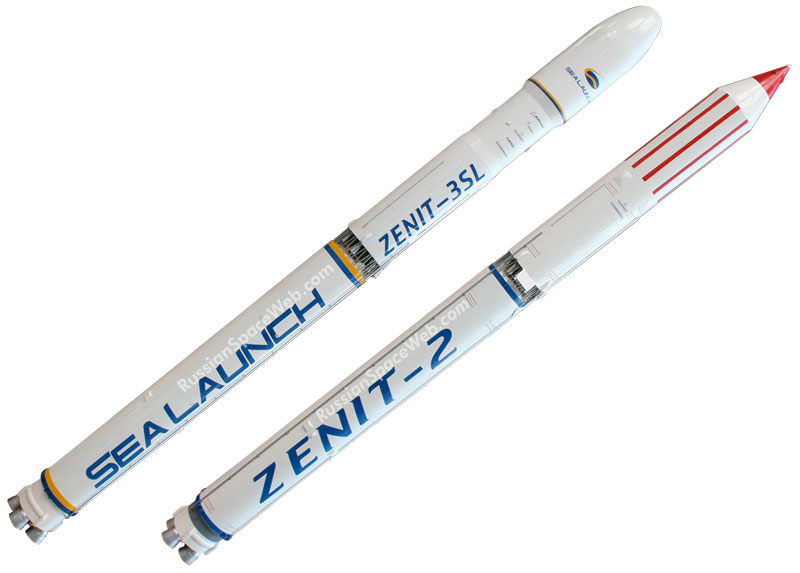
Different versions of the Zenit rocket:
Base Zenit-2 rocket (two booster stages) tech dossier:
Zenit development cooperation:
The Zenit rocket became the latest and the most advanced launch vehicle developed in the former Soviet Union in the 20th Century. The development of the 11K77 launch vehicle, known today as Zenit-2, started at the beginning of the 1970s in the apparent attempt to create a "standartized" family of light, medium and heavy lauchers. According to KB Yuzhnoe sources, the design bureau considered a family of three launchers in its bid for the government assignment to create a "standard" family of launchers:
All three vehicles were designed to share propulsion and control systems, booster and upper stages, processing and launch facilities. For the 11K37 vehicle KBTM bureau's Department 8 (PKO-8) studied a launch complex with the vertical assembly of the vehicle on the launch pad. It would be the first precedent for this type of launch processing in the USSR. The design experience was later applied toward the Angara project. (103) Of these three, the Soviet space forces, VKS, was primarily interested in the 11K77 version, to which KB Yuzhnoe gave a priority in development. The preliminary design of the 11K77 vehicle was completed in April 1974. However in 1975, the original configuration of the rocket, featuring multi-modular architecture, was abandoned in favor of a single-module booster. On March 16, 1976, Central Committee CPSU and the Soviet of Ministers officially approved the development of the 11K77 Zenit project. In agreement with NPO Energia, the Zenit's first stage was chosen as a base for the strap-on boosters of the Energia super heavy-lift launcher. The original plans called for the first test launch of the Zenit rocket in 1982. Sometime in the second half of the 1970s, the Ministry of the General Machine Building, overseeing space industry in the USSR, also proposed the Zenit as a launch vehicle for a super-secret Tselina-2 electronic intelligence satellites, also in the development at the time. However, the developers of the super-powerful engine of the first stage for Zenit run into considerable trouble. Between 1981 and 1983, the problems plagued the test-firings of the RD-171 engine. One of the solutions proposed at the time was a use of the one-chamber engines from the first stage of the N-1 rocket. On top of the difficulties with the engine development, the financial problems in the industry in the mid-1980s further slowed down the program. The construction of the launch complex for the Zenit-2 in Baikonur started in 1978 and the first launch pad was declared operational in December 1983. The testing of the Zenit launcher was officially completed in December 1987. In December 1990, with completion of the second (left) launch pad in Baikonur, the complex of the Zenit-2 rocket and Tselina-2 spacecraft was officially accepted into armaments. In the 1990s, the RKK Energia started the negotiations with the potential partners on forming a joint venture with a purpose of launching commercial payloads from a floating platform. The project became known as Sea Launch. In June 2001, Sea Launch officials announced that they offered NASA to use the Zenit rocket and its ocean-based platform to transport cargo to the ISS. APPENDIX Zenit launch log: 1985 April 13: After a one-day delay caused by technical problem with the launch hardware, the first Zenit-2 rocket blasted off from Baikonur. Due to the problems with the controller of the propellant consumption on the second stage of the rocket, its engine run out of fuel and prematurely shot down at T+400 seconds. (67) The payload did not reach the orbit and the launch was not announced at the time. The rocket carried EPN 03.0694 payload equivalent, representing general dimensions, shape, weight and the center of gravity of the Tselina-2 spacecraft. To measure sound and vibration loads during the launch, the EPNs carried acustic sensors and vibration accelerometers. A separate set of accelerometers also tracked the process of payload fairing jettison. The EPN also carried hardware to measure orbit parameters. 1985 June 21: The Zenit-2 rocket blasted off from Baikonur, however its second stage shot down prematurely. Some fragments from this launch reached the orbit, however the launch was not announced at the time. (67) The rocket carried EPN 03.0694 payload equivalent, representing the Tselina-2 spacecraft. 1985 Oct. 22: The Zenit-2 launched successfully. The rocket carried EPN 03.0694 payload equivalent, representing the Tselina-2 spacecraft. The payload was announced as Cosmos-1697. 1985 Dec. 28: The Zenit-2 launched the Tselina-2 satellite. The spacecraft entered wrong orbit due to the malfunction of the second stage of the launch vehicle. The payload was announced as Cosmos-1714. 1986 July 30: The Zenit-2 rocket launched successfully. The rocket carried EPN 03.0695 payload equivalent, designed to test the Zenit's performance at its maximum cargo capacity. The EPN 03.0695 consisted of the Tselina-2 mockup attached to a four-segment cargo article. The payload was announced as Cosmos-1767. 1986 Oct. 22: The Zenit-2 rocket launched the spacecraft announced as Cosmos-1786. The spacecraft apparently failed to circularize its orbit. (Post-Soviet sources revealed that the vehicle carried the Taifun-1B satellite -- a 2-meter sphere intended for the calibration of the antiaircraft and antimissile radar. 1987 Feb. 14: 11:30:00 Moscow Time: Zenit-2 launched Cosmos-1820, thought to be a prototype of the Orlets-2 imaging reconnaissance spacecraft. In reality, the rocket carried EPN 03.0695 payload equivalent, designed to test the Zenit's performance at its maximum cargo capacity. The EPN 03.0695 consisted of Tselina-2 mockup attached to a four-segment cargo article. 1987 March 18: The Zenit-2 launched successfully. The rocket carried EPN 03.0694 payload equivalent, representing general dimensions, shape, weight and the center of gravity of the Tselina-2 spacecraft. The payload was announced as Cosmos-1833. 1987 May 13: Zenit-2 successfully launched the Tselina-2 spacecraft. The payload announced as Cosmos-1844. Michael Gorbachev, the head of the ruling Communist Party at the time, personally witnessed the launch in Baikonur. 1987 Aug. 1: 06:59:00 Moscow Time: Zenit-2 launched Cosmos-1871, thought to be a prototype of the Orlets-2 imaging reconnaissance spacecraft. In reality, the rocket carried EPN 03.0695 payload equivalent, designed to test the Zenit's performance at its maximum cargo capacity. The EPN 03.0695 consisted of Tselina-2 mockup attached to a four-segment cargo article. 1987 Aug. 28: 11:20:00 Moscow Time: Zenit-2 launched Cosmos-1873, thought to be a prototype of the Orlets-2 imaging reconnaissance spacecraft. In reality, the rocket carried EPN 03.0695 payload equivalent, designed to test the Zenit's performance at its maximum cargo capacity. The EPN 03.0695 consisted of Tselina-2 mockup attached to a four-segment cargo article. This was the last test launch of the Zenit rocket. 1988 May 15: Zenit-2 launched the Tselina-2 spacecraft announced as Cosmos 1943. 1988 Nov. 23: Zenit-2 launched the Tselina-2 spacecraft announced as Cosmos-1980. 1990 May 22: Zenit-2 launched the Tselina-2 spacecraft announced as Cosmos-2082. 1990 Oct. 4: Zenit-2 failed 4 seconds after the launch with Tselina-2 spacecraft destroying right launch pad at Site-45 in Baikonur. From now on, only left pad was used for Zenit launches. 1991 Aug. 30: Zenit-2 failed to place a satellite into orbit due to the second stage failure. 1992 Feb. 5: Zenit-2 failed to place a satellite into orbit due to the second stage failure. 1992 Nov. 17:10:42 Moscow Time: Zenit-2 successfully launched the Tselina-2 spacecraft announced as Cosmos-2219. 1992 Dec. 25: Zenit-2 launched Tselina-2 spacecraft officially announced as Cosmos-2227. 1993 March 26: Zenit-2 launched the Tselina-2 spacecraft officially announced as Cosmos-2237. 1993 Sept. 16: Zenit-2 launched the Tselina-2 spacecraft officially announced as Cosmos-2263. 1994 April 23: Zenit-2 launched spacecraft officially announced as Cosmos-2278. 1994 Aug. 26:15:00:00 Moscow Time: Zenit-2 launched Cosmos-2290 believed to be the Orlets imaging reconnaissance satellite. 1994 Nov. 4: Zenit-2 launched Resurs O1-3 spacecraft from Baikonur. 1994 Nov. 24: Zenit-2 launched the Tselina-2 spacecraft announced as Cosmos-2297. 1995 Oct. 30-31: Zenit-2 launched Tselina-2 spacecraft announced as Cosmos-2322. 1996 Sept. 4: Zenit-2 launched Tselina-2 spacecraft announced as Cosmos-2333. 1997 May 20: Zenit exploded 48 seconds after launch, while lifting Tselina-2 spacecraft. The debris fell eight miles downrange. 1998 July 10, 08:30 Moscow Time: After several delays, Zenit-2 successfully launched Resurs-O1-4 and five foreign payloads into orbit including IRIS-1, Thailand's TMSAT, the Israeli TechSAT-2, Chilean FaSAT-Bravo and Germany's SAFIR-2 1998 July 28, 13:15 Moscow Time: Zenit-2 launched Tselina-2 spacecraft announced as Cosmos-2360. 1998 Sept. 9 (10): Zenit-2 (Number 22L, 11K77.05, No. 18L) failed after the launch from Baikonur with 12 Globalstar cellular phone communications satellites. The cause of the failure was traced to the onboard flight control system. Before this failure Globalstar planned to launch two additional Zenits with 12 sats each. The launch vehicle was delivered to Baikonur on June 8, 1998, and was originally scheduled for launch on July 15, 1998. The rocket known as 11K77.05 lacked braking engines in the tail section of the second stage, since payloads would separate sideways from its launch dispenser. In addition, the second stage was equipped with the system allowing to depressurize the oxygen tank to avoid the explosion of the discarded stage after it releases its payload in orbit. For the same purpose, the launch was scheduled during night time to minimize the overheating of the stage. The first stage of the Zenit-2 carried refurbished engines, "cannibalized" from the cancelled Energia rocket. The interior of the payload fairing was covered by thin sheets of metal to optimize thermal environment for the payload. To complete the upgrades, a Globalstar logo was painted on the flight control section on the top of the second stage. 1999 March 27: The first Zenit-3SL rocket is launched successfully with a dummy satellite from the ocean-based Sea Launch platform. 1999 July 17: 08:37:59 Moscow Time, Zenit-2 successfully launched Okean-O remote sensing spacecraft from Baikonur. 1999 Oct. 9, , 2:15 p.m. PST: Zenit-3SL launched Direct TV 1-R broadcast satellite from a the Sea Launch floating platform located 154 degrees western longitude. 2000 Feb. 3: 12:26:00 Moscow Time, Zenit-2 successfully launched Tselina-2 spacecraft officially announced as Cosmos-2369. 2000 March 12: 6:49 a.m. PST: Zenit-3SL failed to deliver ICO F-1 mobile communications satellite from the Sea Launch platform 230 miles from Kiritimati (Christmas Island) due to the loss of pressurization in the propellant tank of the second stage. 2000 July 28, 3:42 p.m. PDT: Zenit-3SL successfully returned to flight launching PAS-9 communications satellite from the SeaLaunch platform at 154 degrees Western longitude. 2000 Sept. 25: Zenit-2 successfully launched the Yenisei-2 imaging reconnaissance spacecraft. 2000 Oct. 21: Zenit-3SL successfully launched Thuraya communications satellite from the Sea Launch floating platform in the Pacific Ocean. 2001 Jan. 8: An attempt to launch the Zenit-3SL rocket from the floating platform in Pacific was aborted only seconds before scheduled blastoff due to payload malfunction. The incident knows no precedents in the history of Russian space program, the representative of the KB Yuzhnoe, based Dnepropetrovsk, Ukraine said. Zenit-3SL with a US-built XM radio-broadcast satellite was at the final seconds in the countdown on Jan. 8, when the payload controllers requested a delay. The launch was scrubbed, but by that time the special membranes onboard the Zenit's first stage has already exploded to allow the propellant flow toward the main RD-171 engine. The move, known as irreversible operation, requires refurbishment of the engines, or replacement of the first stage before the rocket can be used again. KB Yuznoe representative was clear in placing the blame for the incident on the payload. The western news reports this week made it look like the launch was scrubbed due to the damage of the Zenit rocket. "They (the payload controllers) reported the readiness for launch 30 and 5 minutes in the countdown, then, in the last second, when we started irreversible operations, they suddenly yelled "stop, stop," KB Yuzhnoe representative said. "They were lucky we did not launch a dead satellite," he added. The Sea Launch officially said that only "minor out-of-specification condition was detected on the satellite." 2001 March 18, 2:33 p.m. Pacific Time: Zenit-3SL successfully launched XM-2 (Rock) radio-broadcast satellite from the Sea Launch platform. 2001 May 9, 01:10 Kiev Time (May 8 EST): Zenit-3SL successfully launched XM-1 Radio-1 (Roll) radio broadcast satellite from a floating platform in the Pacific Ocean. 2001 Dec. 10, 22:19 Baikonur Time: The Zenit-2 rocket launched the Meteor-3M remote-sensing satellite from Baikonur Cosmodrome's Site 45. Along with the 2,477-kilogram Meteor, the Zenit-2 was carrying a cluster of international payloads with the total weight of 188 kilograms. It included Moroccan MAROCTUBSAT and Pakistani BADR-R satellites. Also onboard were the Compass spacecraft developed at KB Mashinostroenia in the city of Miass and designed to test the techniques of predicting earthquakes, and the Reflector experiment developed by NII KP design bureau and designed to monitor "space junk." All five spacecraft were inserted into a 1020-kilometer orbit with the inclination 99 degrees toward the Equator. This launch was originally expected in December of last year, however it was continuously delayed mainly due to the problem with the US-build SAGE-III instrument installed onboard the Meteor-3M. The previous launch dates included October and November 30, 2001. This was the 35th launch of the Zenit rocket from Baikonur. 2002 June 15, 22:39 GMT: The Zenit 3SL succesfully launched the Galaxy 3C communications satellite from the Sea Launch platform stationed on the Equator at the point 154 degrees Western longitude. 2003 June 10: After a year-long lull in operations, the Sea Launch consortium successfully delivered a communications satellite into orbit. The Zenit 3SL rocket, built in Ukraine and Russia, blasted off from the Sea Launch platform, positioned in the equatorial region of the Pacific Ocean, at 1356 GMT on June 10, 2003. The rocket carried Thuraya 2 spacecraft designed to provide mobile telephone services in the Middle East, Africa, Europe and Asia. The spacecraft is expected to operate in the geostationary orbit. 2003 Aug. 8: Less then two months after its last mission, the Sea Launch consortium successfully delivered another communications satellite into orbit. The Zenit-3SL rocket blasted off from the floating platform stationed in the Pacific Ocean near the Equator at 8:30:59 p.m. Pacific Daylight Time on August 7 (0330:59 GMT, August 8). The booster carried a single communications satellite co-owned by EchoStar Communications Corporation and Loral Skynet, and therefore designated EchoStar IX/Telstar 13. The Block DM-SL upper stage released the 4,737-kilogram payload into a geostationary transfer orbit and the spacecraft was expected to use its own propulsion system to enter its final geostationary orbit over the Equator, 121 degrees Western longitude. 2003 Oct. 1: The Sea Launch consortium successfully completed its thrid mission in 2003. The Zenit-3SL rocket blasted off from the floating platform stationed in the Pacific Ocean near the Equator at 04:03 GMT on October 1, 2003. The booster carried a single communications satellite co-owned by US-based PanAmSat Corporation and Japanese JSAT corporation, and therefore designated Galaxy 13/Horizons 1. The Block DM-SL upper stage released the 4,090-kilogram payload into a geostationary transfer orbit and the spacecraft was expected to use its own propulsion system to enter its final geostationary orbit over the Equator, at the longitude 127 degrees West. 2004 Jan. 11: The Sea Launch consortium successfully conducted the first space launch of 2004. The Zenit-3SL rocket blasted off from the Odyssey floating platform stationed at 154 deegrees West Longitute in the Pacific Ocean near the Equator on January 11, 2004 at 0413 GMT. The booster carried a single Telstar 14/Estrela do Sul 1 communications satellite in geostationary orbit. The spacecraft was built by Space Systems/Loral and is operated by Loral Skynet do Brasil. The spacecraft carries 41 high-powered Ku-band transponders with five unique and interconnecting coverage beams. The satellite is to serve growing markets such as broadcast video and cable programming, Internet backbone connectivity, VSAT data and other telecommunications services. More than fifty percent of the satellites power is focused on Brazil, providing dedicated Ku-band solutions for the Brazilian marketplace. The satellites other beams covers the Americas and the North Atlantic Ocean, where Connexion by Boeing will use the satellite to support its Internet-to-aircraft service. The mission was originally planned for launch in November 2003. 2004 May 4: Sea Launch Company today successfully delivered the DIRECTV 7S broadcast satellite to orbit from its ocean-based platform on the Equator, marking ten consecutive successes for this highly reliable system, the compnay's statement said. Early data indicate the spacecraft is in excellent condition. The Sea Launch's Zenit-3SL rocket lifted off at 5:42 am PDT (12:42 GMT) from the Odyssey Launch Platform, positioned at 154 degrees West Longitude, precisely on schedule. All systems performed nominally throughout the flight. The Block DM-SL upper stage inserted the 5,483 kg (12,063 lb.) DIRECTV 7S satellite into geosynchronous transfer orbit, on its way to a final orbital position at 119 degrees West Longitude. A ground station in Weilheim, Germany, acquired the spacecrafts first signal, shortly after spacecraft separation, as planned. 2004 June 10: A long-delayed military mission finally took off successfully from a Russian launch site in Kazakhstan. A Zenit-2 rocket (No. 1-95) carrying a classified payload for the Russian Ministry of Defense blasted off from Site 43 in Baikonur Cosmodrome at 05:28 Moscow Time. According to the Russian Space Forces, the spacecraft separated from the upper stage of the launch vehicle at 05:41 Moscow Time and successfully established radio contact with ground control. The payload was designated as Cosmos-2406. (The same designation had been previously assigned to a military payload, which was later renamed, freeing number 2406.) According to North American Aerospace Defense, NORAD, Cosmos-2406 entered a 848 by 865-kilometer orbit, with an inclination of 71 degrees toward the Equator. Both, the altitude and inclination exactly match orbital parameters of the Tselina-2 series of electronic intelligence, ELINT, spacecraft. According to KB Yuzhnoe of Dnepropetrovsk, Ukraine, the manufacturer of the Tselina satellites, the mass of Cosmos-2406 payload was 3,100 kilograms, which is close to known specifications for the Tselina-2 payload. This mission was expected as early as mid-February 2004, as part of Security 2004 exercise, however did not take place. Technical problems reportedly delayed the mission again from February 28 and April 6. On April 25, 2004, the countdown for the launch was scrubbed at T-55 minutes due to failure in the ground power supply system. On April 26, 2004, another problem in the ground launch equipment stopped at T-88 minutes preparations for a launch scheduled for 14:42 Moscow Time at T-88 minutes. The launch was then reportedly rescheduled to 02:46 on April 27, but never took place. The vehicle was then removed from the launch pad and returned to the assembly building. The mission was then rescheduled for June 5-15 period. 2004 June 28: Technical problems during the launch of the Zenit-3SL rocket from the ocean-floating platform left a commercial communications satellite in the wrong orbit, Tuesday, June 28, 2004. The Sea Launch's Zenit-3SL rocket lifted off at 8:59 pm PDT (3:59 GMT , June 29), as scheduled, from the Odyssey Launch Platform, positioned at 154 degrees West Longitude in the Pacific Ocean, carrying Lorals Telstar 18 communications satellite. Two booster stages of the launch vehicle appeared to perform flawlessly, however problems apparently developed during two firings of the Block DM upper stage. SeaLaunch only said officially that the spacecraft was separated into a reduced apogee orbit and that a ground station in Perth, Australia, acquired the spacecrafts first signal, shortly after spacecraft separation. In the same statement, Jim Maser, president and general manager of Sea Launch, said, We are still assessing the data and we are optimistic the spacecraft will achieve its specified lifespan on orbit. We are supporting our Loral customer in this assessment. Unofficial reports showed that two firings of the Block D engine were 9 and 26 seconds shorter than planned, resulting in lower but recoverable orbit. 2005 Feb. 28: After several delays caused by bad weather, a Zenit-3SL rocket successfully launched a commercial payload from its ocean-floating platform on February 28, 2005. The Sea Launch's Zenit-3SL rocket lifted off at 7:51 PST on February 28, 2005 (0351 GMT, March 1, 2005), from the Odyssey Launch Platform, positioned at 154 degrees West Longitude in the Pacific Ocean. The rocket carried the 4,703 kg XM-3 satellite into an optimized geosynchronous transfer orbit of 2468 km x 35786 km, on its way to an orbital location for routine testing. Later, the satellite was expected to move into a final orbital position at 85 degrees West Longitude. A ground station in South Africa acquired the spacecraft’s first signal an hour after liftoff, as planned, Sea Launch said. Built by Boeing Satellite Systems, International, Inc., the XM-3 satellite is a 702 model spacecraft, designed to provide 18 kilowatts of total power at the beginning of its life. Like its sister spacecraft, XM-1 and XM-2 – also launched by Sea Launch - XM-3 was expected to transmit more than 150 channels of digital-quality music, news, sports, talk, comedy and children's programming to subscribers across the continental United States. The mission was previously planned for the fourth quarter of 2004. 2005 April 26: Sea Launch Company successfully delivered DIRECTVs Spaceway F1 satellite to orbit, completing the launch of the heaviest commercial satellite to date, the company said. According to Sea Launch, early data indicated the spacecraft was in excellent condition. The Zenit-3SL rocket lifted off at 12:31:30 am PDT (07:31:30 GMT), as scheduled, from the Odyssey Launch Platform, positioned at 154 degrees West Longitude. All systems performed nominally throughout the flight. The Block DM-SL upper stage inserted the 6,080 kg (13,376 lb) Spaceway satellite into a geosynchronous transfer orbit, on its way to a final orbital position of 102.8 degrees West Longitude. A ground station in South Africa acquired the spacecrafts first signal less than an hour after liftoff, as planned. The Boeing 702 model spacecraft, with a design life of 12 years, was manufactured at Boeings Satellite Development Center in El Segundo, Calif. It includes a flexible payload with a fully steerable downlink antenna that can be reconfigured on orbit to seamlessly address market conditions. 2005 June 23: The Zenit-3SL rocket has successfully sent a 5,500-kilogram Intelsat Americas-8 communications satellite on its way to a final geostationary position at 89 degrees West Longitude. A Sea Launch's Zenit-3SL rocket lifted off from the Odyssey Launch Platform stationed at 154 degrees West Longitude at 7:03:00 am PDT, June 23, 2005. All phases of the flight profile performed as expected. Two-and-a-half minutes into the flight, the first stage of the Zenit-3SL vehicle separated and then the protective payload fairing was jettisoned. Five minutes later, the second stage separated from the Block DM upper stage. The upper stage burned for nearly eleven minutes, coasted for about ten minutes, and then separated from the spacecraft over Brazil, just 29 minutes after liftoff. A ground station in Fucino, Italy, acquired the spacecraft signal. All systems are operating nominally. 2005 Nov. 8: Sea Launch Company successfully delivered the Inmarsat-4 (I-4) communications satellite to geosynchronous transfer orbit (GTO). Early data indicated the spacecraft was in excellent condition. A Zenit-3SL vehicle lifted off on November 8, 2005, at 6:07 am PT (14:07 GMT), from the Odyssey Launch Platform, positioned at 154 degrees West Longitude. All systems performed nominally throughout the flight. The Block DM-SL upper stage inserted the 5,958 kg (13,108 lb.) satellite to geosynchronous transfer orbit, on its way to a final orbital position of 53 degrees West Longitude. A ground station at Lake Cowichan, in British Columbia, acquired the first signal from the satellite less than 25 minutes after spacecraft separation, as planned. Inmarsat-4 is designed to provide high-speed mobile service to people throughout the Americas during its 13-year service life. It is one in a series of satellites designed to support the Broadband Global Area Network (BGAN) for high-speed delivery of Internet and intranet content and solutions, video-on-demand, videoconferencing, fax, e-mail, phone and LAN access. One of a family of three similar spacecraft, this Inmarsat-4 F2 satellite carries a single global beam that covers up to a third of the Earth's surface, 19 wide spot beams and 228 narrow spot beams. It has a total end-of-life power of 13kW. 2006 Feb. 15: After two delays, the Sea Launch venture successfully delivered a communications satellite into orbit. The Zenit-3SL rocket blasted off from Odyssey platform positioned at 154 degrees West Longitude in the Pacific Ocean at 23:35 GMT on February 15, 2006. The rocket carried the EchoStar X satellite toward its final geostationary orbit planned to be at 110 degrees West longitude. A ground station in Uralla, Australia, acquired the first signal from the satellite, as planned. The first launch attempt on February 8, 2006, was scrubbed shortly before launch due to "off-nominal indication from the Ground Support System" according to Boeing. Later bad weather forced to postpone another launch attempt scheduled for February 12, 2006. 2006 April 12: A Zenit-3SL vehicle (No. 21L) lifted off at 23:30 GMT on April 12, 2006, from the Odyssey Launch Platform, at 154 degrees West Longitude in the equatorial Pacific. All systems performed nominally throughout flight, Sea Launch said. The Block DM upper stage inserted the 4401 kg (9703 lbs) JCSAT-9 satellite to GTO, on its way to a final orbital position of 132 degrees East Longitude. A ground station in Uralla, Australia, acquired the first signal from the satellite. Built by Lockheed Martin Commercial Space Systems (LMCSS), the high-power hybrid A2100AX spacecraft carries C-band, Ku-band and S-band transponders and is designed for a minimum mission life of 12 years on orbit. JCSAT-9 joins nine other JSAT spacecraft currently in orbit, covering North America, Hawaii, Asia and Oceania with communications and broadcasting services for corporate and inter-company networks as well as international telecommunications services. The rocket for this mission was originally built for Globalstar satellites, scheduled for launch on Sept. 19, 1998. The mission was cancelled after the launch failure on Sept. 9, 1998. Until April 1999, it was stored at Site 42 in Baikonur and then shipped back to the production plant to be refurbished. 2006 June 18: The Zenit launcher successfully delivered PanAmSat’s Galaxy 16 communications satellite to geosynchronous transfer orbit, GTO. Early data indicate the spacecraft was accurately positioned and in excellent condition, Sea Launch company, which operates the vehicle, said. A Zenit-3SL vehicle lifted off at 12:50 am PDT (07:50 GMT) from the Odyssey Launch Platform, positioned at 154 degrees West Longitude in the equatorial Pacific. All systems performed nominally throughout flight. The Block DM upper stage inserted the the 4,640 kg (10,229 lb) Loral 1300-series spacecraft, to geosynchronous transfer orbit, GTO, on its way to a final orbital position of 99 degrees West Longitude. A ground station at Hartebeesthoek, near Pretoria, South Africa, acquired the first signal from the satellite shortly after spacecraft separation. Built by Space Systems/Loral, Galaxy 16 carries 24 C-band and 24 Ku-band transponders, designed to meet the needs of a variety of broadcast customers in the continental United States, Alaska, Hawaii, Mexico and Canada. Galaxy 16 replaces Galaxy 4R and is the newest member of PanAmSat’s North American Galaxy fleet. With this mission, Sea Launch has now successfully launched four satellites for PanAmSat, including Galaxy 16, Galaxy 13/Horizons-1 in 2003, Galaxy 3C in 2002 and PAS-9 in 2000. This is Sea Launch's sixth mission with a spacecraft built by Space Systems/Loral. 2006 Aug 21 (Aug. 22 GMT): Sea Launch Company successfully delivered the Koreasat 5 communications satellite to geosynchronous transfer orbit (GTO). Early data have indicated the spacecraft was accurately positioned and in excellent condition. A Zenit-3SL vehicle lifted off at 8:27 pm PDT on August 21, 2006 (03:27 GMT, Aug. 22) from the Odyssey Launch Platform, positioned at 154 degrees West Longitude in the equatorial Pacific. All systems performed nominally throughout flight, Sea Launch company said. The Block DM upper stage inserted the 4,448 kg (9,806 lb) Spacebus 4000 C1 platform to GTO, on its way to a final orbital position of 113 degrees East Longitude. A ground station at Fucino, Italy, acquired the first signal from the satellite shortly after spacecraft separation. Built by Alcatel Alenia Space for the KT Corporation and Korea's Agency for Defense Development, the hybrid multi-band satellite will be part of South Korea's new high-capacity Spacecom System over the Asia-Pacific. This is Sea Launch's fourth successful mission of 2006 – two additional missions were planned for 2006. 2006 Oct. 31: After a four-day delay by technical problems, the Zenit-3SL rocket successfully delivered its commercial payload. Zenit-3SL vehicle lifted off on October 30, 2006, at 3:49 pm Pacific Standard Time (23:49 GMT) from the Odyssey Launch Platform, positioned at 154 degrees West Longitude in the equatorial Pacific. All systems performed nominally throughout the flight, according to the Sea Launch venture. The Block DM upper stage inserted the 5,193 kg (11,448 lbs.) XM-4 spacecraft into geosynchronous transfer orbit, on its way to final orbital position of 115 degrees West Longitude. A ground station at Hartebeesthoek, near Pretoria, South Africa, acquired the first signal from the satellite in orbit. On October 26, 2006, the first launch attempt was postponed shortly before a scheduled liftoff, "due to off-nominal data from its automated launch support equipment," Sea Launch venture said. "Following the direction to stop the countdown, the launch team immediately implemented system safing and securing operations, according to procedure. Both the spacecraft and the launch vehicle were in excellent condition," Sea Launch's statement said, provding no additional details. The launch was scheduled for October 26, 2006 at 23:49 GMT, with the launch window closing at 00:47 GMT on October 27. XM-4 was the 4th Boeing 702 spacecraft manufactured at the Boeing Satellite Development Center in El Segundo, Calif. - and orbited by Sea Launch - for XM Satellite Radio. The high-power S-band satellites had Digital Audio Radio Service (DARS) payloads built by Alcatel Alenia Space, France, to broadcast state-of-the-art digital radio programming directly to cars, homes and portable radios throughout the continental United States and Canada. Designed for a 15-year lifespan, the XM-4 satellite had 18 kilowatts of total power at the beginning of life on orbit. The Zenit rocket failure on the Sea Launch platform 2007 Jan. 30: The Zenit-3SL rocket exploded at liftoff from the Sea Launch platform stationed in the Pacific Ocean Tuesday. According to witnesses, the RD-170 engine of the first stage had just ignited, followed by a tilt of the rocket and by the immediate fireball, which completely obscured the vehicle. The live webcast of the launch was cut off shortly thereafter. The mission, which was scheduled to lift off on January 30, 2007, at 23:22 GMT, (18:22 EST, 15:22 PST), was to deliver the NSS-8 communications satellite for New Skies company. The spacecraft was destroyed in the mishap. 2007 June 29: Russian military received a new "ear in the sky," launching a satellite designed to intercept electronic communications. The Zenit-M rocket blasted off from Site 45 in Baikonur Cosmodrome, Kazakhstan, on June 29, 2007, at 14:00 Moscow Time. In accordance with the usual practice for the Russian military launches, the payload was identified as a satellite from the Cosmos series (Cosmos-2428). No details on the goals of the mission was officially released, however it is widely believed that the Zenit rocket delivered its most frequent military payload - the Tselina-2 satellite. According to official Russian media, Titov Main Test and Control Center of the Russian space forces had established contact with the satellite at 14:16:36 Moscow Time and all the systems onboard the spacecraft worked well. The satellite is likely to be the last spacecraft in the series built by KB Yuzhnoe of Dnepropetrovsk, Ukraine. The development of the new generation spacecraft for electronic intelligence had been apparently transferred to contractors inside Russia, after the fall of the Soviet Union. During the summit of Russian and Ukrainian head of states in 2001, they reportedly reached an agreement to complete the construction and launch of last two Tselina payloads. The first was sent aloft in 2004. The latest launch was previously expected to take place in August-September 2006 and then it was postponed to December 16, 2006, January and February 14, 2007, and the beginning of the second quarter of 2007. The Zenit-M rocket (also known as No. 1-2005), which has been used for the latest launch, differed from the standard Zenit-2 launcher by a modified first stage engine, known as RD-171M and capable of a delvering a five-percent increase in thrust, comparing to the standard RD-171 engine. The rocket also featured a different guidance system and a new main flight control computer, designated Biser-3. While lighter then the previous system, Biser-3 enables more accurate delivery of the payload into the orbit. The rocket was originally built to deliver Globalstar satellites on December 19, 1998, however the mission was cancelled in the wake of the failure of a similar vehicle in 1998. The launch vehicle was then refurbished for the Zenit-M program, which Roskosmos considers a stepping stone toward the Zenit-3M vehicle. In combination with Block DM and Fregat upper stages and larger diameter payload fairing, Zenit-3M would be capable of delivering from 2 to 3.6 tons of payload to the geostationary orbit, according to Russian space agency, Roskosmos. Sea Launch scrubs launch attempt, returns to home port Published: 2007 Nov. 17; updated Nov. 19; 20; 21; 22; 27 Worsening weather conditions in the Pacific Ocean forced to cancel the latest attempt of the Sea Launch venture to return to flight after the accident last January. A statement released by the company on the morning of November 21, 2007, said that it was "in the process of determining the next launch opportunity for the Thuraya-3 satellite." Such wording might be an indication that Sea Launch officials were facing a dilemma -- either to continue waiting at sea in the hope of better weather, or returning to the home port for a costly turnaround. According to unofficial reports, the mission was delayed by three days and the launch vehicle was lowered into the horizontal position and removed from the launch pad. After waiting at sea for another three days, Sea Launch announced on Nov. 27, 2007, that its vessels were returning to the home port. The Zenit-3SL rocket was scheduled to blast off from the Odyssey platform stationed in the equatorial region of the Pacific Ocean on November 21, 2007, around 7:25 a.m. Pacific Standard Time, (15:25 GMT). The rocket is carrying the 5,180-kilogram Thuraya-3 communications satellite for Thuraya Satellite Telecommunications Company, based in the United Arab Emirates. This would be the first mission for the Sea Launch venture since the January 31 launch failure, which destroyed the rocket and its payload, as well as damaged the floating launch platform, just seconds after blastoff. Shortly after the accident, a video of the rocket collapsing and exploding below the platform had become one of the post popular features on the YouTube web site. At the beginning of March 2007, a statement by KB Yuzhnoe, the Zenit manufacturer, promised the return to flight in the summer-fall 2007. The launch was later expected on Oct. 28, 2007. In the preparation for the return to flight, the Odyssey launch platform and the Sea Launch Commander ship left the port of Long Beach on Nov. 1, 2007. At the time, the launch was scheduled for Nov. 13 or 14, 2007. After the platform had arrived to the launch area, high winds and strong currents forced to scrub launch attempts on Nov. 13, 14, 17, 18, 19, at 7:37 a.m. and Nov. 20 at 7:29 Pacific Time. Sea Launch returns to flight Published: 2008 Jan. 15 Almost a year after a spectacular explosion, which damaged an ocean-based launch pad, the Sea Launch venture has returned to flight successfully, with the first space launch of 2008. The Zenit-3SL rocket blasted off from the Odyssey platform stationed in the equatorial region of the Pacific Ocean on Jan. 15, 2008, at 11:49 GMT. It carried the 5,180-kilogram Thuraya-3 communications satellite for Thuraya Satellite Telecommunications Company, based in the United Arab Emirates. According to unofficial reports, the mission went flawlessly, with orbital insertion and two firings of the Block DM upper stage completed. 2008 March 19: The Sea Launch international venture successfully delivered a broadcast satellite into orbit from an ocean-based platform on the Equator, the company announced. A Zenit-3SL rocket lifted off on March 19, 2008, at 3:48 pm PDT (22:48 GMT) from the Odyssey Launch Platform, positioned at 154 degrees West Longitude, as scheduled. According to Sea Launch, all systems performed nominally throughout the flight. The Block DM-SL upper stage inserted the 5,923-kilogram DIRECTV 11 satellite into geosynchronous transfer orbit, on its way to a final orbital position at 99.2 degrees West Longitude. Acquisition of the spacecraft’s first signals from orbit were expected later. The DIRECTV 11 satellite is based on Boeing's 702-series platform, and according to the manufacturer, it is among the largest and most powerful Ka-band satellites built to date. 2008 April 28: The Zenit-3SLB, a variation of the Sea Launch-based launch vehicle, flew its first mission from Kazakhstan. The rocket equipped with a DM-SLB upper stage blasted off from Site 45 in Baikonur on April 28, 2008 at 09:00 Moscow Time. It carried Israel's AMOS-3 communications satellite. According to the Russian space agency, Roskosmos, the launch went flawlessly and the satellite was released into its planned orbit. The mission was previously expected in the fourth quarter of 2007 and wa later rescheduled to March 12, 2008. It was also scrubbed by technical problems on April 24, 2008. 2008 May 21: The Sea Launch international venture launched a communications satellite into orbit from an ocean-based platform on the Equator, the company announced. A Zenit-3SL rocket lifted off on May 21, 2008, at 09:43 GMT from the Odyssey Launch Platform. The Block DM-SL upper stage successfully completed its first burn, sending the Galaxy 18 satellite for the Intelsat consortium toward its into geosynchronous transfer orbit, on its way to a final orbital position. Sea Launch confirmed that both burns of the upper stage were successful. The mission was delayed from May 13, 2008. The postponement was attributed to bad weather in the launch area. 2008 July 15: The EchoStar XI broadcast satellite was successfully launched from its ocean-based platform on the Equator, marking its fourth successful mission of 2008 and its third mission for DISH Network, the Sea Launch company announced. According to the company, the Zenit-3SL rocket lifted off at 10:21 p.m. Pacific Decree Time on July 15, 2008 (05:21 GMT, July 16) from the Odyssey Launch Platform, positioned at 154 degrees West Longitude. One hour later, the Block DM-SL upper stage inserted the 5,511 kg (12,150 lb) EchoStar XI satellite into geosynchronous transfer orbit, on its way to a final orbital position at 110 degrees West Longitude. Operators at the Gnangara ground station in Perth, Australia, acquired the spacecraft’s first signals from orbit shortly after spacecraft separation. All systems performed nominally throughout the mission, Sea Launch said. 2008 Sept. 24: The Sea Launch venture conducted a successful launch of the Galaxy 19 communications satellite, the company announced. According to Sea Launch, the Zenit-3SL rocket lifted off on Sept. 24, 2008, at 2:28 a.m. PDT (09:28 GMT) from the Odyssey Launch Platform, positioned at 154 degrees West Longitude. Just over an hour later, the Block DM-SL upper stage inserted the 4,690 kg (10,340 lb) Galaxy 19 satellite into geosynchronous transfer orbit. Operators at the Hartebeesthoek ground station in South Africa acquired the spacecraft's first signals from orbit shortly after spacecraft separation. All systems performed nominally throughout the mission, Sea Launch said. Built by Space Systems/Loral (SS/L), the 1300-series hybrid spacecraft carries a total of 52 physical transponders. The Galaxy 19 satellite will provide Intelsat customers 50-state coverage, as well the Caribbean, Canada and Mexico. It will be located at 97 degrees West Longitude. 2009 Feb. 26: The Zenit-3SLB rocket with the Block DM-SLB upper stage lifted off from Site 45 in Baikonur Cosmodrome at 21:30 Moscow Time on Feb. 26, 2009. It carried 4,010-kilogram Telstar 11N communications satellite for the commercial company Telesat of Canada. Built by Space Systems/Loral (SS/L) from 1300-series platform, the satellite is equipped with 39 Ku-band transponders and is designated to work in the position 37.5 degrees West longitude over the Equator, to provide multimedia services in Central and North America, Europe, Africa and as well as for sea and air carriers over the Atlantic Ocean. It was the second launch for the multinational consortium operating the Zenit rocket and its launch complex in Baikonur, Kazakhstan, to deliver commercial payloads into the geostationary orbit. The first mission of the Land Launch in April 2008 delivered its payload into a slightly incorrect orbit, resulting in shortening of the operational life of a commercial satellite. In the meantime, Land Launch’s second mission experienced a number of delays on the ground. As of beginning of October 2008, the original launch date at the end of 2008 was dependent on the departure from Baikonur of another satellite -- Measat 1R satellite, which was severely damaged in the pre-launch processing incident. The spacecraft went through de-fueling process, but had to be decontaminated and certified for the return to the US. At the time, Telstar 11N was expected to be shipped to Baikonur in mid-November 2008. Measat 1R finally departed from Baikonur on Nov. 6, 2008, and safely arrived to the US a day later. In order for Telstar to meet the launch window opening on Dec. 21, 2008, it had to be delivered to Baikonur on Nov. 15, 2008. Otherwise, the mission could be delayed as far as the end of March - beginning of April 2009. The launch was ultimately re-scheduled for February 26, 2009.2009 April 20: The Zenit 3SL rocket successfully delivered the SICRAL 1B communications satellite to geosynchronous transfer orbit, for Telespazio, a Finmeccanica/Thales company, based in Rome, Sea launch company announced. The rocket lifted off on April 20, 2009, at 08:16 GMT. carrying the dual-use Italsat 3000 spacecraft, with a mass of 3,038 kg (6,697 lb). Built by Thales Alenia Space, the satellite is designed to provide communications services for the Italian Ministry of Defense, NATO and allied nations. The mission was delayed from December 2008 and late January/beginning of February and Feb. 19, 2009. 2009 June 22: The Zenit-2SB rocket lifted off on June 22, 2009, at 01:50 Moscow Time from Baikonur's Site 45. The vehicle carried the Measat-3a communications satellite for Satellite Systems Sdn. Bhd of Kuala Lumpur, Malaysia. According to the Russian space agency, eight minutes and 30 seconds after the launch, the Block DM-SLB upper stage and its payload successfully separated from the launch vehicle. According to the Land Launch venture, which markets Zenit missions from Baikonur, the satellite's separation took place at 04:14:47 GMT (08:14 Moscow Time). Spacecraft health has been checked (Telemetry and Command) with nominal results, the company's statement said. A 2,366-kilogram Measat-3a satellite, (previously designated as Measat-1R) carries 12 Ku-band and 12 C-band transponders and features three antennas to provide C-band fixed satellite services across the Asia Pacific, the Middle East, Africa, Europe and Australia; and Ku-band direct-to-home television broadcasting to Malaysia and Indonesia. It was built by Orbital Science Corporation. On Aug. 9, 2008, in Baikonur, during processing of the satellite for launch then scheduled for Aug. 21, 2008, it was seriously damaged by a crane, which hit the spacecraft's antenna, requiring its repairs at the manufacturer's facilities in the US. By the beginning of October 2008, the satellite was drained of its toxic propellants and was going through decontamination and certification process to return it to the OSC factory in US. As of the end of October 2008, the return to the US was scheduled for Nov. 6, 2008 with the launch from Baikonur in the Spring of 2009. The shipment of the satellite from Baikonur did take place as scheduled on Nov. 6, 2008, and it safely arrived to the US a day later. The satellite was expected to be shipped to a decontamination facility in New Mexico before returning to the manufacturing plant for repair. At the time, it was scheduled to return to Baikonur in March 2009 and fly in April 2009. By the end of January 2009, the launch was re-scheduled for June-July 2009 period, however these plans conflicted with the scheduled launch of the Intelsat 15 satellite. The final decision was expected to be based on the progress of Measat's repairs. Finally, by the end of February 2009, it was announced that the mission would take place in June 2009. This page is maintained by Anatoly Zak; last update: June 22, 2009 |
PICTURE GALLERY
A Zenit-2 booster blasts off from Baikonur's Site 45 carrying a Yenisei-2 classified imaging satellite. Copyright © 2001 RussianSpaceWeb.com
A fully-assembled Zenit-2 booster is used for personnel training in the assembly building in Baikonur. Copyright © 2001 by Anatoly Zak
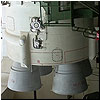
An interstage structure connecting first and second stages of the Zenit-2 vehicle. Copyright © 2001 by Anatoly Zak
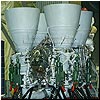
A tail section of the Zenit's first stage with a four-chamber RD-170 engine. Copyright © 2001 by Anatoly Zak
The 11K55 project -- the "light" version of the Zenit launcher. Credit: KB Yuzhnoe
The 11K37 project -- the "heavy" version of the Zenit launcher. Credit: KB Yuzhnoe
A cutaway view of the three-stage Zenit-3 launch vehicle, equipped with Block-D upper stage. Zenit-3 would be able to deliver one (1) ton of payload to the geostationary orbit after its launch from Baikonur. Zenit-3 has never flown from Baikonur but, later became a base for the Sea Launch project. Copyright © 2001 RussianSpaceWeb.com
The Svityaz project -- the air-launched version of the Zenit rocket, carried on top of Mriya transport plane. Credit: KB Yuzhnoe The RD-170 engine powered the first stage of the Energia rocket. Click to enlarge: 300 by 400 pixels / 56K Copyright © 2005 Anatoly Zak
The RD-120 (11D123) engine powers the second stage of the Zenit launcher. Copyright © 2001 by Anatoly Zak / RussianSpaceWeb.com
The Zenit-3SL rocket launches Telstar 18 on June 28, 2004. Credit: Boeing
The Zenit-3SL rocket launches Koreasat 5 on Aug. 22, 2006. Credit: Sea Launch The Zenit rocket with the NSS-8 comsat explodes on the Sea Launch pad on Jan. 30, 2007. Credit: Sea Launch |