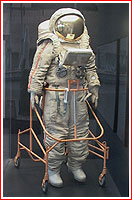
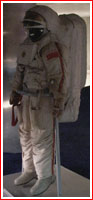
| |
  
|
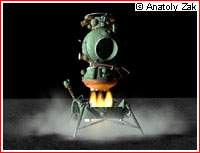
LK lunar module for the L3 project During the 1960s, the Lunar Spacecraft, in Russian "Lunnyi Korabl" or LK, was conceived as a part of the L3 lunar expeditionary complex to be carried aloft by the N1 rocket. From the outset, Soviet designers understood that despite being the largest launch vehicle developed by the USSR, it could only carry two-person crew on a lunar mission and only one to the surface of the Moon.
Known specifications of the LK spacecraft:
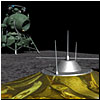
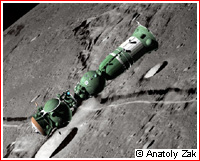
Similar to the American Apollo missions, LK was designed to separate from a lunar orbital spacecraft (LOK), in orbit around the Moon. After a descent to the lunar surface and, hopefully, a successful "moonwalk," the cosmonaut would blast off from the Moon onboard LK and link up with LOK. Following the moonwalker's transfer back from LK to LOK, both cosmonauts would jettison the LK and depart toward Earth onboard the LOK. However, unlike in Apollo, no internal tunnel between LOK and LK existed, therefore back-and-forth movement of a crew member between two ships would have to be done in spacesuit, via the same hatch in LK, which would be used to walk on the lunar surface. Also unlike in Apollo, the same propulsion unit of the Block E would be used for the final phase of the descent on the lunar surface and for a takeoff. The initial descent to the Moon would be propelled by the Block D stage attached to LK. Block D would jettison and crash onto the lunar surface, after which Block E's engine would take over. LK lander design
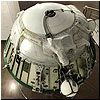
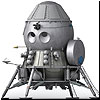
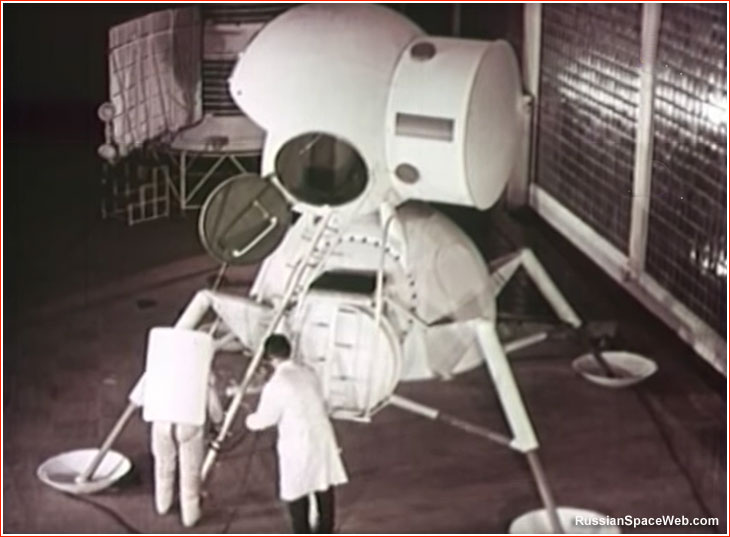
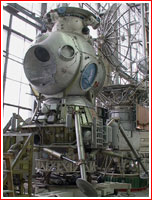
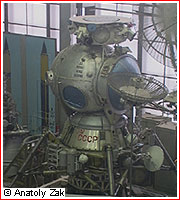
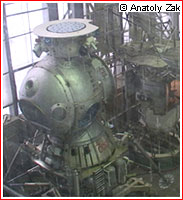
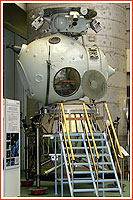
A full-scale prototype of the LK lander used for training shows an earliest configuration of the spacecraft designed in 1967. As a system, the LK spacecraft (development designation 11F94) consisted of the lunar module itself and the Block E propulsion system. However, structurally, the spacecraft would be subdivided into the Lunar Landing Aggregate, (Lunnyi Posadochnyi Agregat, LPA) and the Lunar Ascent Vehicle, (Lunnyi Vzletnyi Apparat, LVA). In turn, LPA consisted of a lattice-structured main body with a diameter of 2.27 meters and a four-legged lunar landing device, (Lunnoe Posadochnoe Ustroistvo, LPU). In its launch configuration, the stowed landing gear would have a span of 2.26 meters. (231) It would be likely deployed immediately after the jettisoning of the protective shroud in preparation for landing in the lunar orbit. In 1965, the development of the landing mechanism was subcontracted to KB Arsenal. The lunar module consisted off following major elements:
Block E was permanently attached to the bottom of the cosmonaut compartment, while the LPA/LPU landing device was connected to Block E with a set of pyrotechnic devices, which would be severed at the takeoff from the Moon. LPU also carried small solid-propellant motors designed to press the vehicle into the lunar surface upon touchdown. They were developed at NPO Altai (a.k.a NII-9, ANIIKhT) in the city of Biysk. In addition, a special retractable umbilical mast linked various systems in the LPA/LPU landing device to the cosmonaut compartment. The mast would be retracted prior to the ascent vehicle's blastoff from the Moon. On all its sides, LPA was heavily loaded with various sub-systems and scientific gear including:
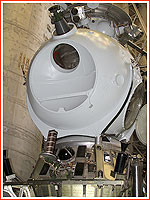
The 105-kilogram scientific package would reportedly include a 59-kilogram robotic arm and a drill with an operational life span of 60 minutes. (231) The LVA ascent vehicle consisted of the cosmonaut compartment, another avionics compartment, the attitude control section and a Block E propulsion unit. Like in Apollo's lunar module, the 2.3 by 3.0 meter's cabin had a complex geometrical shape dictated by its dual function as a landing and docking command center. However where Apollo featured an angular multiplying shape, the LK crew module sported a complex combination of semi-spherical structures. In its architecture, it clearly borrowed from the original design of the Soyuz spacecraft. 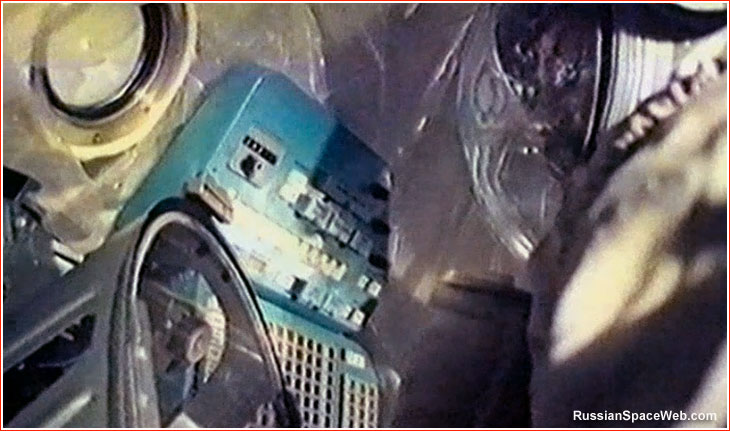
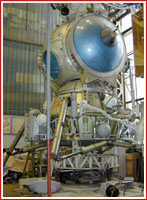
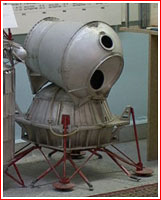
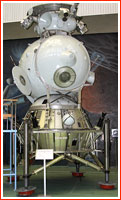
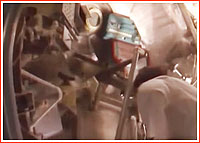
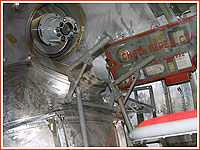
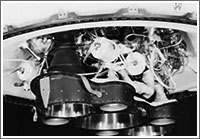
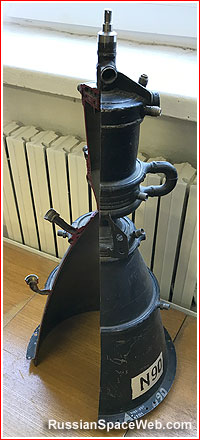
An interior view of the LK lander. A circular cutaway in the front of the cabin contained a window which would afford a good view of the surface below the ship during landing. The pilot could steer the spacecraft to a touchdown while standing at the controls, in case of problems with the nominal automated descent mode. To save space and room, the cabin famously had no seat. However, like all Russian spacecraft and unlike Apollo, LK's cabin featured a normal nitrogen-oxygen atmosphere, instead of the oxygen-only life-support system in early NASA spacecraft. The flight control system featured an onboard computer and enabled the cosmonaut to select the final landing site and conduct the approach and touchdown manually. (202) During its development, the LK lander went through several reincarnations, which becomes apparent when one compares different versions of the spacecraft preserved at various locations in Russia. Block E propulsion system for the LK lander The Block E propulsion system, developed at OKB-586 in Dnepropetrovsk, was one of the most critical systems onboard the N1-L3 complex. Unlike any other phase of the lunar expedition, a failure of Block E during takeoff from the surface of the Moon would inevitably result in the loss of a cosmonaut. To improve the reliability of Block E, the one-chamber 11D411 engine had a backup 11D412 engine with two combustion chambers. Combined, the two engines would create a propulsion system designated 11D410. Both were burning a mix of unsymmetrical dimethyl hydrazine and nitrogen tetroxide. Attitude control propulsion To maintain its orientation in space, the LOK and LK spacecraft were equipped with a 11D73 and 11D76 (DOK-DKP) thrusters developed at the design bureau of Aviation Plant No. 500, which was renamed Soyuz Tushino Machine Building Design Bureau, or TMKB Soyuz. Thermal control system In addition to an extra-reliable propulsion, the lunar lander needed a very effective system to remove heat while it was constantly baking in sunlight on the surface of the Moon. Korolev's design bureau (known as TsKBEM at the time) subcontracted the development of a thermal control system for the LK spacecraft to NPO Nauka. This organization had extensive experience in development of life-support systems for Soviet aviation and space industry. Within NPO Nauka, Department No. 59 took the responsibility for the development of the first Soviet vaporization device for use in space. A special vaporizer was developed to remove extra heat from the spacecraft using boiling alcohol as a coolant. The coolant was contained in a special tank divided by a flexible membrane onto a coolant storage and an air-pressurization chamber. The unit had the capability to maintain the temperature of the coolant at a predetermined level. The vaporizer consisted of four elements: the unit itself; four coolant tanks; valves controlling the coolant supply; dosage controllers; pressure sensors, to monitor minimum pressure in the coolant supply, which would indicate either depressurization of the supply system or out-of-coolant state. On the vapor half of the system, it had a valve for the boiling pressure of the coolant, dosage device for the supply of the coolant into the vaporizer, a temperature regulator on the exit from the vaporizing chamber, including a control unit and temperature sensors. (346) Landing legs In 1965, a delegation of the 3rd Directorate of the Ministry, which oversaw the KB Arsenal navy weapons center in Leningrad, suddenly paid a visit to the enterprise accompanied by engineers from OKB-1. The group requested the chief of Arsenal's production I.A. Medvedev and N.N. Kazakov to develop a landing gear for the lunar vehicle designated 11F694 under a very short deadline. Despite initial skepticism of the company's leadership, three months later Arsenal's engineers reportedly showed acceptable technical solutions to the design to their colleagues at OKB-1. A special test stand, which was designed for trials of the landing gear and its amortization system was constructed outside of the department No. 837 at Arsenal's campus. (559) One of the challenges of the project was the work with components of the gear made of titan, with which the company had little previous experience. Due to tight schedule, two and sometimes three-shift work was required at KB Arsenal's production plant. (560) By 1967, several sets of landing gear for LK were delivered for integrated tests in Zagorsk. KB Arsenal then worked on the development of landing gear for unmanned lunar probes, five of which operated on the surface. (559) Development and flight testing The flight testing of the LK spacecraft started with a specially equipped helicopter, simulating the ship' landing profile. During a sortie on April 17, 1970, the flight control system of the LK spacecraft was tested during a helicopter test. At least four full-scale mass and size mockups of the LK 11F94 spacecraft, GVM (from the Russian Gabaritno-Vesovoi Maket) were expected to be assembled for flight tests of the N1 rocket:
Three prototypes of the LK module, designated T2K, were also launched into the Earth orbit on Soyuz (11A511) rockets. During the flights, the ship's Block E propulsion systems conducted multiple firings, simulating maneuvers during the lunar expeditions. In addition, a KS-1000-0 simulator (from the Russian Kompleksny Stend) of the LK lander was built for development purposes and it eventually ended up at the demo hall of the Moscow Aviation Institute, MAI. However due to the continuous failures of the N1 rocket and the subsequent cancellation of the N-1-L3 project, the LK module never had a chance to carry a Soviet cosmonaut to the lunar surface.
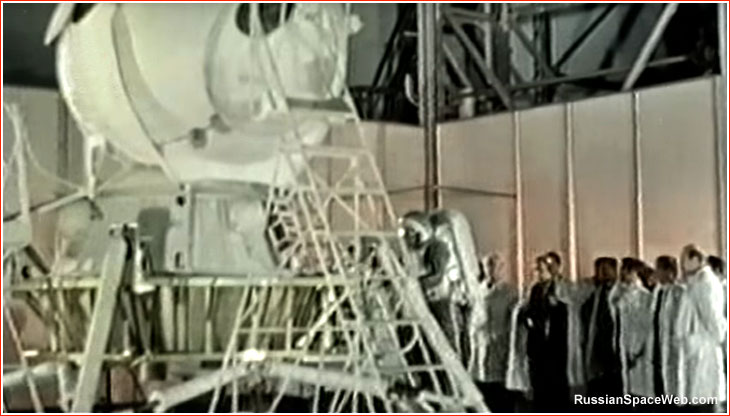
A lunar EVA practice with the LK lander mockup. Known development prototypes of the LK lander*
**Nine volumes of documents had been issued for this vehicle, indicating that it could be used in one of actual launches of the N1 rocket. *List does not include the KS integrated development prototype known as "Kompleksny Stend" (Integrated Stand).
|
|

|