|
.
|
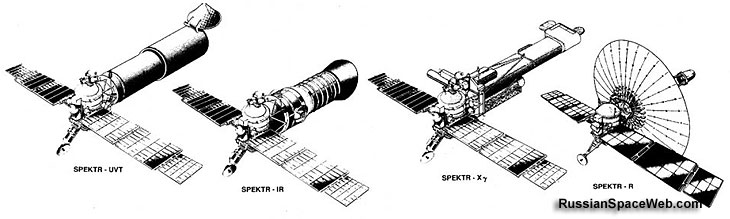
Origin of the Spektr series For more than three decades in the making, the Spektr project envisioned a series of space observatories, which would "divide" between themselves a huge swath of the electromagnetic spectrum from radio waves to ultraviolet light and to X-rays. The program resembled NASA's plans for a quartet of "great observatories," including an optical telescope, later known as Hubble; a gamma-ray observatory, GRO (later Compton); an X-ray telescope, AXAF (or Chandra) and an infrared observatory, SIRTF (later Spitzer). While all US "great observatories" made it to orbit between 1990 and 2003, the Spektr series remained grounded by the economic cataclysms of the post-Soviet period.
Roots of the Spektr program go all the way back to the beginning of the 1980s, when NPO Lavochkin design bureau, USSR's prime developer of scientific space probes, completed the preliminary design of a new-generation spacecraft dubbed 1F and 2F, which later became a basis for the Phobos (Fobos) project. Although the primary purpose of the project was the development of a standard platform for various deep-space missions, Lavochkin also hoped to use the 1F design as the basis for space telescopes. The priority to the development of the Phobos project over the space observatories was given by a special decree of the Central Committee of the Communist Party and the Soviet of Minister signed on May 8, 1980. The document approved the development of scientific space projects in the USSR during the period from 1981 to 1990. It called for two phases in the Soviet space-based astrophysics projects:
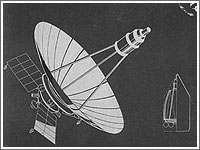
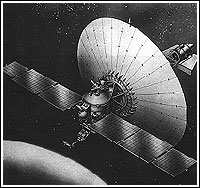
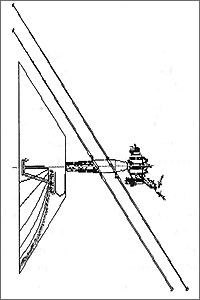
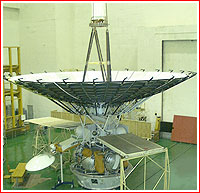
Between 1982 and the end of 1983, the design bureau completed technical proposals for a space-based radio telescope designated Radioastron. Since the spacecraft was expected to follow the Soviet Astron mission, the new project was also known as Astron-2 (2A). However, the architecture of the proposed spacecraft was heavily based on the 1F platform instead of the Mars probes, which served as a basis for the original Astron and Granat observatories. Radioastron was expected to carry a radio antenna with an impressive diameter of 10 meters and listen to radiowaves with bandwidth of 72, 18, 6 and 0.8 centimeters. The spacecraft would fly in the Earth's orbit with an apogee of 750,000 kilometers. The radio-telescope would follow the Astron UV observatory, launched in 1983 and the X-ray telescope planned to fly later in the 1980s, within the Granat project. Designing from Phobos Very early on, critics pointed out that the 1F platform was ill-suited for astrophysics, even in comparison to the older 4V spacecraft bus, which was developed for missions to Venus, but also converted into the Astron and Granat observatories. The attitude control system of the spacecraft installed on the 1F platform could easily navigate planetary probes, however its accuracy would be way below typical requirements for a high-precision telescope. In addition, the spacecraft lacked either electrically driven fly-wheels, which drastically improve the stabilization in space, or movable solar panels, which could track the Sun without the need to reposition the entire satellite disrupting observations in the process. On July 27 and Aug. 2, 1983, the presidium of the Academy of Sciences reviewed and made a decision to launch Astron Radio spacecraft in 1987 or 1988, which would be able to register electromagnetic radiation in the centimeter range of the spectrum. According to the same decision, in 1990, it would be followed by a more complex Astron spacecraft capable of capturing radiation in the millimeter range. On Aug. 1, 1983, the Military Industrial Commission, VPK, issued official decision No. 274 entitled "On works for creation of automated interplanetary vehicles for the exploration of planets of the Solar System, the Moon and cosmic space." The document provided a new impetus for the development of astrophysics satellites. New technical proposals issued in mid-1984 included a spacecraft with a gamma-ray telescope designated 2AG and the 2AM spacecraft with an antenna for registering millimeter-range radio waves. Both satellites now sported rotating solar panels, fly-wheels and a highly sensitive star-tracking orientation system. Initially, NPO Lavochkin subcontracted the development of the critical attitude control system for the spacecraft to a division of NIIAP, a leading Soviet avionics producer led by Nikolai Pilyugin. However in the following five years this assignment had to be transferred to the main office of NIIAP and then back to its branch. By the end of the 1980s, Designer General at NPO Lavochkin, Vyacheslav Kovtunenko, proposed to base future astrophysics satellites on the existing Oko spacecraft, which were originally designed to track incoming ballistic missiles. According to the plan, the missile-watching infra-red telescope onboard Oko would be replaced with scientific instruments and the satellite would be pointed toward heavens instead of the Earth's surface. Designated AM, for "astrophysics module," the recycled platform would inherit a high-precision attitude control system developed by Khartron avionics bureau in Kharkov, Ukraine. The Oko satellite's radio system developed at NPO Kometa and intended to deliver highly classified information exclusively to top-secret military ground stations in Serpukhov and Komsomolsk-na-Amure, would be replaced with communication gear originally developed by the RNIIKP design bureau for the 1F spacecraft. The decision to use the 72Kh6 platform for astrophysics was first formulated by its developer, NPO Lavochkin, in January 1985 and confirmed by a joint decision with the Academy of Sciences and the Crimean observatory on May 16, 1985. (479) Known specifications of the astrophysics module (AM) (118):
On Dec. 31, 1987, the Soviet Academy of Science and Glavkosmos USSR (which was responsible for international alliances of the Soviet rocket industry) issued an official "Decision on the order of design and development of the Spektr series." The document projected following launch date for the Spektr family:
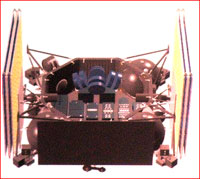
From the outset of the project, Soviet radio-astronomers hoped that Spektr-R would be followed by next-generation orbital radio-telescopes designated Spektr-M Millimetron and and Spektr-S Submillimetron. As their names suggest, they would be sensitive to radiowaves in the millimeter and sub-millimeter range -- which is shorter than radiowaves registered by Spektr-R and thus provide even more resolution to astrophysicists than their predecessor. (614) With the federal funding collapsing at the beginning of the 1990s, all scarce resources of the Russian space science budget were directed toward the long-delayed Mars-94 project (later renamed Mars-96). Following its tragic loss in November 1996, it was decided to switch future scientific priorities toward the Spektr observatories, with Spektr-RG first in line to fly. All three Spektr missions were being prepared under an umbrella of multilateral international agreements. By 1997, international teams produced test prototypes and some flight versions of scientific payloads for the Spektr-RG and Spektr-R missions with a total development price tag of $200 million. According to US-Russian documents signed in January 1996, NASA's Jet Propulsion Laboratory promised to supply four state-of-the-art recording devices for Russian ground control stations supporting Spektr-R mission. Ground-based radio telescopes in the US would also participate in the project. As of 1996, the launch of Radioastron was expected in 1999-2000 or around a year after its older sibling, Spektr-RG would go into orbit. (402) Despite all the international involvement and its status of the highest priority mission, Spektr-RG never had a chance to reach the launch pad during the 1990s due to severe underfunding. By 2002, as the scientific goals of Spektr-RG were about to be matched and eclipsed by the Europe's Integral observatory, even Russian astrophysicists lost interest in the project. On Feb. 13, 2002, the Russian Academy of Sciences decided to switch its funding priority to the Radioastron mission. Its launch was then timed for 2004-2006, or no later than 2007, to beat similar US and Japanese missions, which were anticipated in 2008. In 2001, the funding of the Spektr-R project was expected to reach between 10 and 23 million rubles, clearly far too little for a significant advance of the project. According to some estimates, a billion rubles would be required for the completion of the project and the additional 700 million rubles would be needed to procure a Proton rocket for its launch. (402) Facing a decade-long delay of the mission, NPO Lavochkin had to replace a number of critical avionics which were intended for the Spektr series. Previously, developers hoped to use backup radio systems left over from the Mars-96 and Interbol missions on the two first Spektr satellites. However, with the new launch dates, these sensitive avionics would far exceed their warranty for reliable operation. In the post-Soviet turmoil, the manufacturing of duplicate units was no longer feasible. As a result, in 2001, NPO Lavochkin subcontracted the development of a brand-new communication system to OKB MEI. The telemetry system and the flight control computer, which had previously flown onboard the Kupon communications satellite and the Arkon-1 reconnaissance satellite, were to be supplied respectively by the Izhevsk Radio Plant and by a design bureau in Zelenograd. By mid-2003, a management reshuffle at NPO Lavochkin led to a major course correction in the engineering policy of the organization. A veteran of Lavochkin's Babakin research center, Konstantin Pichkhadze, replaced Stanislav Kulikov as Designer General. Pichkhadze made the decision to scrap the entire family of AM modules and develop a brand-new spacecraft bus, based on a more advanced but technically challenging unpressurized platform. The new platform was dubbed Navigator. Initially, it was expected to become the basis for the Spektr-R and Elektro-L spacecraft, with future space telescopes using an even more advanced platform. (479) Spektr-R specifications:
|
|

|