|
|

|
|
|||||||||||||||||||||||||||||||||||||||||||||||||||||||||||||||
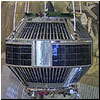
Rodnik military communications satellites Like their predecessors in the Strela (an "arrow") family of satellites, Rodnik (Strela-3M) spacecraft were designed for the so-called "store-and-dump" communications. The spacecraft of this type records a piece of communication, such as a fax, a telex or an e-mail, in its onboard recorder as it overflies a sender and when the satellite reaches a range of receiving antennas of an addressee, it downlinks the message. The method was intended primarily for communications in very remote areas lacking more traditional ground-based communications channels. Strela-3 are believed to be used by military and civilian intelligence services and other government agencies. (501)
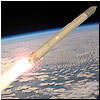
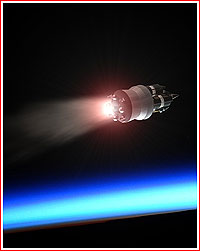
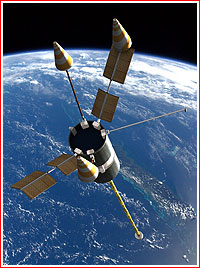
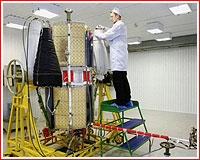
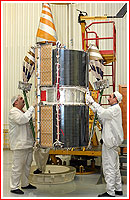
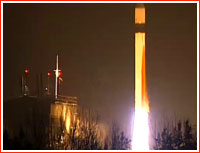
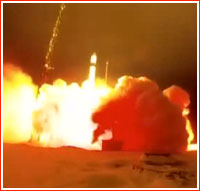
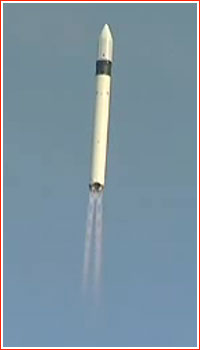
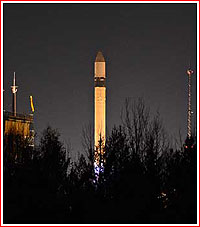
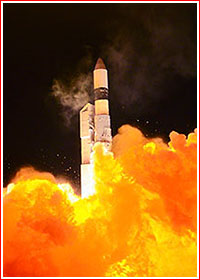
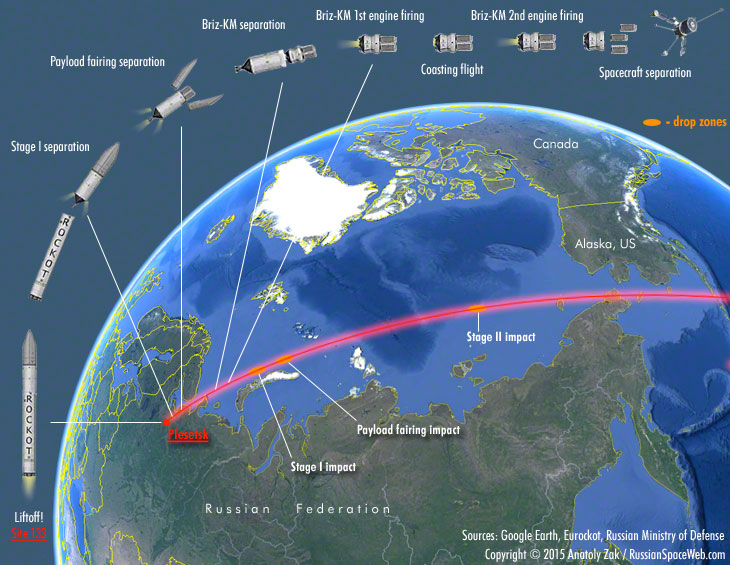
The Rodnik satellite in operational position. Rodnik series In 2005, in connection with a military launch from Plesetsk on December 21, official Russian media disclosed the existence of the Rodnik ("water spring") satellites. The communications network of the same name (possibly designated 14S137) was also associated with Strela-3M (14F132) satellites, which were launched along with their predecessors -- Strela-3. Rodnik satellites were believed to be a military version of the Gonets spacecraft upgrade known as Gonets-M. Each drum-shaped satellite has an estimated mass of 280 kilograms. Rodnik's current launch profile Like all other Rockot missions, Rodnik satellite clusters lift off from Facility 14P25 at Pad 3 at Site 133 in Plesetsk with a vertical launch from a surface-based container. To reach an orbit with an inclination 82.5 degrees, the Rockot booster heads northeast from Plesetsk with an azimuth of 13.7 degrees. The first stage powered by three RD-0233 engines and one RD-0234 engine operates for around two minutes and separates under thrust of small solid-propellant motors at an altitude of around 65 kilometers. It then crashes into the Arctic Ocean, just west of Novaya Zemlya archipelago, more than 1,000 kilometers from the launch site. At the time of the separation, four small RD-0235 vernier engines on the second stage already fire to provide initial acceleration for the vehicle, followed by the ignition of the main RD-0236 engine after the first stage falls away. Shortly thereafter, the payload fairing splits into two halves with the help of 32 pyrotechnic locks and falls away. Five minutes after the liftoff, at an altitude of more than 200 kilometers, the Briz-KM upper stage with its three payloads separates from the second stage, which also fires its breaking solid motors and then reenters the atmosphere and falls into the Arctic Ocean more than 3,700 kilometers downrange. Four seconds later, Briz-KM fires its main engine for about nine minutes in order to reach a 160 by 1,479-kilometer transfer orbit with an inclination 82.5 degrees toward the Equator. The upper stage and its payload then climb passively along its orbit. After the stack reaches the highest point (apogee) of this orbit around an hour later, Briz-KM fires its engine again for about a minute, forming a final circular orbit of the mission at an altitude of 1,500 kilometers above the Earth surface and stretching from the South Pole to the North Pole of the planet. The three satellites separate from the upper stage one hour, 50 minutes after launch. Around 11 minutes later, Briz-KM is programmed to fire its engine for less than two minutes in order to avoid collision with its released payloads.
Rodnik (Strela-3M) missions 2005 Dec. 21: Russian space forces launched a dual payload from the nation's northern cosmodrome in Plesetsk. A Kosmos-3M rocket (No. 232) blasted off from Pad 1 at Site 132 at 22:34 Moscow Time on December 21, 2005, carrying the Gonets-1M ("messenger") low-orbit communications satellite for the Russian government agencies and a classified military payload, which was not given any designation in the official statements immediately following the launch. The unnamed satellite were later identified as belonging to a brand-new Rodnik series and it was given an official name Kosmos-2416. A representative of the Russian space forces said that the rocket had performed flawlessly and the spacecraft had been expected to separate from the rocket at 23:28 Moscow Time, however the milestone could not be confirmed until the payloads entered the communications range with ground control stations at 00:28 Moscow Time on December 22, 2005, or almost two hours after the launch. The mission was previously scheduled to take off on Dec. 15, 2005 and Dec. 20, 2005. 2008 May 23: A converted ballistic missile delivered a cluster of satellites, after a successful launch from Russia's northern cosmodrome. The Rockot booster lifted off from Plesetsk on May 23, 2008, at 19:20:09 Moscow Time. The vehicle carried a trio of Strela-3 (Rodnik) satellites officially identified as Kosmos-2437, Kosmos-2438 and Kosmos-2439, along with the Yubileiny experimental spacecraft. The separation of three Strela satellites from Briz-KM upper stage was scheduled for 21:04:18 Moscow Time on May 23. The separation of the Yubileiny spacecraft was scheduled for 21:05:08 Moscow Time. The maneuver of deorbiting of the Briz-KM upper stage was scheduled between 21:15:15 and 21:16:55 Moscow Time. The launch was previously expected at the end of 2007 and on Feb. 28, 2008. 2009 July 6: Russia launched a trio of military satellites from its northern cosmodrome. The Rockot booster lifted off on July 6, 2009, at 05:26 Moscow Time, carrying three military satellites, according to the official Russian media. The payloads, identified as Kosmos-2451, Kosmos-2452 and Kosmos-2453 were released into their operational orbit at 07:01 Moscow Time. ISS Reshetnev later reported that it was responsible for the development and manufacturing of the triple payload in the mission and that the satellites were designed for military communications. 2010 Sept. 8: Russia launched a converted ballistic missile with a satellite trio from the nation's northern launch site. The Rockot booster lifted off from Plesetsk Cosmodrome on Sept. 8, 2010, at 07:30 Moscow Time. The vehicle carried a Gonets-M No. 12 spacecraft for the Gonets-D1M network, along with two classified payloads - Kosmos-2467 and -2468 -- possibly belonging to the Rodnik series of military satellites. Payloads were scheduled to separate from the Briz-KM upper stage at 09:14 Moscow Time, while vehicles would be in the range of the Russian ground control stations, according to a Russian space forces spokesman. The Russian space agency, Roskosmos, qualified the mission as a success. This launch was previously expected on Dec. 28, 2009, and was later delayed to February, March and Sept. 4, 2010. 2012 July 28: Almost a year and a half after a launch failure, Russia's Rockot booster returned to flight successfully delivering four satellites. The light-weight launcher lifted off on July 28, 2012, at 05:35:34 Moscow Time (01:35 GMT; planned liftoff time was 05:35:00) from Pad 3 at Site 133 in Plesetsk. According to official reports, it carried a pair of Gonets-M communications satellites (No. 13 and No. 14) for the Gonets-D1M multi-function network, MSPSS, and a MiR (Yubileiny-2) remote-sensing spacecraft. A classified military satellite was also announced to be onboard under an official designation Kosmos-2481. According to Russian sources, it belonged to the Strela communications network (17F13) and was similar to civilian Gonets satellites. Russian space agency, Roskosmos, confirmed that both Gonets payloads and MiR successfully reached the orbit, separating from their upper stage at 07:19 Moscow Time on July 28 (planned separation time for MiR was reported to be 07:20:33). For Gonets the operational orbit has an altitude of 1,500 kilometers and an inclination 82.5 degrees toward the Equator. Industry sources confirmed that the first communication session between ground control and MiR (Yubileiny-2) satellite had been conducted successfully. The launch was preliminary planned in December 2011, in March 2012, but it had to be postponed to May 26, June 30, then to July 13 and to July 28. The last two-week delay was caused primarily by issues with avionics onboard Rockot's Briz-KM upper stage. Civilian payload were delivered to Plesetsk on May 28 and the fueling of the launch vehicle was conducted on July 26. 2013 Jan. 15: Russia opened the record of space missions in 2013 with a launch of a converted ballistic missile carrying a trio of military satellites. A Rockot booster equipped with a Briz-KM upper stage lifted off from Pad No. 3 at Site 133 in Plesetsk Cosmodrome on Jan 15, 2013, at 20:24:59 Moscow Time (11:25 EST). The vehicle was carrying a trio of military communications satellites for a constellation believed to be designated Rodnik-S. The spacecraft is the latest incarnation of the Strela series, one of the oldest military satellite families tracing its roots to the 1960s. Rodnik also closely resembles its civilian version - Gonets-M. According to Aleksei Zolotukhin, a representative of Russia's Air and Space Defense Forces, VKO, quoted by RIA Novosti news agency, ground facilities of Titov Chief Testing Center started tracking the Rockot vehicle at 20:28 Moscow Time. The satellites were expected to reach their operational orbit at 22:09 Moscow Time (13:09 EST), Zolotukhin said. The Interfax news agency reported that the Briz-KM upper stage with its payloads successfully reached an initial parking orbit. A second firing of the engine onboard Briz-KM was expected before the release of the satellites into their final orbit. The official Russian media confirmed the successful delivery of the satellites around 22:18 Moscow Time. The satellites were officially designated Kosmos-2482, Kosmos-2483 and Kosmos-2484. However final orbital parameters of the Briz-KM stage indicated that the vehicle had not performed as scheduled. After releasing its payload, Briz-KM apparently never initiated the last pre-programmed firing of its engine, in order to lower the perigee (lowest point of its orbit) and thus accelerate its reentry into the Earth's atmosphere. It was the first space mission involving a beleaguered Briz upper stage, since a similar vehicle nearly doomed a launch of the Proton rocket last year. The success of the latest mission would clear the way to the return to flight for Proton, Russia's commercial workhorse. The latest Rockot mission with Rodnik satellites was previously scheduled for Aug. 17 and Sept. 14, 2012, before the Proton accident in August. It was later expected in October 2012, however by that month it was rescheduled for November 29. The mission was then postponed to December 8, 2012, at 00:34:48 Moscow Summer Time. By Dec. 6, the launch was delayed until Jan. 15, 2013, due to problems with the performance of the flight control avionics onboard Briz-KM upper stage. On Dec. 8, another Proton left Yamal-402 satellite in the wrong orbit following an engine failure onboard Briz-M stage. Rockot was finally rolled out to the launch pad on Jan. 9, 2013. 2013 Dec. 25: According to a representative of the Russian air and space forces, VKO, quoted by the official RIA Novosti news agency, a Rockot booster equipped with a Briz-KM upper stage and carrying several military satellites lifted off on Dec. 25, 2013, at 04:31:54 Moscow Time. A payload section, including Briz-KM and three satellites, separated from the second stage of the launch vehicle and entered an initial orbit at 04:34 Moscow Time. The satellite reached their operational orbit and established communications with ground control at 06:16 Moscow Time. The satellites were officially designated as Kosmos-2488, Kosmos-2489 and Kosmos-2490. In preparation for the liftoff, the launch vehicle was rolled to the launch pad No. 3 at Site 133 in Plesetsk on December 19. According to unofficial sources, the mission had a goal of delivering three satellites for the Rodnik constellation. It was the seventh launch with Rodnik satellites since the introduction of the series in 2005 and the second such mission in 2013. Following the successful launch on December 25, the commander of the Russian air and space forces, VKO, told the Zvezda TV channel of the Russian Ministry of Defense, that three more communications satellites of the same type had been scheduled for launch in the first quarter of 2014. An official note of the Russian government to the United Nations dated May 15, 2014, indicated that four (not three) satellites had been launched on December 25, 2013, into the same orbit. They were designated Kosmos-2488, -2489, -2490 and -2491. Data from a Western radar indicated that mysterious fourth object had made orbital maneuvers! However, in December 2019, Kosmos-2491 had seemingly disintegrated generating 26 detectable objects. 2014 May 23: A converted ballistic missile launched a classified payload for the Russian military. According to the official Russian media quoting a representative of the Russian Air and Space Forces, VKO, Aleksey Zolotukhin, a Rockot booster lifted off from Plesetsk Cosmodrome on May 23, 2014, at 09:27:54 Moscow Time, carrying a cluster of military satellites. Russian ground control stations started tracking the mission at 09:30 Moscow Time and the rocket was scheduled to release its payloads into a planned orbit at 11:12 Moscow Time, Zolotukhin told the official RIA Novosti news agency. The mission likely carried three satellites for the Rodnik communications network. Shortly after the launch, ISS Reshetnev company, which developed Rodnik-type satellites and its civilian version -- Gonets -- announced that three of its satellites had successfully reached their orbits and had established communications with ground control. This was believed to be the eight launch to build and replenish the Rodnik constellation. The three latest satellites were designated Kosmos-2496, -2497, -2498. However, as in the previous such launch on December 25, 2013, the fourth unidentified object was detected orbiting the Earth a few kilometers away from "routine" Rodnik satellites. Moreover, an analysis of orbital elements from the US radar showed that the "ghost" spacecraft made a maneuver between May 29 and May 31, 2014, despite being identified as "debris" (or Object E) in the official US catalog at the time. Ground observations indicated that the unknown satellite had not exceeded 0.3 meters in size. As with the previous launch, observers were at a complete loss about the possible purpose of the satellite. (Full story) 2015 Sept. 24: Breaking with its long tradition of not identifying military payloads prior to their launches, on Sept. 21, 2015, the Russian Ministry of Defense announced that a cluster of Rodnik communications satellites would be launched on the Rockot booster from Plesetsk on Sept. 24, 2015. According to the official Russian media, the liftoff took place at 01:00 Moscow Time (6 p.m. EDT on September 23) and the payload section successfully separated from the second stage of the launch vehicle at 01:05 Moscow Time. The release of the spacecraft was promised in around two hours. (The liftoff actually took place at 00:59:38 Moscow Time.) The successful release of the satellites was officially confirmed shortly after scheduled separation. The Ministry of Defense announced payloads as Kosmos-2507, Kosmos-2508 and Kosmos-2509 and reported that the satellites had been functioning well. Western radar data showed four objects in a typical orbit for the Rodnik series. Unlike three previous missions, which all inserted their payloads into unique orbital planes, the latest mission delivered the Rodnik trio into the same orbital plane with the spacecraft launched on July 6, 2009, and Sept. 8, 2010, suggesting a possible replacement for no-longer functioning vehicles. With the latest launch, the Rodnik satellites occupied four orbital planes separated by 45 degrees each. However counting Gonets-M satellites, the similar spacecraft were now occupying seven out of eight evenly distributed orbital planes. One orbital plane was shared by Gonets and Rodnik satellites.
Russian military launches a fresh satellite cluster Russian military launched a cluster of small communications satellites for its classified orbital network. A Rockot/Briz-KM launcher carrying a trio of Rodnik communications satellites lifted off from Pad 3 at Site 133 in Plesetsk Cosmodrome on Nov. 30, 2018, 05:27 Moscow Time (09:27 EST). Six modernized Rodniks ordered In 2021, publicly available documents from a court proceedings involving ISS Reshetnev revealed that the OKR Klyuch ("water spring") project awarded by the Ministry of Defense on Nov. 16, 2015, just a year after the Russian annexation of Crimea and resulting Western sanctions on the supply of dual-use aerospace components, had funded development of six new Rodnik satellites (No. 29-34), which would be launched in two clusters designated Block 17 and 18. The program envisioned the replacement of imported hardware aboard the Rodnik series with the indigenously developed components and the transfer of their launches from the discontinued Rockot boosters to the Angara-1.2 vehicles. It called for upgrades of the 14K150 satellite communications system aimed to replace imported avionics of the 14R59 onboard radio equipment used on the 14F132 (Rodnik) satellite. The upgrade program also affected the 14Ts32 ground control complex, used to manage the 14F132 satellites and the 14F161 satellites. The lawsuits associated with the Klyuch program were likely initiated by the Ministry of Defense as a standard practice after the contractor failure to deliver the contracted hardware on time. However, in the process of the litigation, ISS Reshetnev demonstrated that the Ministry of Defense had not completed technical specifications for the upgraded payload until May 17, 2019, causing a domino effect of delays in its development. According to the disclosed plans formulated in 2018, the 14S137 trio of satellites (No. 29, 30 and 31), known as Block 17, was scheduled to be delivered to the launch site between the end of 2019 and the beginning of 2020. The subsequent contract, dated July 2, 2021, called for the delivery of Rodnik No. 29 by April 30, 2023, followed by the shipment of spacecraft No. 30 and 31 and their integration into the three-satellite cluster No. 17 by May 26, 2023, and concluded with the delivery to a launch site by Aug. 30, 2023. By the same date, the satellites No. 32, 33 and 34 had to be delivered and integrated into the 14S137 cluster.
Launches of the Rodnik (Strela-3M) series:
Specifications of the Rodnik (Strela-3M/14F132) satellites (deriving from available information on Gonets-M):
|

|