|
Read more on:
...or on:
...or on:
See also:
Related pages:
Searching for details: The author of this page will appreciate comments, corrections and imagery related to the subject. Please contact Anatoly Zak. Acknowledgments: Author would like to thank Dwayne Day for his help in preparing this section. |
Preparing for flight: Events of 2008 After almost a decade of being a "paper project," Phobos-Grunt had finally received its first substantial funding (40 million rubles) in 2007. (327) By the beginning of 2008, the Phobos-Grunt project was in an active development stage, with engineering versions of scientific instruments and the main spacecraft bus being manufactured. Funding levels remained on track, however increased costs of some components and "snowballing" mission tasks, particularly the addition of the Chinese micro-satellite and a Finnish Mars lander, led to some cost overruns. (282) According to Lev Zeleny, Director of the Space Research Institute, IKI, a funding adjustment was made to the Federal Space Program in March-April 2008 for a shortfall in the Phobos-Grunt project. (285) As of 2008, the price tag on the project was expected to reach 2.4 billion rubles by 2012 (299):
As of May 2008, NPO Lavochkin's documents showed that following elements of the spacecraft had been manufactured:
Despite skepticism expressed privately by the participants in the project and by some outsiders, Russian space officials insisted Phobos-Grunt would fly in 2009. At a high-level agency meeting in January 2008, Director General of NPO Lavochkin Georgy Poleshyuk confirmed one more time that the spacecraft was set for launch in 2009. "We haven't have any discussions (about delaying the mission)," Poleshyuk told RussianSpaceWeb.com in May 2008, "Work proceeds strictly on schedule." According to Poleshyuk and other officials, the project had to reach the following milestones to enable its launch in 2009:
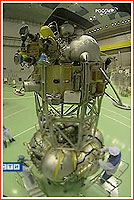
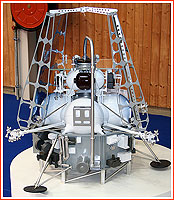
Challenges to launch schedule The head of Lavochkin Georgy Poleshyuk identified the integration of the Chinese micro-satellite, the development of the ground control tracking complex and the development of scientific payloads as the most critical aspects of work for achieving a launch on time. (283) Unofficial sources familiar with the project also described serious problems with the development of the spacecraft's onboard flight control system, BKU, and its operating software. The system's memory reportedly lacked capacity and required parameters for memory access could not be achieved. During 2008, the work on complex avionics, which would control the spacecraft and its vast array of scientific instruments, reportedly lagged behind schedule and its hardware did not meet the project specifications and reliability standards. The valves controlling the propellant lines repeatedly failed during tests, a source said. Thermal control and electrical compatibility of various systems apparently presented a challenge as well. As with many other projects, the situation was also hampered by the exodus of qualified specialists from the industry and from educational institutions supplying new cadre in the field of automated control systems. If history is any guide, it could be very late in the game, when it would become clear that a postponement to 2011 was necessary. The previous ill-fated mission to the Red Planet -- Mars-96 -- was originally scheduled for launch at the end of 1994. However by April 1994, all of the participants learned that it had to be delayed to 1996. (284) The mission ultimately failed during launch in 1996. On Oct. 29, 2008, NPO Lavochkin published an official press release stating that the development of the spacecraft had continued on schedule. Working and operational documentation had been finalized and autonomous tests of key elements of the spacecraft had been completed, the statement said. According to Lavochkin, the testing of the spacecraft's systems had being continuing at the the integrated onboard systems stand. In the meantime, the assembly of a mockup for vibration and static tests had entered final stage and the system assembly of the flight version of the spacecraft was going on, Lavochkin said. Cooperation on ExoMars During 2007, reports surfaced about the possibility of using Phobos-Grunt to relay telemetry from the European ExoMars rover, which was expected to land on the surface of Mars. The idea apparently involved installation of a European relay system onboard Phobos-Grunt. However, the plan was met by many skeptics on both sides, since Phobos-Grunt was expected to fly in 2009-2011 and ExoMars in 2013. Few believed that Phobos-Grunt would be still alive, by the time of ExoMars' scheduled landing attempt on the surface of the Red Planet in July 2015. In addition, Phobos was not the best spot for a relay station. Nevertheless, on June 24, 2008, the Russian space agency, Roskosmos, announced that during a meeting in Paris on Russian-EU cooperation in space, the two sides had agreed to use the communications payload onboard Phobos-Grunt, "taking into account the possibility of upgrades of the Phobos-Grunt communications systems for the purpose of the ExoMars mission support." In return, the European Space Agency, ESA, agreed to provide its ground control network for telemetry, tracking and flight control needs of the Phobos-Grunt mission, Roskosmos said. ESA also helped to plan the Phobos-Grunt mission by snapping high-resolution images of potential landing sites on Phobos. On July 23, 2008, the agency's Mars Express passed as close as 97 kilometers from the moon, acquiring the most detailed images to date of its battered surface. Preparation of the scientific payload During 2008, Moscow-based Space Research Institute, IKI, (responsible for the scientific payload package, KNA, of the Phobos-Grunt spacecraft), completed the manufacturing of technological prototypes of all scientific instruments. All that hardware had been checked on a newly constructed test stand at IKI before being transferred to NPO Lavochkin for further tests with the actual spacecraft bus, the institute's documents showed. Also in 2008, IKI reported the start of the manufacturing of scientific instruments for qualification tests and for the actual mission. However there was no word on the completing the flight-worthy scientific payload by the end of 2008, in order to maintain the 2009 launch date. By the end of 2008, IKI also reported that it was continuing the development of the ground control complex for the Phobos-Grunt project, clearly an indication that it would not be ready to support the mission in 2009. In the meantime, the TIMM and DIAMOND instruments developed in cooperation with the Italian Space Agency could not be built, as the Italian Space Agency failed to provide funding, IKI documents said. However according to Russian officials, at least part of French scientific hardware had been delivered as of February 2009. The Finnish Meteorological Institute, FMI, which cooperated with IKI on the development of the MMS meteorological probe to be deployed on the surface of Mars, also informed its Russian partner that due to funding delays, it would not be able to deliver the vehicle in 2009. However, FMI promised to supply the probe for the 2011 launch window, which by that time seemed the only realistic launch date for Phobos-Grunt. In December 2008, Russia and Finland planned to sign a new contract for the continuation of cooperation on the MMS project. In the meantime, a technological prototype of the Chinese spacecraft, which had to catch a ride with Phobos-Grunt to the orbit of Mars had been delivered to NPO Lavochkin in October or November 2008, the officials involved in the project said. A the time, the delivery of the flight version of the spacecraft was expected in June 2009. 2009: Moment of truth In January 2009, several Russian TV channels run a footage of the Phobos-Grunt spacecraft being assembled at NPO Lavochkin facility in Khimki. For the first time, a newly added truss, designed to accommodate a Chinese "hitchhiker" satellite, was shown being integrated into the structure of the vehicle. The head of the organization, Georgy Poleshyuk, appeared on screen, admitting that the spacecraft's preparation schedule was very tight and that work on the project was now conducted in two shifts. Poleshyuk however still told to an increasingly skeptical audience that Phobos-Grunt would fly in 2009. In April 2009, Francis Rocard, who led French participation in the Phobos-Grunt project said that he was expecting an official announcement about a delay of the mission that month, as soon as the Russian space budget for the year was finalized. The announcement of the delay after the budget approval would ensure funding within a current financial period. According to sources within the industry, around April 21, 2009, Anatoly Shilov, a newly appointed deputy chief of Roskosmos, visited NPO Lavochkin to familiarize himself with the state of the company's projects which were slated for launch in 2009. At the time, NPO Lavochkin could only demonstrate an unfinished return module and four avionics boxes for the flight control system. The main cruise stage of the vehicle was still not available for assembly. However, despite all unofficial reports about the inevitable delay of the mission, the Russian space agency was adamant that Phobos-Grunt would lift off on time. Instead of a widely anticipated announcement about the postponement of the mission in April, Roskosmos and NPO Lavochkin published press-releases on May 5, confirming the launch in 2009. On April 28, 2009, the official RIA Novosti news agency announced that the State Commission for Radio Frequencies, GKRCh, had allocated a range of frequencies for the development, manufacturing and use of radio-electronics within the Phobos-Grunt program. In mid-May, the head of NPO Lavochkin Georgy Poleshyuk traveled to China, as was assumed, to discuss the work on the Phobos-Grunt. He then met with reporters in Plesetsk, where he attended the launch of the Meridian military satellite on May 22. (The satellite was powered by Lavochkin-built Fregat upper stage.) According to Poleshyuk, China had already chartered a plane for the June 17 delivery of its microsatellite, that was to hitchhike Phobos-Grunt to Mars. By the same date, the probe's Flagman main propulsion unit, cruise stage and the soil return vehicle were to be delivered, Poleshyuk said. Phobos-Grunt's final integration to start despite tight schedule On June 15, 2009, Georgy Poleshyuk, the head of NPO Lavochkin attended the opening of the Paris Air and Space Show in Le Bourget, France. There, he told the editor of this web site, that despite a very tight schedule, all major components of the Phobos-Grunt spacecraft were ready for final integration within days. "This year, we have a very busy program of 11 launches, including five scientific spacecraft, among them Radioastron and a geostationary meteorological satellite, however Phobos-Grunt is our number one priority," Poleshyuk said, "From June 17, all major components of the spacecraft have to be delivered to the assembly facility and the final integration of the spacecraft will start beginning on June 20." According to Poleshyuk, the main propulsion unit of the probe was the most complex and critical element affecting the schedule. Known as the Flagman cruise stage, the propulsion system was newly developed for the Phobos-Grunt mission and it was also expected to be employed onboard Luna-Glob and Luna-Resurs spacecraft in 2011. According to Poleshyuk, Flagman had gone through autonomous tests and was also expected to be ready for integration on June 20. In turn, the cruise stage and the main propulsion unit were to be connected by a special truss designed to accommodate the Chinese micro-satellite. Poleshyuk said that the truss and all related interfaces had been also tested and were scheduled for delivery on June 17. The Chinese spacecraft itself was to arrive to Russia on June 18 and had to be available for pre-launch processing on June 20. "Everything now depends on the success of integrated testing ("kompleksnye ispytaniya" in Russian) (of the flight vehicle)," Poleshyuk said, "As of now, we can meet the schedule on the condition of working in two shifts and we have no shortage of workforce to do that. Our last resort is to switch to a three-shift work." According to Poleshyuk, the completion of integrated testing would clear the way to the final processing of the spacecraft and its shipment to the Baikonur cosmodrome in September 2009. Poleshyuk vehemently denied the existence of any political pressure on him or his team to launch Phobos-Grunt on time and said that he would not hesitate to ground a vehicle which did not go through the full cycle of pre-flight testing set three years before. "It would not be a tragedy either for the world or for the country," Poleshyuk said. He reminded that a number of Mars missions had been recently postponed. "If something serious happens during the tests, and I do not exclude that something like that could happen, however now we are preparing for launch... We do have delays with some of 22 scientific instruments, however for the exception of a soil-sampling mechanism they are not critical to the mission," Poleshyuk said, "If some of them are not ready, we can make the decision to drop them, however, as of now, we are working toward a complete scientific package onboard." Asked about level of confidence in the reliability of probe's new systems, Poleshyuk said that Phobos-Grunt carries a great deal of components inherited from previous operational spacecraft. "The main propulsion system had been tested in flight," Poleshyuk said, "and the main flight control system was working not only on our (NPO Lavochkin's) vehicles, but also on RKK Energia's spacecraft." Poleshyuk admitted that some aspects of the mission had never been attempted before and others had not been undertaken by NPO Lavochkin since the Soviet period. Poleshyuk also expressed confidence in the availability of the rocket on time for launch in 2009. He said that the launch vehicle was already at the launch site, even though, according to the Russian space agency, the only Zenit-2SB rocket delivered to Baikonur recently was designated for a "scientific spacecraft," namely the Radioastron orbital telescope. Poleshyuk explained that despite the fact that two other missions (Radioastron and Elektro) were scheduled to fly before Phobos-Grunt, the priority of the latter mission demanded a change in plans. "We "repainted" the rocket, which is currently in Baikonur, for Phobos," Poleshyuk said, "however before the launch we will have a second launch vehicle in Baikonur as a backup." Military support, Chinese satellite delivery to Russia approved On June 25, 2009, the chairman of the Russian government Vladimir Putin signed order No. 869-r formally approving the use of military personnel and facilities for the launch of the Chinese YH-1 spacecraft onboard the Phobos-Grunt spacecraft. The same document also directed the Russian federal customs service to lift taxes, custom fees and any other restrictions on the import of the YH-1 spacecraft and supporting hardware into Russian territory. Testing of landing radar for Phobos-Grunt On Aug 12, 2009, at the Flight Research Institute, LII, a piloted hot-air balloon lifted a test version of the DISD-FG landing radar for the Phobos-Grunt spacecraft. According to a posting on the LiveJournal.com web site, it was the first in a series of hot-air balloon flights scheduled to reach as high as 3,000 meters. The program was conducted by the Avgur airship center under a contract with the Vega enterprise which developed the DISD-FG radar. Vega's representatives said that hot-air balloon flights had provided an ideal simulation of weightlessness during the space flight. Nikolai Galkin, Avgur's balloon pilot, was at the control during the ascent. NPO Lavochkin finally presented an accurate scale model of the Phobos-Grunt spacecraft at Moscow air and space show in August 2009, complete with a truss to accommodate a Chinese YH-1 microsatellite. Despite there being only a couple of months left before the opening of the launch window to Mars in 2009, and continuous rumors about an imminent delay of the mission, Russian space officials remained defiant. A photo apparently showing Phobos-Grunt during assembly was seen at Lavochkin's exhibit. Although it was apparently displayed to high-ranking Russian officials at the opening of the event, the company's representatives refused journalists' requests to get a copy or even photograph the image with digital cameras. It is possible that examination of the photograph could have revealed the lack of readiness of the spacecraft. Judgment week for Phobos-Grunt At the beginning of September 2009, the latest official schedule (which few believed was anywhere close to being realistic), called for the Phobos-Grunt spacecraft to be shipped to Baikonur on Sept. 25, 2009. The resulting launch date apparently slipped to the beginning of November. It was outside of the 2009 launch window to Mars, which was to close around October 25. It was unclear how such move could affect the mission if it had any real chance to take off. It was possible, the removal of scientific instruments from the spacecraft would be required. However it was a moot point, since space officials had to certify results of integrated tests, which had been conducted on the Phobos-Grunt spacecraft since July 2009. On Sept. 14, 2009, less than two months before its scheduled launch, based on reporting by the editor of this web site, the BBC announced that key officials in the project would recommend delaying the mission to 2011. The Russian space agency, Roskosmos, was expected to officially decide the fate of the project within a week and officially announce a delay on the week of September 20. On Sept. 16, 2009, the semi-official Interfax news agency confirmed RussianSpaceWeb.com's and BBC's reporting on the inevitable delay. A flurry of Russian reports followed, including a quote from the director of the Space Research Institute, IKI, Lev Zeleny, saying that the decision to postpone Phobos-Grunt had been made. On September 21, 2009, non-Russian participants in the Phobos-Grunt project received an e-mail from Zeleny announcing the delay. "Russian Academy of Sciences and Roskosmos came to a decision today to postpone the launch of the PhSRM (Phobos-Grunt sample return mission) to 2011," Zeleny wrote, "The Phobos-Soil flight spacecraft and science payload manufactured and integrated. During last three months the spacecraft was under the tests in the Lavochkin association. The main reason of the decision to postpone the launch is to hold additional tests of the spacecraft and its systems to increase reliability of the mission." [sic] However an official announcement of the Russian space agency and the Russian Academy of Sciences expected around September 22 never came. Instead, on September 29, 2009, the agency's web site ran a long interview of its head with the official Rossiskaya Gazeta. In it, Perminov referred to the Bureau Council of the Russian Academy of Sciences as recommending a delay to improve the reliability of the mission. "Scientists hope to clarify the character of the Phobos surface," Perminov said, "this is required for better design of the soil-sampling device." He then added that the reliability of backup communications with the spacecraft had not yet reached 100 percent and more thorough testing of components had been required. The publication did not explain how all these problems could crop up just two months before launch, in the midst of official bragging about the upcoming mission in 2009 and all the fanfare in the government controlled media. Real reasons behind Phobos-Grunt problems Skeptics, who had been proven right in calling the 2009 launch date impossible for years, did not buy the latest official explanations. According to sources within the industry, the main and overwhelming reason that kept Phobos-Grunt on the ground was an early decision by Lavochkin to develop its onboard flight control system, BKU, in-house. Perhaps as a combination of personal ambitions and a desire to maximize government funding, Lavochkin management rejected its traditional subcontractor -- OKB Mars -- as the primary developer of BKU. Instead, a relatively new and inexperienced team at Lavochkin was put in charge of the BKU integration and its software development. Proponents of the new arrangement argued that they could put together a lighter and more robust flight control system than the one offered by OKB Mars. The brand-new BKU for Phobos-Grunt and follow-on planetary missions would be based on components developed by Moscow-based Tekhkom. The relatively new company was a spinoff of NPO Argon, a long-time developer of onboard computers for Russian manned spacecraft. Tekhkom did deliver its promised components with fairly good capabilities and progressive technologies, however Lavochkin's own team struggled to integrate BKU and to write software for it. Although individual elements of BKU had been tested, the fully integrated flight control system had never gone through a complete flight sequence of the Phobos-Grunt mission before the 2009 launch attempt was finally called off. Without a major reorganization of the flight control system development, Phobos-Grunt could still not be ready for the 2011 launch, critics of the project warned. To make matters worse, the overall state of the Phobos-Grunt project had never been anywhere near readiness in 2009, with many critical tests, normally conducted many months or even a year before launch, now crowded into a narrow window from July to September 2009. A key thermal test, aimed to put the spacecraft under the rigors of extreme temperatures in space had to be delayed until the middle of September 2009, months behind schedule. A week earlier, a last-minute attempt to test the touchdown of the lander on Phobos ended with the spacecraft’s landing gear folding under its own weight and threatening to hit the surface of the Martian moon with the bottom of the vehicle... Pressing reset button One "benign" reason which could explain the reluctance of Russian officials to admit the impossibility of a launch in 2009 could be efforts to keep money flowing into the project for as long as possible. Once the delay to 2011 became official, the government could start channeling funding toward more pressing needs. Whether this strategy worked remained to be seen; however a few weeks after the "official" delay of the 2009 launch, reports surfaced about ongoing preparations for thermal, vacuum and electrical testing of the Phobos-Grunt prototype at the NIIKhIMMash facility in Peresvet, north of Moscow. As of the beginning of October 2009, crews in Peresvet were reportedly installing thermal protection blankets onto the prototype. In the meantime, the actual flight vehicle at NPO Lavochkin in Khimki was largely dismantled as soon as the 2009 launch attempt was called off, posters on the web forum of the Novosti Kosmonavtiki magazine said. Given two extra years for upgrades and tests, developers of science payloads and system subcontractors removed their hardware, some of which was only "nominally" ready for flight and would have never made it onboard if Phobos-Grunt had had a real chance to fly in 2009. The Chinese YH-1 hitchhiker satellites, whose delivery from China was advertised as a major milestone in the preparation of the Phobos-Grunt mission, was also shipped back home. Too heavy for 2011? While spacecraft developers got an almost two-year reprieve to sort out problems, mission planners faced a new problem presented by the heavens. Due to the ballistic conditions of the 2011 launch window, the Phobos-Grunt would end up around 150 kilograms "overweight" for the lifting capabilities of the Zenit rocket. Unless some weight-saving measures were implemented on the spacecraft, it could be required to ride into space onboard the more powerful, but more expensive Proton rocket. Developers also faced possible funding issues, as the Russian space science budget was likely to remain fixed and even the relatively modest extra money needed to cover the Phobos-Grunt delay had to come from somewhere. According to experts in the program, the budget for Russia's upcoming astrophysics missions was untouchable, therefore the only "basket" which could provide extra funds would be follow-on missions to the Moon and a barely funded Venera-D project. Next chapter: Phobos-Grunt project in 2010
Page author: Anatoly Zak; Last update: June 13, 2011 Page editor: Alain Chabot; Last edit: March 18, 2011 All rights reserved |
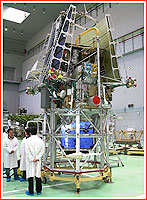
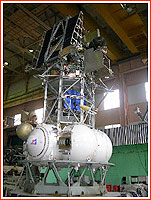
PICTURE GALLERY Below - Test prototypes of the Phobos-Grunt spacecraft:
A structural mockup of the probe
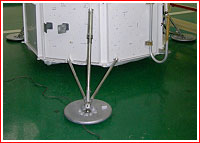
A prototype for tests of landing on Phobos.
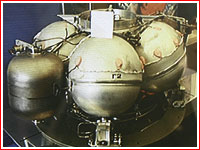
The propulsion assembly of the prototype cruise stage designed for live test firings. Click to enlarge
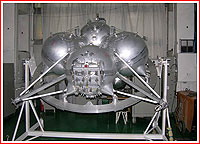
The propulsion assembly of the return rocket in the Phobos-Grunt project. Click to enlarge
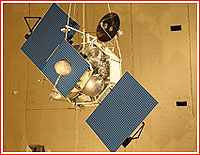
A mockup for antenna testing onboard Phobos-Grunt
The head of NPO Lavochkin, Georgy Poleshyuk (left), with his Chinese colleague posing in front of the Phobos-Grunt spacecraft in July 2008. Note that the spacecraft still lacks a truss adapter to accommodate the Chinese vehicle. Click to enlarge. Credit: NPO Lavochkin
A development prototype of the Phobos-Grunt spacecraft as it appeared in January 2009. Note a truss adapter to accommodate the Chinese vehicle. Click to enlarge. Credit: Vesti
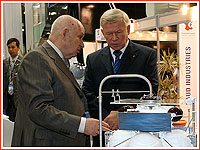
Designer General of NPO Lavochkin, Georgy Poleshyuk (left), talks to the head of the Russian space agency, Anatoly Perminov, next to a scale model of the Phobos-Grunt spacecraft at the formal opening of the Paris Air and Space Show in Le Bourget on June 15, 2009. Click to enlarge. Copyright © 2009 Anatoly Zak
A scale model of the Phobos-Grunt spacecraft, which was demonstrated at the Paris Air Space show in Le Bourget in June 2009. Apparently, it reflected the latest design of the lander and the return vehicle. Click to enlarge. Copyright © 2009 Anatoly Zak
A scale model presented at Moscow air and space show in August 2009 finally accurately depicted the Phobos-Grunt spacecraft, just a couple of months before its promised launch. Click to enlarge. Copyright © 2009 Anatoly Zak
Click to enlarge. Credit: IKI
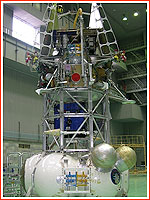
A photo from circa 2009 apparently shows work on integration of the Phobos-Grunt probe with the Chinese YH-1 spacecraft. Click to enlarge. Credit: IKI
A prototype of the Phobos-Grunt spacecraft is undergoing vibration and dynamics tests during 2009. Click to enlarge. Credit: NPO Lavochkin
Click to enlarge. Credit: NITs RKP
A prototype of the Phobos-Grunt spacecraft is lowered into a thermal testing chamber at NITs RKP center in the second half of 2009. Click to enlarge. Credit: NITs RKT |

|