|
  
|
The Core Module
On February 20, 1986, the UR-500K (Proton) rocket launched the core module the space station called Mir, which can be translated as "peace" or "world." The official Soviet news reports, released immediately after the launch, said that the spacecraft had been equipped with six docking ports and it would serve as a core of the future multi-modular orbital station.
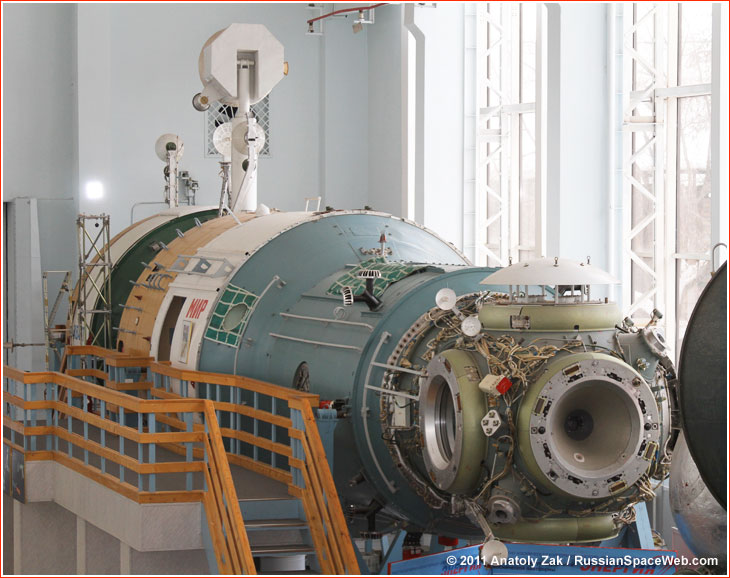
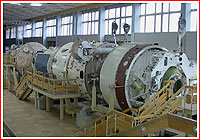
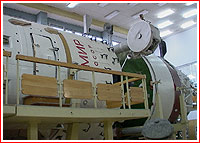
Ground copy of Mir's core module (foreground) and the Kvant-1 module. Core Module, 17KS No. 12701, of the Mir space station at a glance:
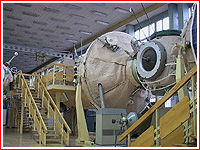
According to Roskosmos, the development work on the Mir orbital complex began in 1976 and involved 280 organizations with 20 different Soviet ministries. Structurally, the core module, known in the industry by its production designation, 17KS, descended directly from the previous Soviet space stations -- Salyut-6 and Salyut-7. Like its predecessors, it was sized as a 20-ton class payload of the UR-500K (Proton) rocket and to fit under its fairing. As before, it was comprized of four isolated compartments: the Transfer Compartment, PKhO, in the front, followed by the main Work Compartment, RO, and concuded with the Transfer Chamber, PrK, carrying the aft docking port. In turn, the PrK, was surrounded by unpressurized Aggregate Compartment, AO, exactly as it was done on Salyut-6 and Salyut-7. However, the PKhO and RO compartments were drastically re-designed. Since most of the payload of the future station was expected to be placed onboard "add-on" modules, the core itself was freed from a huge science instrument section, which used to fill most of the volume inside all previous Salyut labs. Newly available space on Mir's core was used to fit two tiny but comfortable crewmember cabins, each featuring a window! The front section of the module, known as Transfer Compartment, PKhO, was also completely redesigned. Instead of a combination of a cylinder and a cone airlock with a single docking port on all Salyuts, Mir's core had a spherical section with one passve axial port for arriving and departing vehicles and four peripheral passive ports for permanent attachments of add-on modules. At launch, only main axial port and one peripheral port were equipped with cone reseptacles of the SSVP system, while three others had temporary covers, thus saving considerable mass for the overall system and freeing precious volume inside the cramped PKhO compartment for airlock operations. The plan was to move one passive receptacle from one port to another, as the assembly of the station progressed and new modules were added to their permanent positions on the peripheral ports one by one. For that purpose, there were two attachment points on the exterior of the PKhO compartment, which would be used by a special mechanical arm on each arriving module to rotate and move themselves from the initial docking position on the axial port to the permanent position on the peripheral port. The system also allowed the reverse movement of the modules from the peripheral port to the main port, if necessary. The Soviet sources reported that a number of computers was increased from one aboard Salyut-7 to seven machines on Mir. The Mir's launch also marked the new approach to the informational policy in space. The launch of the first crew onboard Mir was announced in advance, the first case in the Soviet spaceflight, which did not involve foreign cosmonauts. 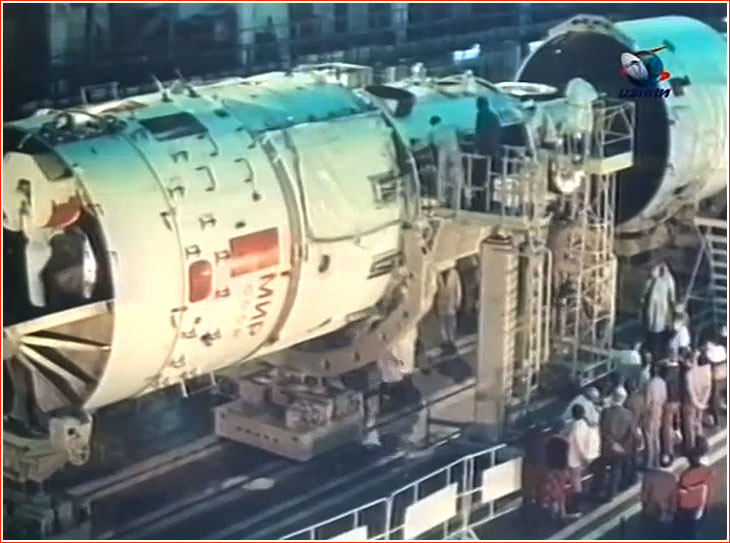
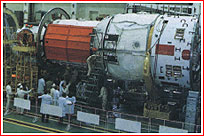
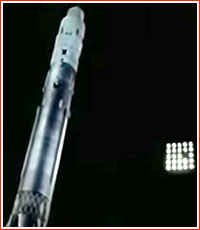
The flight version of the core module of the Mir space station during integration with the payload fairing of its Proton-K rocket in Tyuratam. Two months after the core was launched, Konstantin Feoktistov, the veteran of the Soviet space program gave many hints about the new station's design in the interview to Izvestia. (88) In particular, Feoktistov said that in the future during further deployment of the station, there would be a possibility to employ new systems, which would considerably save onboard propellant. Obviously, he meant onboard gyrodines, which would arrive in the following years onboard Kvant-1 and Kvant-2 modules. Feoktistov also hinted that the core module could be equipped with additional solar panels and that more effective life-support systems were installed onboard. (Feoktistov apparently referred to the new Elektron oxygen-production system, which breaks down water into hydrogen and oxygen.) As it transpired later, the core module received a pair of larger, newly designed solar panels, instead of three panels on the preivous Salyuts. There was also a rotating mechnism for the third panel installed on the core module, but it was intended to be used by a specially designed deployable panel to be installed by spacewalking cosmonauts. To support this work, a set of handrails was installed on the exterior of the core module, leading from the Transfer Compartment, PKhO, (to be initially used as an airlock), to the third rotating mechanism. Wet towels, the main personal hygiene method on the previous stations was expected to be replaced with a special sink equipped with a system to pump in and remove water. Finally, the Soviet sources disclosed that Kosmos-1700 satellite, a.k.a. Luch (Beam), launched ahead of the core module, would be used to relay communications from Mir to the ground control stations. Reportedly, during each orbit the station had a 40-minute window, during which a special antenna installed on the tail section of the core module could "see" the relay sat. 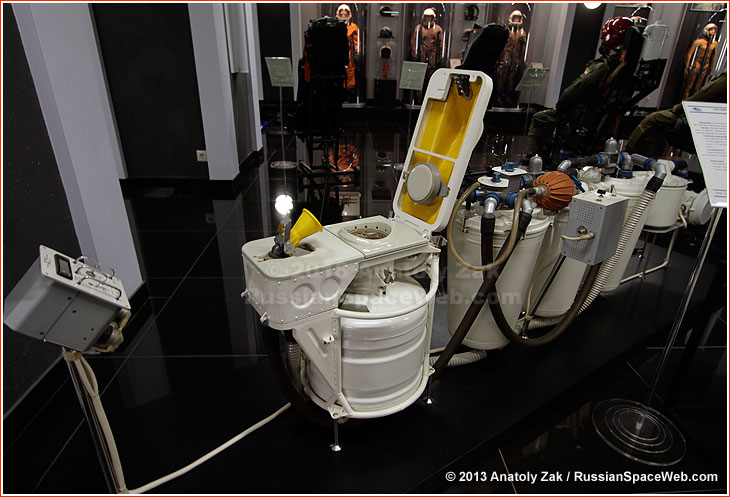
The ASU-8A toilet system was used aboard the Mir space station. Propulsion system The integrated propulsion system, ODU, for the core module of the Mir space station and the future service module of the International Space Station consisted of two orbit-correction engines, KD, designated S5.79 with a thrust of 300 kilograms each and 32 small thrusters, DMT, designated 11D428A-10 and developed at NIIMash with a thrust of 12.5 kilograms each and designed to control course, yaw and bank movements of the module. All these engines would be fed from four tanks with two tanks for oxidizer and two for fuel. Nitrogen gas was used for the pressurization of the tanks. On Nov. 19, 1985, NIIKhimmash test center started firing and corrosion tests of the 7P17KS EU500 test article of the propulsion system for the core module at 4A bench of IS-104 test facility. On Oct. 23, 1997, NIIKhimmash started same type of tests on the 8P17KS EU917 article representing the propulsion system of the Zvezda service module. It was conducted at the 4E bench of the IS-104 facility. In addition to endurance testing, the prototype was used to confirm the possibility of firing orbit correction engines aboard the Progress cargo ship, while feeding it with propellant from the service module. On Oct. 3, 2012, the 40th engine firing of the Zvezda's propulsion test unit was conducted.
|
|
||||||||||||||||||

|