| |
|
|
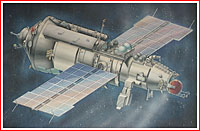
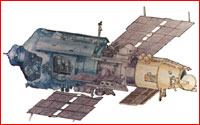
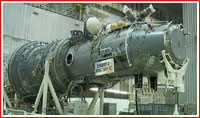
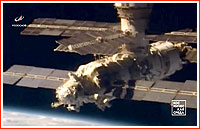
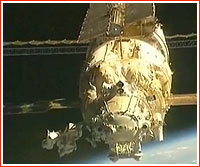
Mir's Kvant-2 module Kvant-2, launched in 1989, was the first of the four Mir modules based on a TKS transport spacecraft. The TKS was developed in the 1970s for the Almaz military orbital station. After the Almaz program had been abandoned in 1981, KB Salyut, the TKS developer, convinced the Soviet leadership to use the hardware from Almaz program for yet-to-be-launched Salyut-7 and Mir space stations.
Kvant-2 module (77KSD) at a glance:
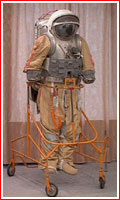
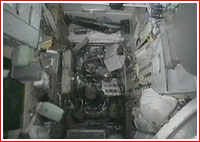
The TKS-based modules would replace the original design of add-on modules known as Series 37. Unlike "self-propelled" TKS-based module, the spacecraft from Series 37, required a space tug, which would deliver it from the initial orbit to the station. The government the approved the initiative by KB Salyut, despite objections from NPO Energia, the Mir's developer. NPO Energia leadership insisted that the TKS ships were oversized, and not very well suited for the role. Instead, NPO Energia proposed its own design of the modules. They would be delivered to the station by a yet-to-be-developed space tug, which borrowed its propulsion system from the core module. Yet, the government approved the KB Salyut plan. The letter "D" in the designation 77KSD stands for Russian "do-osnasheniya," which essentially means "to equip to a full extent." The Kvant-2 mission was to add a second set of gyrodines to Mir, which unlike those installed inside Kvant-1 module, were mounted on the exterior of the module. According to NPO Energia, this proved to be the wrong decision, since the replacement of the failing gyrodines turned out to be much more difficult than those in Kvant-1. Kvant-2 was also carrying new life-support systems for recycling water and generating oxygen onboard the station, which would reduce the dependence of the orbital lab from the ground. The Kvant-2 was subdivided into three sections isolated from each other by hatches. One section was a large airlock featuring a one-meter hatch, opening outward. A special backpack unit, an equivalent of NASA's Manned Maneuvering Unit, MMU, was located inside Kvant-2's airlock. It was expected to be used during EVA's, particularly during Buran missions to Mir. Among other payloads, Kvant-2 was carrying a rotating platform for cameras and scientific instruments, which could be controlled by the crew or controllers from the ground and an Incubator-2 unit for life science experiments. The propulsion system onboard Kvant-2 featured small 11D458 and 17D58E thrusters developed at NIIMash.
|
|

|