| |
 
|
||||||||||||||
|
Docking
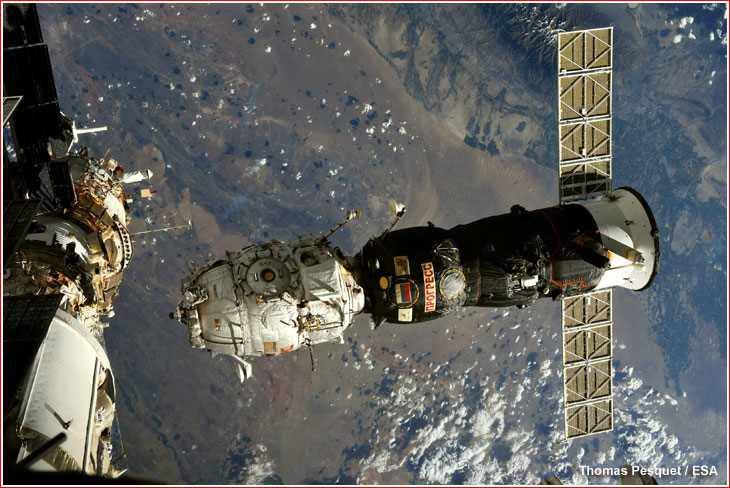
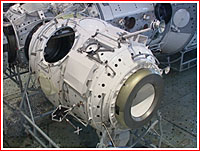
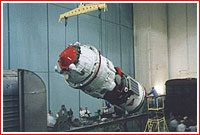
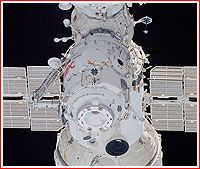
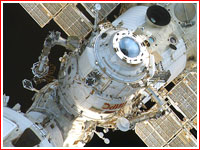
Compartment, SO1, The Docking Compartment, also known as Pirs ("Pier") or SO1 from the Russian Stykovochny Otsek-1, provides the docking location for transport ships visiting the Russian Segment of the the International Space Station, ISS, and also serves as an airlock for spacewalks on the exterior of the outpost.
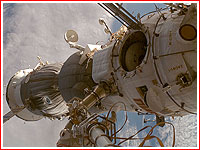
An isolated view of the Docking Compartment and the Mini-Research Module-2 in orbital configuration.
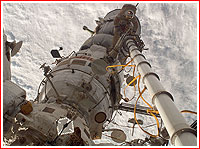
The Pirs Docking Compartment, SO1, was eventually re-purposed for docking at the nadir (Earth-facing) port of the Zvezda Service Module, SM, of the International Space Station. In addition to a pair of docking mechanisms on opposite ends of the cylindrical body, the module has two side hatches with a diameter of one meter allowing spacesuited cosmonauts to exit and return to the Russian Segment of the ISS. (NASA developed its own, larger airlock for the US segment of the outpost.) With the addition of the first Docking Compartment, Russian transport ships received the third docking port on the ISS. Prior to its arrival, Soyuz and Progress vehicles could dock either to the aft port of the Zvezda service module, or to the Earth-facing (nadir) port of the Zarya FGB control module. Two other existing docking ports onboard the Zvezda module (so-called zenith and nadir ports) had the interface designed for larger and heavier modules, not compatible with the standard hardware normally installed on the Soyuz spacecraft. With only two regular docking ports available on the Russian segment, Progress supply ships had to be undocked from the station every time a fresh Soyuz spacecraft arrived at the ISS to replace its older predecessor. (At least one Soyuz had always had to be present at the station at all times to support permanent presence of three crew members.) After the Soyuz exchange was completed, the Progress cargo ship has to be either discarded or redocked to the station with the use of the TORU remote-control system operated manually from inside the ISS. In 1997, the Progress slammed into the Mir space station during the docking exercise with the use of the TORU remote control -- the accident, which could cost the Mir crew its life. With the Docking Compartment-1, occupying the Earth-facing nadir port of the Zvezda module, the incoming Soyuz spacecraft was able to dock to the compartment's free Earth-facing port. On its way to the station, the Docking Compartment served as a cargo spacecraft, delivering the third spacesuit and the second Strela deployable boom designed to facilitate spacewalking operations, EVAs, on the station's exterior. Finally, additional supplies and consumables needed by the crew at the time of the module's launch were loaded in the remaining available volume inside the spacecraft. RKK Energia in Korolev originally developed the Docking Compartment as one of the elements of the Mir-2 space station, the Russian successor to Mir. With the merger of the Mir-2 and Freedom projects in 1993, the Docking Compartment became the part of the Russian segment of the ISS. As several other Mir-2 modules, the Docking Compartment was designed to maneuver in orbit and dock with the station with the help of the instrument and propulsion section, PAO, borrowed from the Progress cargo ship. Combined with the PAO section, the Docking Compartment-1 fit under a standard payload fairing of the Soyuz launcher. The maximum diameter of the module did not exceed 2.2 meters -- standard for the Progress spacecraft. After the Docking Compartment arrived at the ISS, the PAO section of the module was designed to jettison to expose the standard passive docking port on the spacecraft intended for the incoming Soyuz crew vehicles. According to the original assembly plan of the International Space Station, the Docking Compartment-1 was be eventually replaced with a much larger Universal Docking Module, USM. Launched by a Proton rocket, the USM was to provide life-support capabilities for as many as six crew members aboard the Russian segment of the ISS. Shortly before the USM arrival, the Docking Compartment-1 was to be discarded to free the Earth-facing "nadir" port of the Zvezda service module. The same early plans also called for the addition of he new Docking Compartment-2, as well as Russia's future science modules to multiple ports on the USM module. However, the development of the USM fell far behind schedule due to severe underfunding of the Russian segment by the federal government. Changing role During a redesign of the Russian segment of the ISS in 2001, RKK Energia planned to use Docking Compartment-1 as an "interface" between simplified NEP platform and the zenith (upward looking) docking port of the Zvezda service module. The construction of the Docking Compartment-2 would be abandoned altogether, according to that scenario. To play its new role, the Docking Compartment would be equipped with a grappling device for the station's robot arm which would be used to place the module to its new location prior to the arrival of the FGB-2 module to the station. Some minor modifications inside SO1 would be required as well. In 2001, the transfer of Docking Compartment from nadir to zenith docking port of the Zvezda service module was expected at the end of 2004. Mission chronology of Docking Compartment 1 2001 Jan. 9: RKK Energia started final testing of the Docking Compartment, the next Russian element of the International Space Station, ISS. The module's construction was lagging behind schedule due to financial problems. Although there were still some technical and financial issues to resolve, RKK Energia hoped to ship the module to Baikonur in March or April in preparation for the launch onboard the Soyuz rocket in June 2001. Officially, the launch date is still set for June 1, 2001, however, a manager of the project said on January 4, it couldn't take place before the end of June. RKK Energia still needed $1 million in funding from Russian Aviation and Space Agency, Rosaviakosmos, to purchase subsystems for the orbital tug, which would deliver the Docking Compartment from its initial orbit to the station. This figure did not include the cost of the Soyuz launch vehicle and its payload fairing, which Rosaviakosmos, procures directly from its manufacturer. The Russian federal government approved the budget for the space program, however, Rosaviakosmos was yet to allocate funds for particular projects, RKK Energia officials said. In the meantime, the work on two larger Russian elements for the station remained at a virtual stand still due to lack of funds, RKK Energia managers said. The development of the so-called Science Power Platform, which was expected to carry solar panels, radiators and a robot arm for the Russian segment, was frozen at the initial construction stage. RKK Energia tried to find "non-government" solutions to the problem of the Russian segment, by paying for the construction through commercial deals with its Western partners. A scaling down of the elements of the Russian segment was also under consideration. 2001 July 13: The Docking Compartment-1, was to leave Moscow for Kazakhstan today in preparation for its launch then scheduled for September 2001. Late that night, the new module, known as Docking Compartment-1, or Pirs (Pier), was to leave the RKK Energia's manufacturing and testing facility in Korolev, on the northeastern outskirts of Moscow for a journey by rail to its launch site at Baikonur Cosmodrome in Western Kazakhstan. The module was expected to arrive to Baikonur's Site 254 on July 16 for its final processing before its launch, then scheduled for September 15, 2001. According to RKK Energia sources, the Docking Compartment was to be used for a "commercial" spacewalk in the fall of 2001 paid for by a Japanese company. The purpose of the activity was yet to be disclosed, however it was expected to have an advertising nature. The module's departure for Baikonur coincided with the Shuttle mission to install a larger airlock on the US segment of the station. 2001 July 16: The Docking Compartment arrived to Baikonur. 2001 July 18: The Docking Compartment was installed into a processing facility inside Site 254 in Baikonur. The preparation for a two-week testing of the electrical system of the module was scheduled to start on July 19. 2001 Sept. 15, 03:35 Moscow Time: A Soyuz rocket successfully launched the Docking Compartment toward the ISS; (previous launch date: Aug. 25) 2001
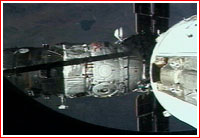
Sept. 16: The Docking Compartment-1, dubbed Pirs, docked automatically
to the nadir port on the Zvezda service module at 8:05 p.m. CDT as the station
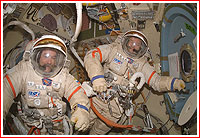
orbited 250 miles above Mongolia. The 16-foot-long, 8,000-pound module approached the station from below and behind, beginning its automated docking sequence shortly after 5:30 p.m. About 20 minutes later, the station's thrusters moved it to the proper orientation for docking. The station's large solar array wings were positioned to eliminate contamination from the jets on Pirs as it made it final approach. After the probe-and-drogue docking system completed capture of the incoming module and pulled the two spacecraft together, 12 active latching hooks were driven to their closed position, locking the module securely in place. After docking, the Expedition 3 crew checked to make sure there was a good seal between the station and its new module, then began to equalize pressure between the two craft prior to the first opening of the hatch to Pirs, which was scheduled later that evening. The aft instrumentation and propulsion system locked onto the docking compartment itself was to be jettisoned later that month to set the stage for spacewalks by the crew to install and activate key systems for the compartment's future operation. Three space walks were to be conducted in October and November 2001 from Pirs by the Expedition 3 crew - two by Pilot Vladimir Dezhurov and Flight Engineer Mikhail Tyurin and one by Culbertson and Dezhurov - to electrically mate the Docking Compartment to Zvezda and install more equipment on the outside of the module. 2001 Sept. 26, 3:36 a.m. Moscow Time: Mission control in Korolev commanded the propulsion and instrument section, PAO, to jettison from the Docking Compartment of the Russian segment of the ISS. The PAO section then fired its engines to deorbit. The maneuver freed the nadir (Earth-facing) docking port on the Docking Compartment, which will be used by the ISS-bound Soyuz spacecraft. The PAO section originally served as an orbital tug for the Docking Compartment during it delivery from the initial orbit to the ISS. Pirs module is being prepared for departure
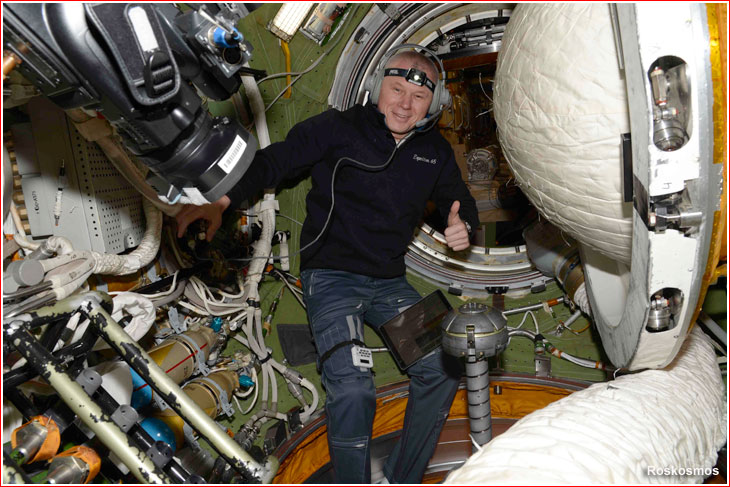
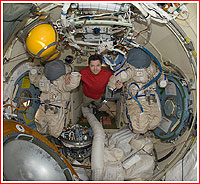
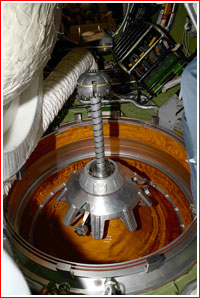
Oleg Novitsky from the Soyuz MS-18 crew poses inside the transfer compartment of the Zvezda Service Module, SM, on July 9, 2021, configuring its nadir docking port for the separation of the Pirs Docking Compartment, SO1, then scheduled for July 23, 2021. The active docking mechanism of the Pirs module is partially visible at the bottom of the photo. The cover of the Zvezda's nadir port is on the right. The hatch into the Zarya Control Module is behind Novitsky. There is another docking tunnel into the MIM2 Poisk module beyond the frame of the photo on the top. On July 14, 2021, Roskosmos announced that members of the 65th expedition aboard the ISS, were preparing (Insider Content) the Pirs module for its departure (Insider Content) on July 23. Working in coordination with the Chief Operational Mission Control Group, GOGU, of the Russian ISS Segment on the ground, cosmonauts Oleg Novitsky and Petr Dubrov worked on isolating hydraulic lines of the Pirs Docking Compartment, SO1, and wiring flight control system for sending commands aboard SO1 via the Progress MS-16 cargo ship, Roskosmos said. The cosmonauts also checked the docking mechanism (between Zvezda and Pirs) and recorded data from various systems of the module. Pirs module departs the ISS, deorbits
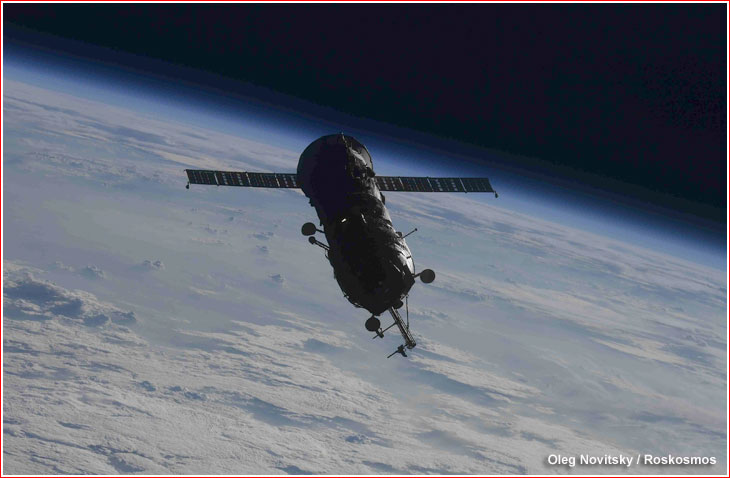
After nearly 20 years at the International Space Station, ISS, the Pirs Docking Compartment, SO1, undocked from the nadir (Earth-facing) port of the Zvezda Service Module, SM, on July 26, 2021, at 13:55 Moscow Time (6:55 a.m. EDT) in the joint stack with the Progress MS-16 cargo ship. At the time, the spacecraft was orbiting the Earth over the Eastern China and within communications range of Russian ground stations. Within four minutes (13:59:00 Moscow Time, according to schedule), Progress MS-16 performed a short separation burn to increase distance from the ISS. The deorbiting maneuver was planned within around three hours aiming at the reentry of the Pirs/Progress stack over the Pacific. According to NASA, Docking compartment spent 19 years, 313 days 9 hours 50 minutes and 45 seconds at the station and 19 years 315 days 15 hours 1o minutes and 47 seconds in flight. Progress MS-16 initiated braking maneuver as planned at 17:01 Moscow Time (10:01 a.m. EDT) and after a 1,057-second (17.6-minute) burn, the module/cargo ship duo reentered the dense atmosphere at 17:42 Moscow Time (10:42 a.m. EDT).
Technical specifications of Docking Compartment-1 and Mini-Research Module-2:
|
|

|