|
|
|
  
|
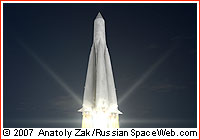
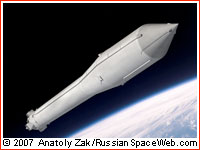
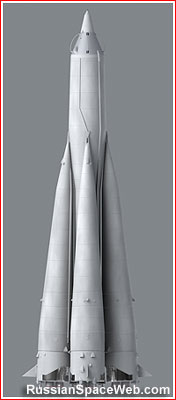
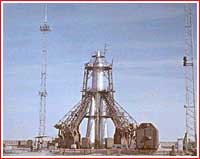
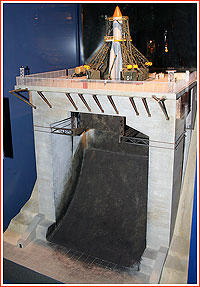
Sputnik launch vehicle (8K71/8A91)
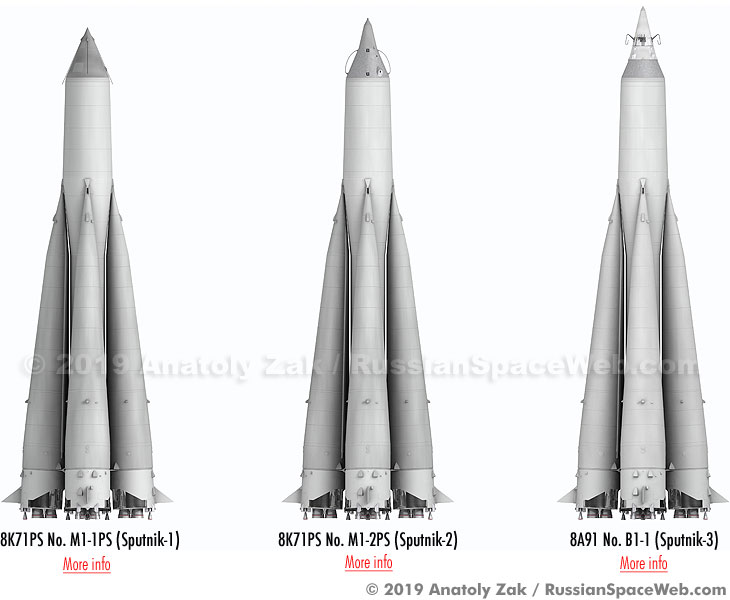
The version of the R-7 rocket that was destined to carry the first satellite into orbit was designated 8K71PS No. M1-1PS. That particular vehicle received several upgrades deferring it from earlier experimental R-7 rockets. (52) Along with the military warhead, gone were measurement hardware, top avionics section containing the vibration monitoring system, cables connecting the rocket and the warhead and a considerable portion of the flight control hardware, including the radio-control system. Some of the onboard electric batteries were also removed. (51) As a result, the total mass of the rocket went down from 280 tons for the original R-7 rocket to 272.83 tons (or 267 tons, at the time of liftoff) for the space launcher. At liftoff, the engines would reach the total thrust of around 398 tons. (256, 52) Upon reaching the orbit, the main engine cutoff had to be performed by the gyroscopic integrator or on a command from the emergency contact of the turbine in the main engine. Such command would be issued as soon as the rocket run out of fuel or oxidizer. All tracking of the rocket in flight had to be conducted passively by means of radar, without onboard response, and with the help of ground telescopes. Both ways had a limited range and accuracy. Based on experience with the previous launch of the R-7 rocket, ground controllers expected the Binokl (binocular) tracking system to "see" no further than 200 kilometers for the rocket, and much less for a satellite. In the meantime, the P-30 radar demonstrated an effective range of 500 kilometers, when tracking aircraft. Its effectiveness would be further reduced by a relatively slow rotation of its antenna. Optical sensors Kth-41 and KT-50 available in Tyuratam at the time had a range of 100-200 kilometers, also too short for effective tracking of a satellite. (51) Modifying the rocket for Sputnik-2For the launch of the second satellite, the second braking nozzle was added to the core stage of the rocket to prevent tumbling of the vehicle upon entering orbit. (248) As in the rocket launching the first satellite, the braking nozzle would employ gas, which pressurized oxidizer tank during the powered flight. (84) Once in orbit, a special programming device, installed on the core stage would switch the Tral-Ts telemetry system from transmitting the parameters of the rocket to channel data from scientific payloads. (52) To help maintain proper temperature in the dog cabin, the transfer cone, which connected the satellite with the rocket, was thoroughly polished, additional thermal blanket were added and copper panels were installed on the telemetry boxes. The core stage was also equipped with deployable reflectors. To maximize scientific payload of Sputnik-2, some flight control equipment was removed from the rocket. For the same purpose, the flight profile was modified to ensure maximum use of onboard propellant. It was achieved by programming the flight control system to shut down the main engine only when its turbo pump detects that it run out of either propellant or oxidizer. In the previous launch, this way of shutting down the engine was only a backup mode. The rocket for Object D: 8A91By the time the third Soviet orbital mission was prepared to fly, a new version of the R-7 launch vehicle designated 8A91 was also in works. It was a transitional upgrade between the older 8K71 ballistic missile and the yet-to-be-tested lighter 8K74 ICBM designed for a longer range. Chemical milling was used to shave off some extra metal from waffle-like tank walls. In addition, the Tral-V telemetry system was removed from the first stage and its tasks of data transmission were transferred to a single Tral unit on the second stage. (537) Mass changes led to a different flight profile. The engine of the core stage would be throttled down from 73 tons to 60 tons, while strap-on boosters would be throttled up 25 percent 17 seconds before their separation. Also special covers would be introduced to reduce the backward thrust of separation nozzles. The radio-equipment bay was replaced with an adapter section. The development of the 8A91 launch vehicle was completed by the beginning of 1958. (84)
Technical specifications of the R-7 ICBM and Sputnik launcher:
This page is maintained by Anatoly Zak Last update: May 8, 2019 All rights reserved
|
|
|||||||||||||||||||||||||||||||||||||||||||||||||||||||||||||||||||||||||||||||||||||||||||||||||||||||||||||||||||||||||||

|