Sources

Site map

Site update log

About this site

Mailbox


UR-500 (Proton) rocket infrastructure overview:

Site
Completion date
Purpose
Details
92
1962
Processing area
-
95
1962
Residential area
-
81
1965
Two launch pads
-
200
1976
Two launch pads
-

In 1962, the Soviet government approved the program of construction of the launch complex for the UR-500 (Proton) rocket located on the western edge of Baikonur Cosmodrome. The original complex included two launch pads, but total four Proton launch pads have been built here. Baikonur has always remained the only location from which the Protons could be launched.

The 4th Test Directorate of the NIIP-5 test range was responsible for the processing of the Proton rocket. (100)

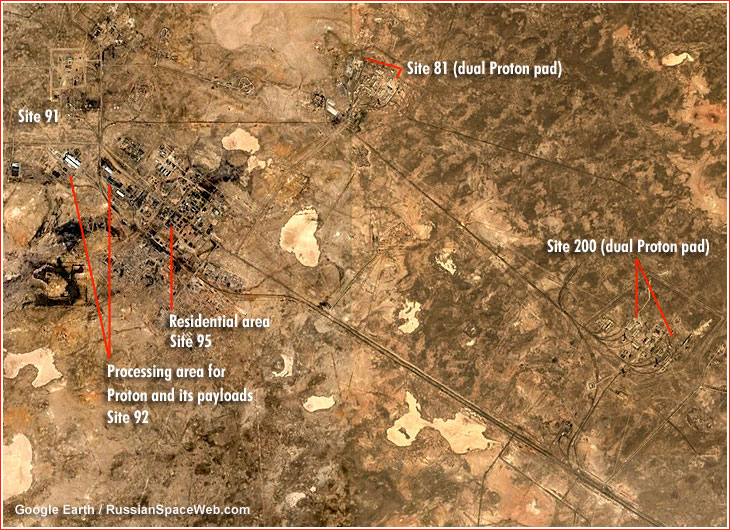
The people who serve the Proton rockets and some of its payloads usually live in the residential area on the west wing of Baikonur, known as Area (Ploshadka) 95. The processing facilities for the rocket located at Site 92. The same site was also home of the extensive processing infrastructure for the Almaz program, completed around 1971. (78)

Dual-pad Proton launch complexes occupy Site 81 and Site 200. An underground bunker, with the launch control eqiupment was located at Site 83. A back up command post was at Site 82.

Site 92

Building 92A-50 The most payloads destined to ride Proton rockets are processed in the Building 92A-50 in Area 92. This is the one of the most sophisticated facilities in Baikonur founded in the beginning of the 1970's and completed in 1981. (70 p. 235) The overall testing as well as fueling and pneumatic pressurization of the spacecraft can be conducted in the dedicated work places inside the building. Also inside this facility, the satellites are integrated with the upper (fourth) stage of the Proton rocket and covered with the payload fairing.

Building 92-1 The Building 92-1, which is around 120 meters long and 50 meters wide, is used to assemble the Proton launchers in horizontal position. The segments of the rocket arrive into the building by rail from Khrunichev production plant in Moscow. Up to four launchers can be processed in the building simultaneously.

The payload, known by Russian abbreviation KGCh, which stands for (Space Head Section), loaded with propellant and packed under its fairing and, if necessary, upper (fourth) stage, is delivered to Building 92-1 by rail for integration and testing with the first three stages of the rocket.

This is the last step in Proton integration, after which the entire complex is loaded by cranes on the flat railroad transporter and it is ready for rollout to the launch pad.

Site 95

The main residential area, which provides housing for the personnel is often referred to as "Proton city" by foreign visitors and officially known as Site 95.

Along with military barracks and auxiliary infrastructure, the area includes hotels Cometa, Fili and Polyot for visitors and personnel temporary working at the site. In the mid-1990s, the Khrunichev enterprise, which conducted its commercial launch campaigns from the area, invested into renovation of the facilities in the area.

Site 81

The two original launch pads, Number 23 and Number 24, for the Proton rocket are located in Area 81 also known as Facility (Ob'ekt in Russian) Number 333. Two pads are separated by a distance of about 600 meters.

Pad 24 is the oldest launch facility for the Proton, which hosted the first launch of the rocket in 1965. The pad was under renovation since 1979 for almost two decades, and no launches took place here until 1999.

Pad 23 was completed in 1966 and it was used for the first time in 1967. The pad was taken out of service for renovations at the end of the 1970s and it remained officially under repair for almost a decade. Yet, in the 20th Century it was the most extensively used launch facility for the Proton rocket.

When most space launch complexes in Baikonur were transferred under civilian control at the end of the 1990s, Area 81 remained under jurisdiction of the Strategic Missile Forces. It was finally transferred under control of KBOM design bureau at the beginning of 2006. The organization initiated a number of upgrades at the site, including the installation of the new test and monitoring equipment.

Site 200

During the 1970's two more launch complexes -- Number 39 and Number 40 -- for the Proton rockets had been under construction in Baikonur. The design of the complex started in 1970 and the actual construction was intitiated in 1972. (70 p. 235) The pads are also known as "Ob'ekt" (Facility) 548 and located at "Ploshadka" (Site) 200, east of the original pads. Pad 40 has entered service in 1977, the Pad 39 -- in 1980.

In December of 1984, the Soviet television released first pictures of the Proton rocket launch from Area 200 carrying Vega planetary probes.

In 1998, both pads in Area 200 were transferred under civilian control of the Russian Space Agency. As of beginning of the year 2000, only Pad 39 remained operational in Area 200, while Pad 40 was officially under repair since 1991.

During 2004, Russian and Kazakh officials discussed the possiblity of building a launch complex for the Angara rocket in Baikonur. A formal agreement between two governments on the construction of the complex dubbed Baiterek was reached on December 22, 2004. The complex would use the former launch pad for the Proton rocket at Site 200.

Launch pad operations

All four pads feature similar design. The railroad transporter with the rocket in horizontal position moves with its front chassis on top of the stationary erector of the launch pad. The erector then rotates 90 degrees and installs the rocket together with its railway transporter and its front chassis vertically onto the launch platform. The rear chassis of the transporter remains on the railway.

The transporter's fixtures holding the rocket then released and the erector rotates down into its storage position below the pad level lowering the transporter back on the rail tracks.

The service tower then moves into position on its own rail tracks completely enveloping the rocket. It allows servicing the rocket during last five days before launch. Service tower rolls away to a distance of about 340 meters from the rocket around 5-6 hours before launch.

All umbilical devices are connected to the Proton rocket at the time of the launch through the special interface at the bottom of the rocket. During the first second of the launch the umbilical cables trail the moving rocket and then separate and fall into a special niche in the launch pad. A protective cover immediately closes over the niche.

Baiterek launch complex

During 2004, Russian and Kazakh officials discussed the possibility of building a launch complex for the Angara rocket in Baikonur. A formal agreement between two governments on the construction of the complex dubbed Baiterek was reached on December 22, 2004. According to one proposal, the complex would use Site-200's launch Pad No. 40 for the Proton rocket, which had stayed abandoned and decrepit at the turn of the 21st century. A ceremonial marker, commemorating the foundation of the Baiterek complex was installed at Pad No. 40, however for several years, little else was going on there.

According to unofficial reports, in November 2006, representatives of Khrunichev enterprise and Kazakh officials were planning to conduct surveillance of a new flight path for the Angara-A5 launcher from Baikonur, which would enable it to reach orbits with inclination 48 degrees toward the Equator. Such trajectory would be almost ideal in terms of delivering maximum cargo possible from Baikonur. This flight path was avoided in the previous half a century of Baikonur's existence, since it would take the rocket over the Chinese territory. It was unclear, if this political issue was resolved in case of the Baiterek project.

During his visit to Baikonur in May 2007, head of the Russian space agency, Roskosmos, Anatoly Perminov told reporters that the Khrunichev enterprise was directed to complete a general draft-schedule of the Baiterek complex development and to start its implementation in the second quarter of 2008.

On April 18, 2008, key contractors in the development of the Baiterek complex, including Khrunichev met with local community leaders and other officials in Kzyl Orda, a regional center near Baikonur Cosmodrome, Kazakhstan Today news agency reported. Two sides discussed projected environmental impact of the Baiterek facility on the surrounding area and on drop zones downrange from the launch site. Space officials assured local representatives that replacement of the Proton rocket with the Angara launcher would improve ecological situation in the region. They also promised to keep all development work at the site transparent to the general public.

The head of the Baiterek joint venture, Aleksandr Taryanik, confirmed that the "real implementation" of the Baiterek project would start in 2008.


Written and illustrated by Anatoly Zak

Last update: April 30, 2008

All rights reserved


PICTURE GALLERY

The Proton rocket inside processing building 92-1. Copyright © 2000 Anatoly Zak


The rollout of the Proton rocket from building 92-1. Copyright © 2000 Anatoly Zak


The Proton rocket arrives to Site 81. Copyright © 2000 Anatoly Zak


The Proton rocket is installed on the launch pad. Copyright © 2000 Anatoly Zak


The Proton reaches vertical position on the launch pad. Copyright © 2000 Anatoly Zak

The launch pad erector is lowered in stored position after the installation of the Proton rocket on the pad. Copyright © 2000 Anatoly Zak


The service tower moves into position around the Proton rocket after it has been installed on the launch pad. Copyright © 2000 Anatoly Zak


Building 92A-50 in Area 92 of Baikonur. Copyright © 2000 Anatoly Zak


During 2004, Russian and Kazakh officials discussed the possiblity of building a launch complex for the Angara rocket in Baikonur. According to one proposal, the complex would use the former launch pad for the Proton rocket at Site 200. Copyright © 2000 Anatoly Zak