|
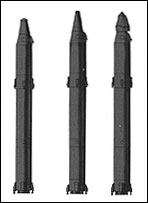
The R-36 rocket family
The R-36
family represented the second generation of the intercontinental ballistic
missiles, ICBMs, developed in the USSR during the Cold War. It was developed in parallel
with the Titan-2 ICBM in the United States.
The heavy-weight
R-36 recieved several new and exotic features, such as multiple warheads and decoys, as well as a capability to develop an orbital
speed. The latter became a base for the Fractional Orbital
Bombardment System, or FOBS, where the warhead and the upper stage of
the ICBM would actually enter the orbit around the Earth on its way to a target.
The development
of the R-36 was officially authorized on April 16, 1962. (74)
The missile was declared operational in 1966 and remained in armaments
until 1978.
Specifications of the R-36
family:
|
Number
of stages |
2 |
2 |
3 |
2 |
|
Length |
34.5
meters |
32.2 meters (31.7 meters in some modifications) |
32.65
- 34.5 meters |
32.2
meters |
|
Diameter |
3.05
meters (with protruding elements - 3.6 meters) |
3.05
meters (with protruding elements - 3.6 meters) |
3.05
meters (with protruding elements - 3.6 meters) |
3.05
meters (with protruding elements - 3.6 meters) |
|
Total
mass (fueled) |
179
-183.89 tons |
179
-183.89 tons |
181,297
kilograms |
183.45
tons |
|
Fuel |
|
|
|
|
| Oxidizer |
Nitrogen
tetroxide |
Nitrogen
tetroxide |
Nitrogen
tetroxide |
Nitrogen
tetroxide |
| Mass
of fuel |
48.5
tons |
48.5
tons |
48.5
tons |
48.5
tons |
| Mass
of oxidizer |
121.7
tons |
121.7
tons |
121.7
tons |
121.7 |
|
|
15,200
km |
10,200
km |
40,000
km |
10,200
- 12,000 km |
| Stage
1 |
|
|
|
|
| Stage
1 length |
18.87
meters |
18.87
meters |
18.87
meters |
18.87
meters |
| Stage
1 diameter |
3.0
meters |
3.0
meters |
3.0
meters |
3.0
meters |
| Stage
1 propellant mass: |
118.9
tons |
118.9
tons |
118.9
tons |
118.9
tons |
|
Stage
1 dry mass |
6.4
tons |
6.4
tons |
6.4
tons |
6.4
tons |
|
Stage
1 total mass (fueled) |
122.3
tons |
122.3
tons |
122.3
tons |
122.3
tons |
| 1st
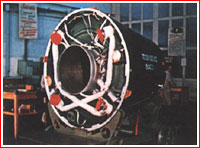
stage propulsion |
3
two-chamber RD-250 engines creating RD-251 (8D723) main engine;
1
four chamber RD-68M steering engine |
3
two-chamber RD-250 engines creating RD-251 (8D723) main engine;
1
four chamber RD-68M steering engine |
3
two-chamber RD-250 engines creating RD-251 (8D723) main engine;
1
four chamber RD-68M steering engine |
3
two-chamber RD-250 engines creating RD-251 (8D723) main engine;
1
four chamber RD-68M steering engine |
| Stage
2 |
|
|
|
|
| Stage
2 length |
9.4
meters |
9.4
meters |
10.03
meters |
12.9
meters |
| Stage
2 diameter |
3.0
meters |
3.0
meters |
3.0
meters |
2.2
meters |
| Stage
2 dry mass: |
3.7
tons |
3.7
tons |
3.7
tons |
3.7
tons |
| Stage
2 fueled mass: |
49.3
tons |
49.3
tons |
49.3
tons |
57.52
tons |
| 2nd
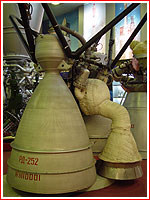
stage propulsion |
1
two-chamber RD-252 engine;
1
four-chamber RD-69M engine |
1
two-chamber RD-252 engine;
1
four-chamber RD-69M engine
|
1
two-chamber RD-252 engine;
1
four-chamber RD-69M engine
|
1
two-chamber RD-252 engine;
1
four-chamber RD-69M engine
|
|
Stage
3 |
|
|
|
|
|
Stage
3 (orbital) fueled mass |
n/a |
n/a |
3,648
kg |
n/a |
|
Stage
3 (orbital) propellant mass |
n/a |
n/a |
2
tons |
n/a |
|
Warhead
type |
Single 8F675: 8 Megatons |
Single
8F675: 20 Megatons |
Single
8F021: 5 Megatons (2.3 MT according to 98) |
Three
8F676: 2.3 Megatons warheads each; |
|
Warhead
mass |
3,950
kilograms |
5,825
kilograms |
1,410-1,700 kg |
3
warheads 1,425 kg each; |
|
Decoy
mass |
272
kilograms |
272
kilograms |
238
kilograms |
401
kilograms |
R-36
development team:
| Overall
design |
OKB-586 |
M.
Yangel |
Dnepropetrovsk |
| Main
engine (two stages) |
OKB-456 |
V.
Glushko |
Moscow |
| Steering
engine (two stages) |
OKB-586 |
M.
Yangel |
Dnepropetrovsk |
| The
launch complex (surface) |
KBTM
(PKO-8) |
- |
Moscow |
| Control
system |
NII-885 |
N.
A. Pilugin |
Moscow |
| The
launch complex (silo) |
KBSM |
E.
G. Rudyak |
- |
| Thermo-nuclear
warhead |
VNIIEF |
B.
V. Litvinov |
Chelyabinsk |
RD-251/252
engine specifications:
|
Developer |
OKB-456
(Moscow) |
OKB-456
(Moscow) |
| Thrust
at the sea level |
241
tons |
- |
| Thrust
in vacuum |
270.4
tons |
92
-120 tons |
| Chamber
pressure |
85
kg per sq. cm |
91
kg per sq. cm |
| Burn
time |
120
seconds |
160
seconds |
| Height |
2.88
meters |
2.168
meters |
| Diameter |
2.52
meters |
2.59
meters |
| Dry
mass |
1,730
kilograms |
715
-725 kilograms |
|

|