| |
|
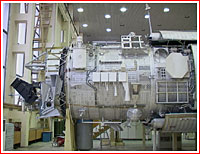
Mir's Priroda module
Priroda module (77KSI) at a glance:
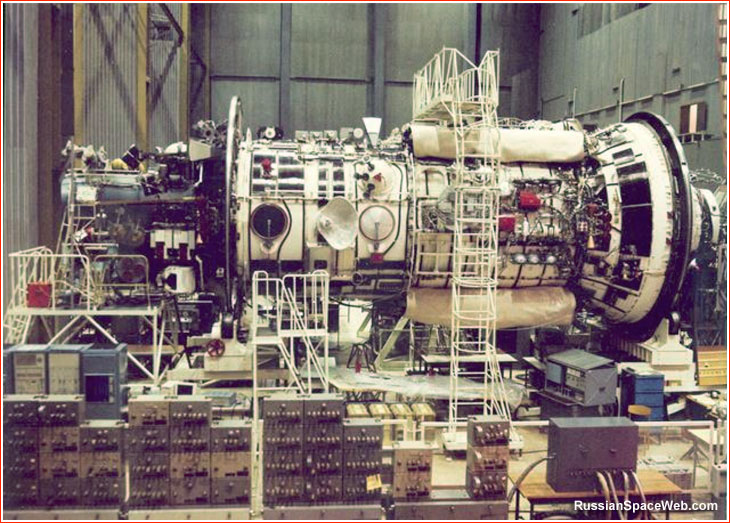
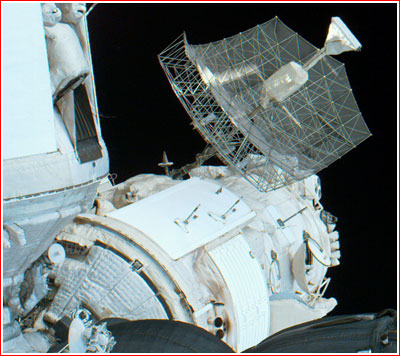
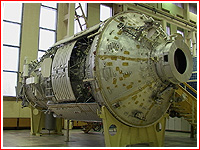
The Priroda module was a Russian equivalent of NASA's Mission to planet Earth developed in the 1980s. The spacecraft was intended for a wide range of remote-sensing experiments. As its military sister ship, the module Spektr, Priroda stuck on the ground for years due to luck of funds. As it happened with Spektr, the Priroda's mission was revived, when NASA signed up for a series of flights onboard Mir. The last module of Mir, completed a decade-long assembly of the Mir space station, delivering unprecedented amount of scientific payload. Along with remote-sensing equipment the module was carrying the hardware for material processing, meteorological and ionosphere research, as well as equipment for US, French and German experiments. The propulsion system featured small 11D458 and 17D58E thrusters developed at NIIMash. Soon, after Priroda successfully reached the orbit on April 23, 1996, a failure in its electrical supply system cut in half the amount of energy available onboard. Since in its final configuration the Priroda had no solar panels, the module had only one attempt of docking with Mir, before loosing all its power and maneuverability. Given the fact that several previous modules had to abort the initial docking attempts, the ground controllers were extremely nervous about the situation. Fortunately, the Priroda docked to Mir flawlessly on April 26, 1996. Onboard Mir, the module reportedly required a considerable amount of power for its full-scale operations. Due to limited power supply during the last expedition to Mir in 2000, the cosmonauts had never had a chance to activate the module's payloads.
|
|
 |