|
|
|
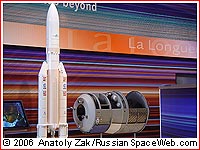
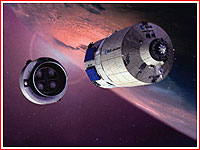
Design of the ATV cargo ship Europe's first transport ship developed for the manned space program could not actually carry people, however it did give the continent's future astronauts their biggest hope for entering space onboard their own vehicle. Conceived in the 1980's, the Ariane Transfer Vehicle, ATV, sported many features of a piloted ship and, potentially, could leave a technical heritage for human space flight. European space officials also stressed the importance of the ATV's highly sophisticated docking system for future deep-space missions, such as soil sample return from Mars, which by 2008 had emerged as a potential goal of the European Space Agency.
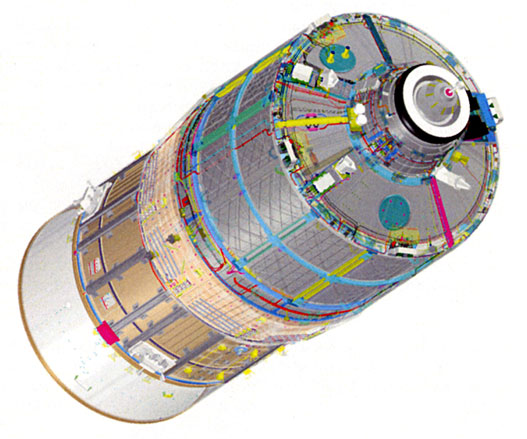
Color-coded schematic of the ATV structural "anatomy": the ICC module is shown in gray; the EAB in light brown; the EPB in dark brown and the SDS in white. Credit: EADS Astrium
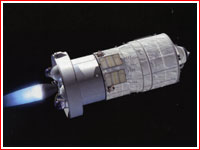
ATV mission With the arrival of the Columbus laboratory to the ISS in February 2008, the European Space Agency, ESA, has assumed a new responsibility as an "operational partner" in the program. As a result, ESA was now required to contribute to the operations of the ISS, at a level equivalent to 8.3 percent of its operating costs. From the outset of the program, Europe chose to make its contribution in the form of services, with deliveries to the ISS of dry cargo, water, gases and refueling propellant, as well as a propulsion support to the ISS. The latter included contributing to the station's attitude control system (Debris Avoidance Maneuvers) and re-boosting the station to compensate for the orbital decay caused by atmospheric drag. All these jobs would be done by the ATV cargo ship. The cost of ATV program reached 2.5 billion euros, with half spent on development and the other half on manufacturing and launch of flight vehicles. Ten ESA member states had contributed funding. (274) General description Launched by the Ariane-5 rocket, the ATV consists of a cargo module, which includes a pressurized section and a service module incorporating the avionics and propulsion system. During the lifetime of the program, the ATV was expected to carry up to 7.4 tons of payload to the ISS every 18 to 24 months. Although the ATV is not a manned spacecraft, it had to be equipped with an Environmental Control and Life Support System, so that the station crew could enter its pressurized module once it is docked to the outpost. (274)
ATV technical characteristics:
*Shown maximum payload that can be carried by each subsystem, but they can not be reached simultaneously on the same mission. ATV development team: In the ATV program, a European consortium EADS Astrium led 30 major contractors from 10 countries of the European Union, as well as from Russia and the US:
Russian systems onboard the ATV:
Page author: Anatoly Zak; Last update: January 18, 2023 Editor: Alain Chabot; Last edit: March 6, 2008 All rights reserved
|
|
||||||||||||||||||||||||||||||||||||||||||||||||||||||||

|