|
|
|
    
|
||||||||
|
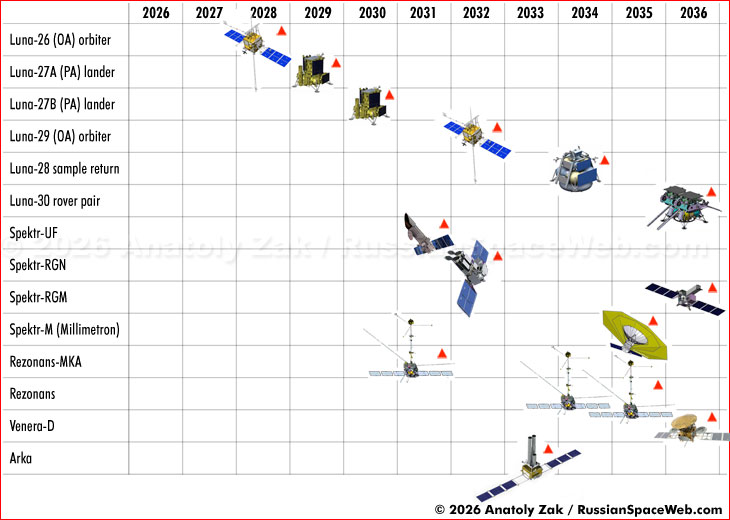
Russian space science program faces widening years-long gap In the last week of January 2026, Bauman Technical University in Moscow held the traditional Korolev's Readings, where Roskosmos presented its timeline for 14 space science projects officially under development, including six lunar robotic missions, five space observatories, three geophysics spacecraft, and a Venera probe.
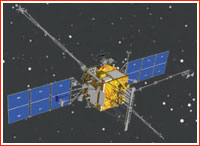
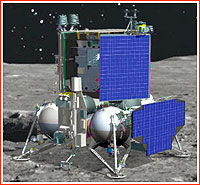
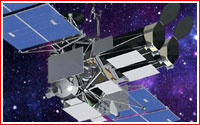
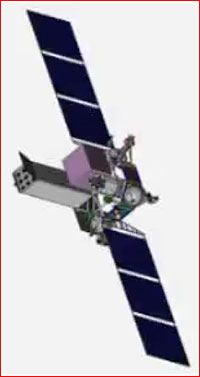
Most notably, the 2026 schedule did not expect a single scientific mission to reach the launch pad in nearly three years. Given the probability of various technical challenges to such complex spacecraft, the gap in launches of Russian science missions could easily extend into the 2030s, even if all the promised money was provided as scheduled. According to Roskosmos, the Luna-26 orbiter remained the top priority, but its launch date has been pushed to late 2028, essentially making a delay at least into 2029 practically inevitable. Next, two lunar landers (Luna-27A and -27B) were expected to fly in year-long intervals, which for spacecraft of this complexity was nowhere near realistic. For a credible schedule, based on recent performance and the capabilities of the developer, the planners would have to allocate at least four or five years between each mission, but it would obviously be politically suicidal. For example, it will be at least five years between the failed launch of the Luna-25 lander and the launch of the less-complex Luna-26 orbiter (INSIDER CONTENT), if it launches as promised in 2028. Even though, there was a considerable commonality in the design of the Luna-27A and Luna-27B landers, scheduled for launch in 2029 and 2030, their prime developer NPO Lavochkin, would typically need several years between the launches of the far less complex and practically identical Elektro-L weather satellites. The second copy of the Luna-26 spacecraft, modified to serve as a relay orbiter, was moved forward in the timeline to late 2032 in order to support two surface missions in the 2030s, but the spacecraft so far retained the designation Luna-29 from the old revision of the schedule. Under the latest timeline, it would be followed by the Luna-28 sample return mission (INSIDER CONTENT) in late 2034, probably carrying a miniature rover, which could select soil samples, while communicating with the Earth via Luna-29 pre-deployed in the lunar orbit. Next, according to the schedule, the Luna-30 lander would deliver a pair of mid-size rovers to the Moon in late 2036. Obviously, all missions with launch dates in the mid-2030s were pure paper concepts, primarily depending on funding in the next decade. In April 2026, the Interfax quoted Sergei Chernyshov, Vice President of RAN, citing essentially the same schedule, but Luna-30 and Luna-28 swapping places, pushing the soil samples delivery to 2036, but advancing the rovers' deployment to 2034. If it was not a misquote, such a switch would hardly make the program less challenging or more realistic. Possibly, the change meant to use the rover mission for collecting the samples, which would then be delivered to Earth by the subsequent return vehicle. Astrophysics missions Russia's space-based astronomy and astrophysics program looked even bleaker, despite the addition of two observatories in what had to be qualified as a wish list rather than a solid program. According to the latest schedule, the first to go, as early as 2031, was the "almost finished" Spektr-UF ultraviolet telescope (INSIDER CONTENT), which had been in the assembly shop for the past decade waiting for the replacement of its foreign components. The newly added Spektr-RGN X-ray observatory (INSIDER CONTENT) was "front loaded" into the schedule at the end of 2032, apparently thanks to an opportunity for using available spare parts, infrastructure and experience from the already flying Spektr-RG telescope. In the meantime, the most complex and expensive project in the program — the Spektr-M Millimetron observatory (INSIDER CONTENT) — was now moved to the end of 2035, which was beyond the farthest 10-year horizon of the Russian budget projection. Even further ended up the Venera-D project (INSIDER CONTENT) aiming to land on Venus, Russia's lone planetary exploration mission, which formally survived the cuts, but was not expected to fly before 2036, a largely symbolic date. All of these missions, plus a trio of Rezonans space weather satellites and the Arka Sun monitor, were the responsibility of NPO Lavochkin, which in the post-Soviet period had not come anywhere close to demonstrating the kind of launch tempo that would be required by the latest schedule even with all its remote launch dates. Several other proposed missions, which were long featured in the Russian exploration plans and promoted in the official press have disappeared from the program. The schedule no longer listed any Mars or Phobos exploration probes, no comet or asteroid visits, no attempts to send a mission to Jupiter and no plans to explore the Sun.
|
|

|