|
|
|
    
|
||||||||||||||||||||||||||||||||||||||||||||||||||||||||||||||||||||||
Soyuz launches classified payload Military personnel in Plesetsk opened Russia's orbital launch count of 2026 with the liftoff of a Soyuz-2 rocket carrying multiple secret satellites on February 5.
Soyuz-2 rocket mission on Feb. 5, 2026, at a glance:
As early as Jan. 26, 2026, Russian authorities issued warnings for sea and air traffic in the Barents and Norwegian Seas for a rocket launch planned during a period from Feb. 2 to Feb. 12, 2026, during a seven-hour window from 15:00 to 22:00 UTC. However, according to another announcement, the launch period extended only from Feb. 2 to Feb. 7, 2026. The projected impact sites were located along a ground track to a near-polar Sun-synchronous orbit with an inclination around 97 degrees toward the Equator, previously used by Soyuz rockets carrying various military payloads such as Bars-M cartography satellites. One site, off the coast of the Kola Peninsula in the Barents Sea, would be used to drop the payload fairing, while the second location, south of Svalbard Archipelago, would receive the remnants of the second stage. Strangely, the impact area for the four boosters of the first stage in the Southern Section of the White Sea was announced with two warnings issued in a short sequence at the end of January: one extending from Feb. 2 to Feb. 7, 2026, and another from Feb. 8 to Feb. 12, 2026, hinting at two launches of Soyuz rockets in the same direction. Shortly thereafter, another warning appeared for an area in the Pacific Ocean, which matched the impact distance for the third stage of the Soyuz rocket after its flight on a ballistic trajectory, which indicated that the upcoming mission would feature a Fregat upper stage, which would complete the insertion of the classified payload into an initial orbit. Another restriction zone in the Pacific Ocean, south of Australia, looked typical for the surviving debris of the Fregat stage after its controlled deorbiting. Hours before the opening of the first launch window on Feb. 2, 2026, an additional warning was issued for a period from Feb. 8 to Feb. 11, 2026, for a section of the Barents Sea, North of the Cola Peninsula, which again matched the impact zone for the payload fairing of the Soyuz rocket — another indication that a dual launch campaign was underway. 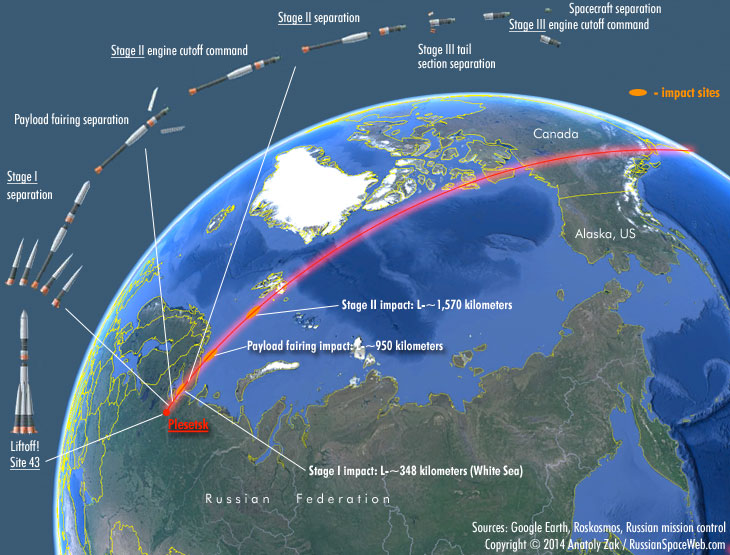
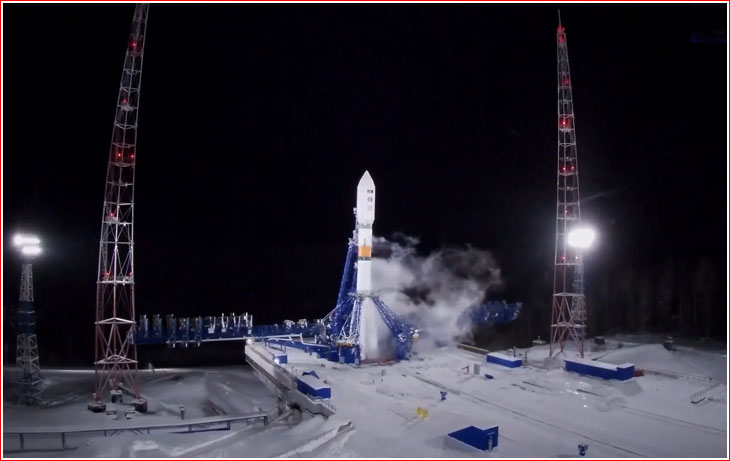
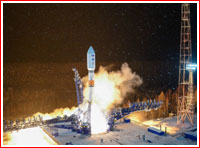
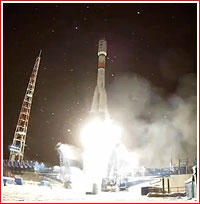
The first Russian launch of 2026 ultimately took place on Feb. 5, 2026, from Site 43 in Plesetsk. According to a poster on the Novosti Kosmonavtiki web forum, the State Commission gave the green light for the fueling of the rocket at 18:53 Moscow Time, in preparation for a liftoff at 21:57 Moscow Time (1:57 p.m. EST). However, according to Roskosmos and the Russian military, the liftoff took place at 21:59 Moscow Time. The Soyuz-2.1b rocket carried multiple spacecraft for the Ministry of Defense. Before the end of the day on Feb. 5, 2026, the US Space Force catalogued a single object associated with the launch in an expected 487 by 512-kilometer orbit with an inclination of 96.6 degrees toward the Equator. However, it was designated 2026-023E, indicating that Objects A, B, C and D were expected to be listed next. Shortly thereafter, the US Space Force issued orbital elements for nine objects associated with the Feb. 6, 2026, launch:
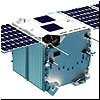
Based on these orbital parameters, it appeared that upon forming its initial near-circular orbit at an altitude just below 330 kilometers, the Fregat released one (main) payload (Object 2026-023A). The space tug then maneuvered to a near 500-kilometer orbit, where it released the rest of its passengers (Objects B, C, D, E, F, G, H and J). According to space observer Robert Christy, the Fregat released secondary payloads in two batches: four objects from B to E were released first, then the space tug conducted a single maneuver, shifting the Right Ascension of the Ascending Node, RAAN (the Equator crossing points from the Southern to the Northern hemisphere) around 2.5 degrees eastward, after which the second quartet of objects (from F to J) separated from the space tug. The Fregat then conducted a pre-programmed deorbiting maneuver, sending itself on a destructive reentry over the Indian Ocean, south of Australia, at around 01:50 UTC on Feb. 6, 2026, Christy wrote. Coincidently, the number of payloads released in the mission was the same as the one delivered during the Soyuz launch from Plesetsk on May 16, 2024, when a trio of Rassvet satellites for Moscow-based Buro 1440 (INSIDER CONTENT) was launched but in a considerably higher orbit. Secret satellites barge in on amateur radio spectrum Based on orbital elements, it appeared that the main object from the Feb. 5, 2026 launch, (presumed to be named Kosmos-2600), maneuvered for the first time around Feb. 21, 2026, and by mid-March 2026, it transitioned to maintaining its orbit at an altitude of 322 kilometers. In the meantime, the orbits of all the secondary payloads from the same launch were decaying slowly without noticeable propulsive counteraction. Yet, the satellites were clearly operational, because in the second half of April 2026, radio amateurs reported detecting their radio signals emitted in a frequency of between 430 and 431 megahertz, which is within the 430-440-megahertz band that the International Telecommunications Union, ITU, had allocated for amateur radio operations, but also outside of the 435-438-megahertz section of that range dedicated specifically to amateur satellite communications. A total of five out of eight secondary payloads launched on Feb. 5, 2026, including Objects D, F, G, H and J, were operating within that frequency, seemingly for telemetry downlinks. Peculiarly, the apparent violation of ITU rules by the Russian military mimicked a recent controversy around Texas-based AST Space Mobile's Blue Walker and Blue Bird communications satellites, which were also accused of barging into the amateur radio frequencies. According to space analyst Bart Hendrickx, there was neither clear understanding of the mission performed by the Feb. 5, 2026, cluster nor its obvious connection to any other satellite families within the growing Russian military spacecraft fleet. The cluster had somewhat similar orbital parameters to those of a subsequent classified launch on April 17, 2026, but the members of the latter group had performed maneuvers, confirming a major design difference. 
|
|
|||||||||||||||||||||||||||||||||||||||||||||||||||||||||||||||||||||

|