|
|
|

Read more about inflatable space structures in:
Searching for details: The author of this page will appreciate comments, corrections and imagery related to the subject. Please contact Anatoly Zak. |
Previous chapter: Node Module
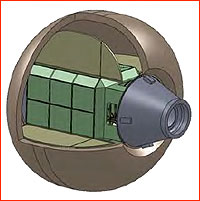
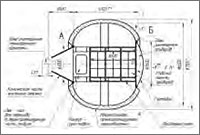
Above: A concept of the Russian inflatable module for the International Space Station, ISS. Russia jumps on the inflatable bandwagon Russia's leading developer of manned spacecraft is working on the expandable module, which could be added to the Russian segment of the International Space Station, ISS. RKK Energia, based in the town of Korolev, just outside Moscow, initiated the project around 2011. Despite an exotic nature of inflatable orbital devices, the technology is hardly new to space program and might yet see its true renaissance in the exploration of the final frontier. History of space inflatables Today often perceived as a relic from the 18th century, inflatable balloons did help to launch the Space Age. In the following decades of space exploration, inflatable devices played numerous even if episodic roles in the shadow of the traditional "hard-body" spacecraft. Far Side rocket Perhaps the most exotic use of inflatable technology for space exploration took place in 1957, when a 60-meter balloon lifted a 893-kilogram rocket dubbed Far Side to an altitude of 30.5 kilometers. From there, the four-stage rocket fired upward, piercing the top of the balloon and delivering 2.3 kilograms of cosmic ray sensors and other scientific instruments to an incredible altitude of 6,440 kilometers above the Earth surface. Beacon Only space historians remember today that the aluminized plastic balloon to be filled with nitrogen gas was among the first spacecraft proposed for launch during the International Geophysical Year, which officially opened the Space Age in 1957. It was developed jointly by a civilian precursor to NASA and by US Army engineers within the Beacon program and was designed to test the orbit-degrading atmospheric drag in the near-Earth space. In April 1958, a model of Beacon even became a prop during contentious hearings at the House Select Committee on Aeronautics and Space Exploration in the wake of the Soviet Sputnik. After four suborbital launches from the Wallops Island on the Nike Cajun rocket, Beacon-1 was fired into orbit on October 23, 1958, on a modified Juno-1 rocket. The satellite was expected to inflate to a diameter of 12 feet, likely becoming the first US satellite easily discernable from the ground. Unfortunately, due to a premature separation from its upper stages, Beacon-1 never made it into orbit. Another attempt on Aug. 15, 1959, was also unsuccessful. Echo In 1960, NASA made two attempts to orbit a 30.5-meter inflatable satellite called Echo, which was designed to serve as a reflector of microwave signals, echoing across intercontinental distances in early experiments with satellites communications. The first launch on May 13 failed, however the second satellite -- Echo 1A -- entered orbit successfully on August 12. On Jan. 25, 1964, NASA followed with a 41.1-meter Echo-2 satellite. However the idea of passive communications reflectors turned out to be still-born, replaced by "active" transponders of traditional communications satellites. Gemini When NASA embarked on the development of its second-generation manned spacecraft called Gemini, engineers considered an inflatable delta wing as an alternative landing system to a primary method of splashing down into the ocean. The inflatable paraglider promised to enable a controlled landing of a two-seat capsule on land, however pressures of the space race left no time to resolve technical challenges of the new system. Still, inflatable air bags were used on the Command Module of the next-generation Apollo spacecraft to ensure its vertical position following water landing. Voskhod-2 The USSR pioneered the use of inflatable structures in manned space flight with a flexible airlock that was launched aboard the Voskhod-2 spacecraft in 1965. During that historic mission, this unorthodox design enabled the world's first spacewalk by Soviet cosmonaut Aleksei Leonov. Luna In 1966, after many failures, the Soviet Luna-9 unmanned probe achieved the world's first soft landing on the Moon. As it transpired, the flower-like E-6 lander in the Luna-9 mission used inflatable air bags to soften the impact onto the lunar surface. The method would play a lasting role in planetary exploration both in the USSR and in the United States and remains the most significant application of inflatable technology for space exploration to date. Vega Soviet scientists went much further with inflatables, placing instrument-carrying balloons on a pair of Vega spacecraft heading to Venus in 1984. Following their flyby of the planet, Vega probes dropped their reentry capsules, which in turn, released a pair of traditional landers and inflatable balloons to float in the misty atmosphere over the alien world. Mars-96 The inflatable landing system first proven in the Luna-9 mission in 1966, was re-incarnated in the post-Soviet Mars-96 project. A pair of two landers carried in that mission were to attempt to land on the surface of the Red Planet. Shortly, before impacting the surface, a pair of airbags would be inflated around each lander to soften the impact. The spacecraft would bounce as high as 70 meters into the thin air before they would finally come to rest. Lines holding the two bags would then be cut and the lander would free fall one meter to the ground. In addition to regular landers, Mars-96 spacecraft also carried a pair of the so-called penetrators. These needle-shaped vehicles were designed to strike the surface of the planet at high speed and penetrate 4-6 meters into the soil. After braking in the Martian atmosphere with the help of an inflatable heat shield, the penetrators were expected to strike the surface of Mars with a speed of around 60-80 meters per second. Unfortunately, Mars-96 got stranded in the Earth orbit and neither inflatable bags of its landers, or inflatable heat shields on its penetrators had a chance to prove themselves. Mars-Pathfinder In the same launch window of 1996, NASA launched the Mars Pathfinder mission, which also relied on inflatable bags to complete its soft landing. The spacecraft completed a flawless trip to Mars and the airbag system successfully delivered a lander and a small rover on the surface of the Red Planet in July 1997. Mars Exploration Rover Seven years later, NASA relied on the tried and tested inflatable cushioning system again, delivering a pair of highly successful Mars Exploration Rovers, a.k.a. Spirit and Opportunity, onto the surface of the Red Planet. IRDT Back in Russia, many space projects faced a budget crunch in the wake of severe economic problems of the post-Soviet period. However the European Space Agency, ESA, saw the Russian inflatable heat shield from Mars-96 project worthy of further development, possibly as a low-cost method of returning cargo from the International Space Station, ISS. ESA co-funded the Inflatable Reentry and Descent Technology, IRDT, project together with the European Commission and DaimlerCrysler Aerospace, DASA. International Science and Technology center, the Moscow-based inter-government organization dedicated to non-proliferation, awarded the contract to build the spacecraft to NPO Lavochkin in Moscow. DASA built a sensor package for the project. A pair of IRDT devices were launched on Feb. 8, 2000, on the same Soyuz rocket from Baikonur. The smaller device was expected to return an experimental package from orbit, while the much larger second device was attached to the Fregat upper stage. To protect the one-ton Fregat during its fiery reentry, the IRDT shield was to inflate from a one-meter compact package up to 12-16 meters in diameter shortly before the reentry. After a six-hour orbital flight both IRDT devices successfully inflated and reentered, however an apparent failure of radio beacons on both payloads coupled with bad weather at the landing site in southern Russia hampered search efforts for several days. In the end, only a small device was recovered. Cosmos-1 The IRDT shield found its new application in the Cosmos-1 solar sailing project. It was privately funded by the US-based Cosmos Studios via the Planetary Society and developed at NPO Lavochkin's Babakin Center in Khimki during the first decade of the 21st century. If successful, it could be the world's first vehicle to use solar sail to propel itself in space. Launched on a converted ballistic missile, Cosmos-1 would reach an apogee of its ballistic trajectory at an altitude of about 400 kilometers. At that time, it was expected to deploy a pair of fan-like sections of the solar sail, which would be held in place by an inflatable frame. The spacecraft then expected to reenter dense atmosphere and land at the Kura impact range in the Kamchatka Peninsula with the help of the inflatable heat shield. The sail itself would burn up on reentry. The first attempt to launch the device in 2001 was unsuccessful due to the launch vehicle failure. On July 12, 2002, another inflatable device was launched from a Navy submarine, however a Volna ballistic missile failed again. On October 7, 2005, another Volna rocket carrying the Demonstrator D-2R inflatable braking device, NTU, flew what appeared to be a normal flight from the Barents Sea toward the Kura impact range in the Kamchatka Peninsula. However, initial efforts to locate the landing craft at the impact site were unsuccessful. The telemetry analysis showed that the inflatable device separated from the rocket and was spin-stabilized. Its navigation, video-monitoring and autonomous radio-telemetry systems were activated. The telemetry transmission from the spacecraft was received at the Kura impact range and the reentry device was released and inflated some 356 seconds after the launch and an altitude of 238 kilometers. The spacecraft entered the discernible atmosphere at an altitude of 100 kilometers and soon after its transmission was interrupted by the layer of plasma, as it would be expected during the reentry. With the dissipation of plasma, the radio contact was restored and continued for 25 seconds. No further data would come from the craft and no debris had been found at the expected landing site. Some preliminary information indicated that the spacecraft might have overflown Kamchatka and fell into the Pacific Ocean. Mars-NET After all the failures, the inflatable heatshield developed during Mars-96, IRDT and Cosmos-1 projects has remained "on the shelf" for possible future flight opportunities. During the 2000s, Finnish scientists hoped to deliver a mini-weather station on the surface of Mars with the help of the same inflatable device. However the spacecraft designed to hitchhike to Mars onboard the ill-fated Phobos-Grunt mission was grounded around 2008. Instead, multiple landers of the same design would be deployed during the Mars-NET mission, which was conceived to study internal structure and the weather on Mars in unprecedented detail. According to the mission scenario, the Mars-NET's "mother ship" would approach the Red Planet and drop a cluster of small landers, which would spread all over the planet for a simultaneous global studies on the surface. Landers would use inflatable landing systems. The actual responsibility for the development of landing vehicles was to be delegated to the Finnish Meteorological Institute, FMI, under a contract with the Russian government within a scheme to cover the Soviet debt to Finland. Manned missions: Transhab During the 1990s, NASA's Johnson Space Center, come closest to launching a manned inflatable module dubbed Transhab. Conceived as living quarters of a Mars-bound spacecraft, Transhab was intended to ride on to the ISS on the Space Shuttle. The goal of the program was to demonstrate the feasibility of inflatable technology in manned space flight. But because of financial and political problems, Congress killed the maverick project in 2000. Bigelow's inflatable space station After the closure of the Transhab project, Nevada-based firm Bigelow Aerospace had acquired NASA's engineering heritage in the hope of building an orbital hotel for space tourists and commercial researchers. Bigelow's near-Earth facility would be comprised of several inflatable structures whose scaled prototypes had been successfully boosted into orbit in 2006 and 2007—ironically, aboard converted Russian ballistic missiles. Bigelow also engaged NASA into an effort to add a small inflatable structure to the American segment of the ISS that would stay in place for at least two years. As of middle of 2013, the module was scheduled to ride to the station aboard a SpaceX Dragon spacecraft in the summer of 2015. Future inflatables Half a century after Aleksei Leonov floated into open space through the inflatable airlock, the company that built his spacecraft, has jump-started work on multi-layered inflatable structures. In its annual report for 2012, RKK Energia said that the new project might pave the way for a new generation of space station modules, interplanetary spacecraft and planetary bases. According to RKK Energia, inflatable modules will provide three times more volume and 1.5 more surface area per unit of mass than traditional metal structures. Also, inflatable modules promise lighter micrometeoroid and radiation shielding than would metal spacecraft. On the Russian segment of the ISS, an inflatable module could dramatically expand available room as well as increase comfort for the crew. The new architecture would also provide increased volume for complex scientific and technological experiments, RKK Energia's document said, likely referring to equipment, such as a centrifuge designed to create artificial gravity in space. In order to accommodate larger experimental subjects, such as humans, the centrifuge would have to be enlarged dramatically, putting serious technical hurdles on its way to space. An inflatable structure would be an ideal, if not the only solution for the delivery of a really large centrifuge. Practical steps RKK Energia began development of the inflatable module in 2011 using its own funding, in the hope of getting a future contract for such a structure from the Russian space agency, Roskosmos. During 2012, RKK Energia evaluated two basic sizes of the inflatable module, which could be launched either on the Soyuz-2-1b rocket or on the Proton-M and Angara-A5 rockets. Available images depicted a design of the inflatable module built around the Progress cargo ship and a larger version of the structure based on what appeared to be a crew module of the next-generation spacecraft, PTK NP. In the course of the project, RKK Energia procured domestically produced materials suitable for the inflatable module and developed a structural design and composition of the module's flexible skin. Engineers then worked out a testing program for samples of the materials as well as for a scale model employing the innovative skin. RKK Energia also assembled a team of subcontractors and began procurement of materials for the construction of experimental prototypes. One of the key challenges facing any structure in space, especially one designed to function for many years, is meteoroid protection. Even more so for the soft skin of an inflatable structure. Fortunately, spacesuit designers have dealt with the problem for decades. In cooperation with TsNIIMash research institute (a key research center at Roskosmos), RKK Energia has successfully tested proposed meteoroid protection for the inflatable space structure. The new protective material was tested alongside traditional AMG-6 aluminum alloy used in aerospace industry. According to the company, the new materials provided 95 percent of the required level of protection. The remaining five percent of the issues were not described. During 2013 and 2014, RKK Energia and its contractors planned to build a one-third-scale prototype of the module for ground tests. (657)
Next chapter: A project of a satellite with a giant radar antenna
APPENDIX The status of the inflatable module development as of the end of 2012:
*July 1
Page author: Anatoly Zak; Last update: August 15, 2013 Page editor: James MacLaren; Last edit: July 16, 2013 All rights reserved |
PICTURE GALLERY
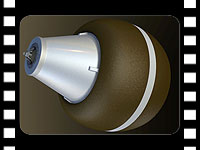
An animation of an inflatable module concept for the Russian segment of the International Space Station. Copyright © 2013 Anatoly Zak
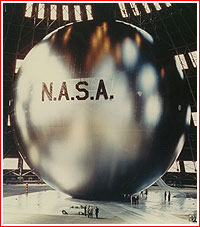
An inflatable Echo satellite during ground testing. Credit: NASA
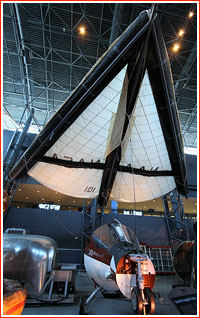
An inflatable landing system for the Gemini spacecraft. Copyright © 2011 Anatoly Zak
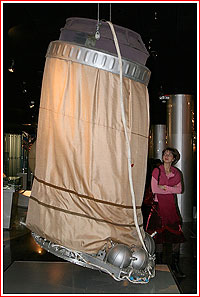
An inflatable airlock from the Voskhod-2 mission. Copyright © 2009 Anatoly Zak
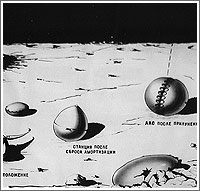
Soviet Luna landers used inflatable air bags to achieve the world's first soft landing on the Moon.
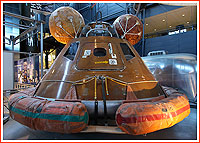
The Command Module of the Apollo spacecraft had inflatable air bags at the top of the capsule designed to keep the vehicle upright after splashdown. Copyright © 2011 Anatoly Zak
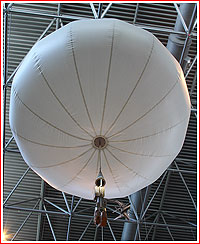
In 1985, the USSR released a pair of inflatable balloons in the atmosphere of Venus. Copyright © 2011 Anatoly Zak
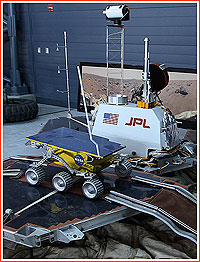
Mars Pathfinder successfully reached the Red Planet with a help of inflatable air bags. Copyright © 2011 Anatoly Zak
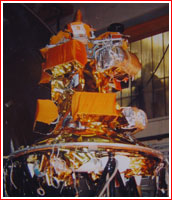
The Cosmos-1 solar-sailing spacecraft during pre-launch processing. Credit: NPO Lavochkin
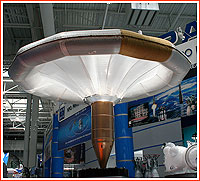
A lander with an inflatable heat-shield for the Mars-NET mission appeared in Le Bourget in 2005. Copyright © 2005 Anatoly Zak
The design of the inflatable module likely based on the crew module of the next-generation spacecraft, PTK NP. Credit: RKK Energia
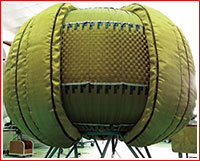
A scaled prototype of the Russian inflatable module. Credit: RKK Energia
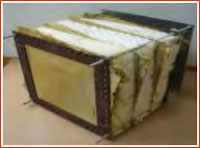
A sample of the multi-layered thermal protection system. Credit: RKK Energia
|

|