|
|
  
In depth:
|
Site
news | Site
map | About
this site | About
the author | Testimonials | Mailbox | ADVERTISE! | DONATE! |
- |
||||||||||||
Tsyklon-4 Xxx.
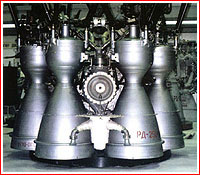
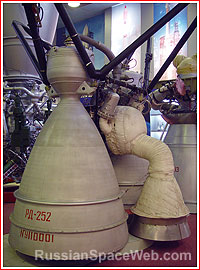
A cluster of three two-chamber RD-250 (8D518) engines formed a six-chamber RD-251 (8D723) propulsion system of the R-36 rocket. RussianSpaceWeb.com archive Known specifications of the Tsyklon-4 rocket:
In early 2000s, Ukraine embarked on a commercial space venture, which envisioned the light-weight Tsyklon-4 rocket based at an equatorial launch site of Alcantara in Brazil. The proposed launch vehicle was expected to use first and second stages of the older Tsyklon rocket and the newly developed third stage. However, KB Yuzhnoe faced insurmountable problems trying to restore the production of the RD-250 series, which were needed for the first and second stage of Tsyklon-4. When the effort was abandoned, apparently at the very initial stage, KB Yuzhnoe decided to buy back old Tsyklon vehicles stored in Russian arsenals. Due to lack of payloads for these rockets in Russia, unused vehicles could theoretically be purchased almost at a price of scrap metal. However big politics soon intervened. An initial offer to acquire the rockets coincided with overtures to the West made by the Ukrainian president Viktor Yanukovych at the beginning of his reign in 2010. In March 2012, Yanukovych approved an association agreement with the European Union which angered the Kremlin. As a result, Moscow refused to supply the rockets. The Ukrainian space officials then ordered an urgent audit of the remaining hardware at the Yuzhmash production plant to see if any remaining inventory could be used for the time being. However, the review failed to identify even a single flight-worthy combustion chamber from the RD-250 series. Only after very difficult negotiations and the re-alignment of Yanukovych to Moscow, KB Yuzhnoe was finally able to secure the buyback of three Russian Tsyklon-2 rockets. In November 2013, when Ukraine had postponed its moves toward Europe, Moscow gave the green light to the Tsyklon deal. Other Russian-Ukrainian space agreements were also negotiated, including Ukraine's participation in the Russian super-heavy launcher program along the lines proposed within the Sodruzhestvo project. It is still unclear how much Ukraine paid for these three Tsyklon vehicles, but according to unconfirmed rumors, the originally allocated sum had mysteriously disappeared and the funds would have to be disbursed for the second time. The three Tsyklons had been delivered to Dnepropetrovsk just in time before the popular uprising in Kiev at the beginning of 2014 toppled Yanukovych's government and put Ukraine back on a path toward European integration. The subsequent Russian annexation of Crimea burned the last economic bridges between the two former Soviet republics. In the meantime, the Ukrainian-Brazilian venture collapsed within the following year. The total price tag for the fruitless Tsyklon-4 joint venture was estimated at more than $900 million, with as much as $400 million spent by Ukraine. However, KB Yuzhnoe hoped to re-use much of the engineering experience gained in the failed venture in the Tsyklon-4M project.
Known specifications of the RD-250 family:
Read (and see) much more about Angara rockets and many other space projects in Russia
Page author: Anatoly Zak; Last update: December 7, 2021 Page editor: Alain Chabot; Last edit: All rights reserved |
|
|||||||||||||
Site
news | Site
map | About
this site | About
the author | Testimonials | Mailbox | ADVERTISE! | DONATE! |

|