|
|
|

Searching for details: The author of this page will appreciate comments, corrections and imagery related to the subject. Please contact Anatoly Zak.
|
Spooky world of Kosmos satellitesA vast majority of satellites that the Soviet Union had launched from 1961 to 1991 carried out military missions. Publicly, however, the USSR denied the very existence of the military space program. Not surprisingly, numerous military space projects were not publically known until the last decade of the 20th century. Previous chapter: Foton-M series
Kosmos series At the beginning of the 1960s, in order to provide a public "comouflage" for its expanding military space program, the Soviet government adopted a policy of assigning Kosmos names to all military satellites reaching orbit. In addition, any non-military payloads, whose mission was supposed to remain secret, were also lumped together with the Kosmos series. First of all, they included failed missions, since the Kremlin could not publically admit any failure in the prestige-driven space program. For example, a number of Soviet planetary probes, which had reached the Earth orbit but then failed to depart to their deep-space destinations, ended up in the Kosmos series. Also, some test missions, which had flown before their programs were publically announced, also became the part of the Kosmos series. During the Soviet period, it was up to independent observers around the world to unscrumble the puzzle of the Kosmos series. Space sleuts based their analysis on a combination of available official data and the amateur satellite tracking information. The post-Soviet Russia adopted "western" approach to public information about classified missions -- military launches would be identified as such and they would receive traditional Kosmos names with a respective number. Civilian launches would no longer be classified. Russia gets its own "ghost" satellites On May 6, 2014, Russia launched a routine spy satellite in the Kobalt-M series. However to the surprise of Russian space watchers, it was designated Kosmos-2495, even though the previously launched military payload was believed to be Kosmos-2491. Unless it was an error, three military payloads were "missing" from the record! Initially, the prevailing theory was that two of the missing numbers were assigned to a pair radar calibration spheres released in December 2013, during the first test launch of the Soyuz-2-1v rocket. The third missing number -- Kosmos-2491 -- was believed to be associated with an object detected by Western radar after the launch of three Strela/Rodnik satellites on Dec. 25, 2013. The story was repeated on May 23, 2014, when another trio of Rodniks had been launched with a mysterious "add-on" payload. Its maneuvers in the following weeks bewildered watchers of the Russian space program. When the GLONASS-M No. 55 was launched on June 14, 2014, under name Kosmos-1500, Russian military essentially confirmed the existence of previously unannounced military payloads. It now looked certain that the May 23 fragment had indeed been Kosmos-2499. The purpose of Kosmos-2491 and Kosmos-2499 "ghost" satellites remained a mystery. As it transpired, the May 5 note submitted by the Russian authorities to the United Nations said that on Dec. 25, 2013, Russia orbited four (not three) satellites, which were designated Kosmos-2488, -2489, -2490 and -2491!
Payloads onboard Foton-M4
Read (and see) much more about this and many other space projects in Russia
Next chapter: Bion-M series
APPENDIX
Kosmos explainer
Page author: Anatoly Zak; Last update: November 24, 2017 All rights reserved |
Media Archive
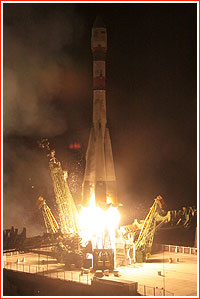
Foton-M4 lifts off on July 19, 2014. Credit: Roskosmos
|

|