|
|

Searching for details: The author of this page will appreciate comments, corrections and imagery related to the subject. Please contact Anatoly Zak.
|
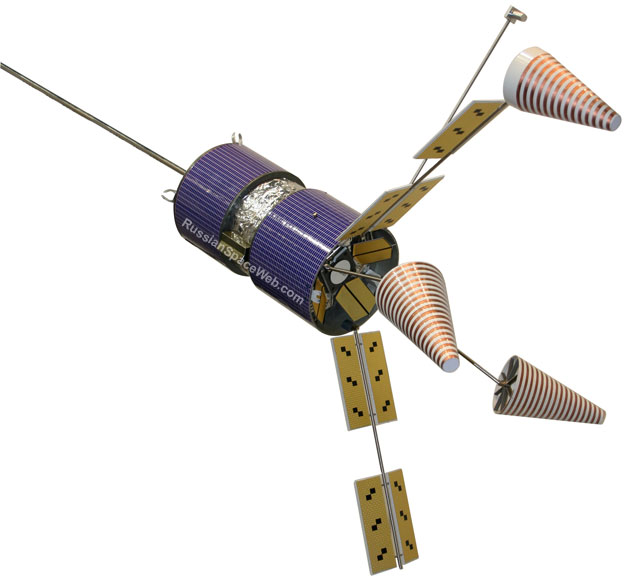
A scale model of the Gonets-M satellite, a close sibling of Strela-3M/Rodnik. Copyright © 2008 Anatoly Zak Strela system description Like their predecessors in the Strela (an "arrow") family of satellites, the Strela-3 spacecraft were designed for the so-called "store-and-dump" communications. The spacecraft of this type records a piece of communication, such as a fax, a telex or an e-mail, in its onboard recorder as it overflies a sender and when the satellite reaches a range of receiving antennas of an addressee, it downlinks the message. The method was intended primarily for communications in very remote areas lacking more traditional ground-based communications channels. Strela-3 are believed to be used by military and civilian intellligence services and other government agencies. (501) The development of the third-generation Strela network was authorized by a government decree on March 11, 1976. The Strela-3 revision of the family was also designated 17F13 and its upgrade -- Strela-3M -- 14F132. The completed Strela-3 constellation was to include 12-18 spacecraft orbiting the Earth in a 1,500-kilometer circular orbit with an inclination 82.6 degrees toward the Equator. The Strela-3 satellite was heavier than its predecessors and provided more effective use of its communication signal. New spiral antennas and their deployment mechanism were specifically designed for the satellite. The spacecraft architecture probably resembled that of their civilian siblings, known as Gonets. Even a partial completion of the network (apparently with as many as six satellites) reportedly enabled its use with direct communications available within limited areas. One cited advantage of the constellation was its capability to pick up signals from very weak transmitters thanks to the satellites' low orbit. Batches of six satellites were originally launched by a single Tsyklon-3 rocket. During the orbital insertion, the Strela payloads would be separated from the upper stage of the launch vehicle, while the rocket's propulsion unit would be still operating (under low thrust), resulting in slightly different orbital parameters for each satellite. (383) During 2002-2004, Strela-3 satellites were launched on Kosmos-3M, carrying a pair of such spacecraft, and afterwards on Rockot lifting a trio on each rocket. Strela-3 satellites officially remained in testing phase during 1992-1996. In 1996, a decision was made to launch Strela-3 satellites on the Rockot launch vehicle from Plesetsk, instead of relying on the Ukrainian-built Tsyklon-3 rocket. The Strela-3 network reportedly included two groups of satellite, one of which remained operational as late as 2012. By that time, 30 launches with Strela-3 had taken place successfully delivering 134 satellites of this type into orbit. Two failed missions resulted in the loss of nine Strela-3 birds. Strela-1 launches:
Strela/Gonets missions since 2001 2001 Dec. 28: In the last space launch of 2001, a Ukrainian-built rocket delivered a sextet of communications satellites into orbit after an early-morning blastoff from Russia’s northern cosmodrome in Plesetsk. The three-stage Tsyklon-3 booster took off from Launch Complex 32 in Plesetsk at 06:24 Moscow Time on December 28. The rocket carried six satellites including three Gonets D1 ("Messenger") spacecraft intended to replenish a low-orbital communications network. Remaining three satellites onboard the rocket belonged to the Russian Ministry of Defense and in an accordance with the standard practice for the military spacecraft were identified as Kosmos-2384, -2385 and -2386. Tsyklon-3 normally inserted the entire cluster of six spacecraft into slightly different circular orbits with an altitude of about 1,400 kilometers and an inclination of 82.6 degrees toward the Equator. This launch was previously scheduled for Dec. 22 and Dec. 26, 2001. A previous attempt to launch a Gonets/Strela cluster at the end of 2000 ended in a failure.
Writing and photography by Anatoly Zak Last update: January 15, 2013 All rights reserved |
IMAGE ARCHIVE
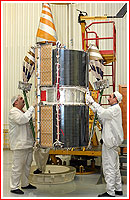
An official photo, showing the Gonets satellite during pre-launch processing. Click to enlarge. Credit: ISS Reshetnev
|

|